

10 Best Voice of Customer Analytics Tools of 2026

10 Best Voice of Customer Analytics Software Shortlist


With so many VoC solutions available online, figuring out which one is right for you is difficult. You know you want to analyze and derive insights from customer feedback and interactions so you can align your product strategy, but need to figure out which tool is best. I've got you! In this post I'll help make your choice easy, sharing my personal experiences using dozens of different tools and having spent countless hours visualizing customer experience through many different lenses, with my picks of the best voice of customer analytics software.
Why Trust Our Software Reviews
We’ve been testing and reviewing product management software since 2020. As product managers ourselves, we know how critical and difficult it is to make the right decision when selecting software.
We invest in deep research to help our audience make better software purchasing decisions. We’ve tested more than 2,000 tools for different product management use cases and written over 1,000 comprehensive software reviews. Learn how we stay transparent & our software review methodology.
The Best Voice of Customer Analytics Tools Comparison Chart
Here’s a comparison chart that summarizes basic details about each of my top voice of customer analytics tools. You can view pricing details and the availability of free trials or demos side-by-side to help you find the best software for your budget and business needs.
| Tool | Best For | Trial Info | Price | ||
|---|---|---|---|---|---|
| 1 | Best for analytics on unified feedback sources | Free demo available | Pricing upon request | Website | |
| 2 | Best for automated feedback tagging | Free demo available | Pricing upon request | Website | |
| 3 | Best for survey distribution across web and mobile | Free demo available | Pricing upon request | Website | |
| 4 | Best voice of customer analytics software for conversational surveys | 14-day free trial + free plan + free demo available | Pricing upon request | Website | |
| 5 | Best for collecting feedback from email surveys | 10-day trial | From $56/month | Website | |
| 6 | Best for AI predictive analytics | Free plan available | From $20/month | Website | |
| 7 | Best for advanced AI feedback categorization | Free demo available | Pricing upon request | Website | |
| 8 | Best for real-time customer feedback and engagement | Free demo available | Pricing upon request | Website | |
| 9 | Best for imparting a personalized customer experience | Free demo available | Pricing upon request | Website | |
| 10 | Best for gamifying the survey and feedback processes | 7-day free trial + free demo | Pricing upon request | Website |

Overviews Of The 10 Best Voice of Customer Analytics Tools
Here’s a brief description of each voice of customer analytics software that showcases each vendor’s best use case, their noteworthy features, and some pros and cons. I’ve also included screenshots to give you a snapshot of their user interface.

Best for analytics on unified feedback sources

Enterpret is an AI-powered VoC analytics platform that pulls in feedback from 50+ sources, auto-classifies it using an adaptive taxonomy, and surfaces sentiment, themes, and revenue-linked insights for product and CX teams.
Who Is Enterpret Best For?
Enterpret is a strong fit for product and customer insights teams at mid-market and enterprise SaaS companies managing feedback at scale across multiple channels.
Why I Picked Enterpret
Enterpret earns its spot as one of the best on my shortlist because of how it handles feedback unification at scale. I love that it connects 50+ sources—support tickets, sales calls, app store reviews, community forums, and surveys—into a single taxonomy that auto-classifies every piece of feedback. The Customer Context Graph links feedback directly to customer segments and revenue impact, letting me see which issues affect retention or expansion. That signal-to-noise clarity distinguishes it from more general analytics tools.
Enterpret Key Features
- Adaptive taxonomy builder: Automatically creates and updates a multi-level feedback classification system as new topics and themes emerge over time.
- AI Insights agent: Lets you query your entire feedback dataset using natural language, so you can ask product questions and get instant, sourced answers.
- Anomaly detection: Monitors feedback volume and sentiment shifts in real time and flags sudden spikes tied to specific features or issues.
- Trend analysis dashboards: Visualizes feedback trends over time across segments, channels, and product areas in a single configurable view.
Pros and Cons
Pros:
- Customizable themes enhance clarity and focus on critical areas
- Makes trend analysis easier across channels
- Central view reduces data silos across teams
Cons:
- Setup takes time initially
- Users report inconsistent AI summaries

Best for automated feedback tagging

Chattermill is an AI-native voice of customer analytics platform that unifies feedback from surveys, reviews, support tickets, and social channels and analyzes it using natural language processing and automated theme detection.
Who Is Chattermill Best For?
Chattermill is a strong fit for mid-market and enterprise customer experience, insights, and product teams that need to analyze high volumes of customer feedback at scale.
Why I Picked Chattermill
I picked Chattermill as one of the best for automated feedback tagging because its Lyra AI engine tags every piece of incoming feedback with themes and sentiment scores the moment it lands in the platform. There's no manual categorization work to set up recurring rules. The AI detects mixed sentiment within a single comment and applies multiple theme tags simultaneously, so a support ticket about a delayed delivery and a broken product doesn't collapse into one vague category. I also like that tagging works across 100+ languages without a separate translation step.
Chattermill Key Features
- Unified feedback inbox: Pulls customer feedback from surveys, reviews, support tickets, and social channels into a single view for analysis.
- Natural language querying: Ask Lyra lets you query your entire feedback dataset in plain English without building manual filters or reports.
- Real-time alerts: Flags sudden drops in sentiment or spikes in specific themes so your team can respond before issues escalate.
- Custom dashboards: Build segmented views by product area, customer tier, or channel to track VoC trends over time.
Pros and Cons
Pros:
- Industry specific sentiment models
- AI powered theme tagging
- Real time sentiment tracking
Cons:
- May require enterprise onboarding
- Pricing not publicly available

Best for survey distribution across web and mobile
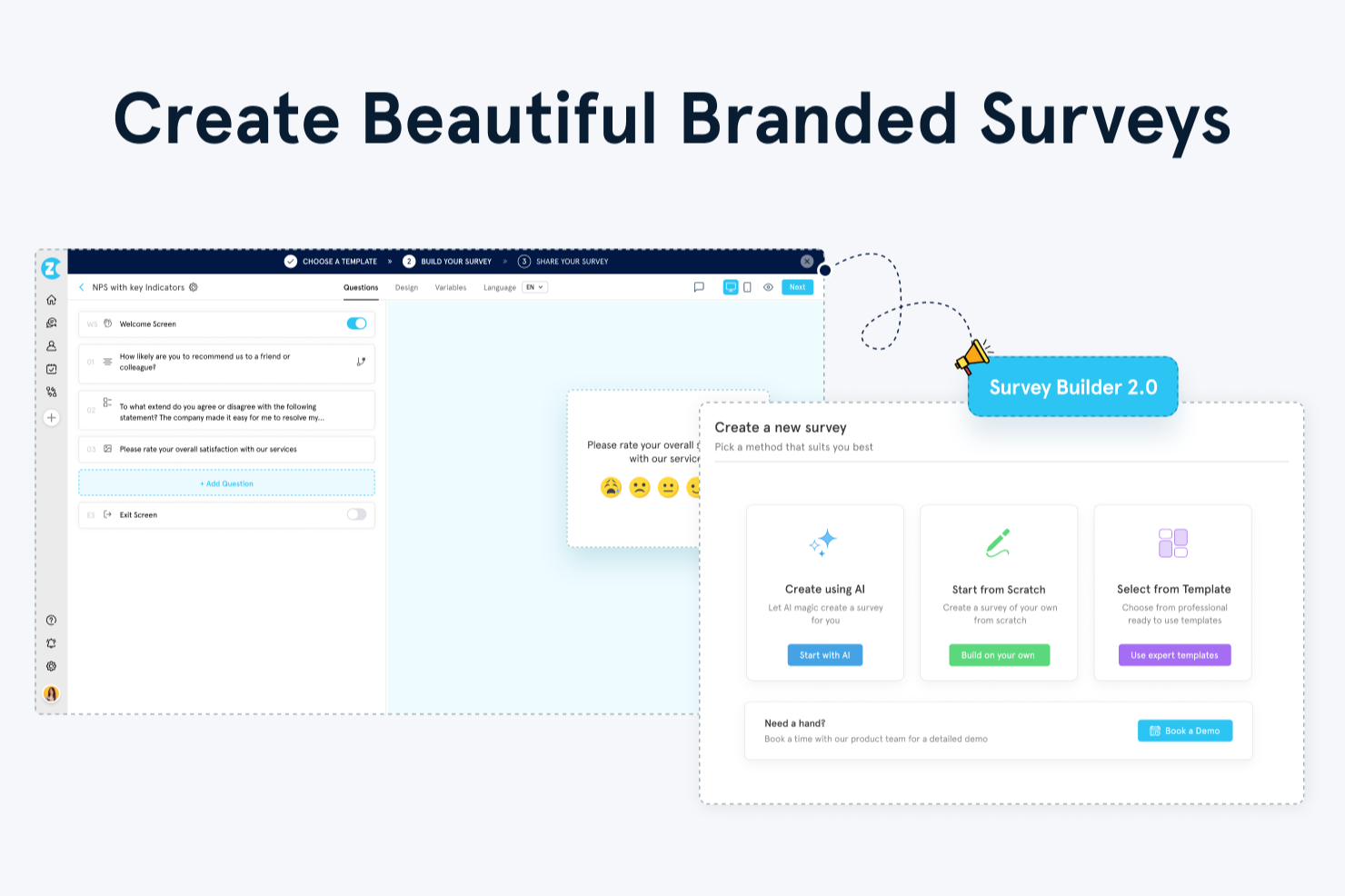
Zonka Feedback is a multichannel VoC platform that combines survey distribution, AI-powered sentiment and thematic analysis, and closed-loop feedback management through web, mobile, email, SMS, and offline channels.
Who is Zonka Feedback Best For?
Zonka Feedback is well-suited for CX and product teams at mid-market to enterprise companies that need to collect and analyze feedback across multiple digital and physical touchpoints.
Why I Picked Zonka Feedback
I picked Zonka Feedback as one of the best because its web and mobile survey distribution goes beyond basic channel coverage. For website surveys, you can deploy pop-ups, slide-ins, bottom bars, feedback buttons, and embedded forms, each triggered by behavior rules like scroll depth, exit intent, or time on page. On mobile, the in-app SDK lets you launch targeted surveys within your app without interrupting the user flow, and device-based targeting means you can serve different surveys to mobile vs. desktop visitors.
Zonka Feedback Key Features
- AI sentiment and emotion analysis: Tags open-text responses with sentiment, emotion, and intent scores across every survey channel.
- Thematic analysis: Groups feedback into auto-detected themes and sub-themes to help you spot patterns without manually coding responses.
- NPS, CSAT, and CES measurement: Built-in metric templates let you track and benchmark satisfaction scores across touchpoints in one dashboard.
- Closed-loop case management: Converts negative responses into cases, assigns them to team members, and tracks resolution status from within the platform.
Zonka Feedback Integrations
Zonka Feedback offers native integrations with Salesforce, HubSpot, Jira, Front, Freshdesk, Intercom, HelpScout, Pipedrive, ActiveCampaign, and Zendesk, as well as collaboration tools like Slack, Microsoft Teams, Zoom, and Google Sheets. It connects with Zapier, Integrately, and Make, supports webhooks, and provides an API for custom integrations.
Pros and Cons
Pros:
- AI auto-tags themes in open-ended responses
- Built-in NPS, CSAT, and CES tracking
- Kiosk mode works offline
Cons:
- Response caps restrict high-volume survey use
- Limited analytics on lower plans

Best voice of customer analytics software for conversational surveys

SurveySparrow is a voice of customer platform that combines conversational surveys, AI-powered text analytics, sentiment analysis, and omnichannel feedback collection to help you capture and analyze customer feedback at scale.
Who Is SurveySparrow Best For?
SurveySparrow is a good fit for CX and customer insights teams at mid-size to enterprise companies that need a dedicated platform for collecting and analyzing customer feedback across multiple channels.
Why I Picked SurveySparrow
I've included SurveySparrow in my top picks because its conversational survey format genuinely sets it apart from traditional form-based feedback tools. Instead of presenting customers with a wall of questions, SurveySparrow serves questions one at a time in a chat-like interface, which I've found drives notably higher completion rates. I also like CogniVue, its AI-powered text analytics engine that runs sentiment analysis and root cause analysis on open-ended responses, so I'm not manually sorting through hundreds of text answers to spot patterns.
SurveySparrow Key Features
- NPS tracking: Monitor Net Promoter Score trends over time with built-in dashboards that segment responses by promoters, passives, and detractors.
- Omnichannel feedback collection: Distribute surveys via email, web embed, QR code, social media, or offline kiosk mode from a single platform.
- Ticket management: Automatically convert negative survey responses into tickets and assign them to team members for follow-up.
- Executive dashboards: Build custom reports with multiple chart types and schedule automated report delivery to stakeholders.
Pros and Cons
Pros:
- Net Promoter Score (NPS) tracking
- Responsive customer support
- Customizable survey themes and templates allow for branding and personalization
Cons:
- Some users may find the conversational format too casual for certain types of surveys
- Reporting is not robust

Best for collecting feedback from email surveys

Survicate is a multichannel voice of customer platform that combines survey distribution across email, website, in-app, and mobile channels with AI-powered sentiment analysis, auto-topic categorization, and a centralized Research Hub for cross-source feedback analysis.
Who Is Survicate Best For?
Survicate is a good fit for product and customer experience teams at SaaS companies who need to collect and analyze customer feedback across multiple digital touchpoints.
Why I Picked Survicate
I've included Survicate in my top picks because of how it handles email survey distribution. You can embed the first survey question directly into the email body, which cuts down the steps a respondent needs to take and meaningfully increases response rates. I also like that Survicate auto-generates the HTML code you need to do this, so there's no engineering lift. Linking responses back to customer profiles in your CRM means every answer is tied to a real user, not just an anonymous data point.
Survicate Key Features
- AI sentiment analysis: Automatically tags survey responses as positive, neutral, or negative to surface trends across your feedback data.
- Research Hub: Centralizes feedback from surveys, app reviews, support chats, and call transcripts into one place for cross-source analysis.
- AI topic categorization: Auto-sorts open-ended responses into themes like UX issues or feature requests without manual tagging.
- NPS, CSAT, and CES dashboards: Tracks key satisfaction metrics over time with filterable, customizable reporting views.
Pros and Cons
Pros:
- Generous free plan
- Custom survey URLs
- Very responsive and helpful customer support team
Cons:
- CRM integration isn’t very robust
- Not possible to recover deleted survey answers
New Product Updates from Survicate

Survicate MCP Support Now Available
Survicate now supports MCP, letting teams use AI tools like Claude, ChatGPT, and Slack to explore survey results, analyze responses and insights, and draft new surveys. For more information, visit Survicate's official site.
 .
.
Klaviyo
Best for AI predictive analytics

Klaviyo is a marketing automation and customer analytics platform that combines AI-driven predictive analytics, review sentiment analysis, and RFM segmentation to help ecommerce brands understand and act on customer behavior.
Who Is Klaviyo Best For?
Klaviyo is a strong fit for ecommerce marketing teams that need to analyze customer purchase behavior and sentiment data to drive retention campaigns.
Why I Picked Klaviyo
I've included Klaviyo in my top picks because its AI predictive analytics go beyond basic metrics. I like that it predicts each customer's lifetime value, churn risk, and next purchase date using actual purchase history, which lets my team prioritize win-back campaigns before customers go cold. Its review sentiment analysis also surfaces trending topics by product category, so I can spot recurring complaints without reading every review manually.
Klaviyo Key Features
- RFM segmentation: Group customers by recency, frequency, and monetary value to identify high-value, at-risk, or lapsed segments.
- Unified customer profiles: View each customer's full purchase history, email engagement, and review activity in a single record.
- Industry benchmarks: Compare your open rates and revenue metrics against anonymized data from similar businesses in your sector.
- Cohort analysis: Track how specific customer groups behave over time based on their first purchase date or acquisition source.
Pros and Cons
Pros:
- Supports omnichannel marketing, including email, SMS, and social media.
- Provides AI-driven insights for personalized marketing strategies.
- Offers comprehensive data integration for unified customer profiles.
Cons:
- Pricing can escalate quickly as contact lists grow.
- Some users desire more customization options.

Unwrap
Best for advanced AI feedback categorization

Unwrap is an AI-powered customer intelligence platform that ingests unstructured feedback from thousands of sources and automatically categorizes, surfaces, and routes VoC insights across your organization.
Who Is Unwrap Best For?
Unwrap is a strong fit for product and customer experience teams at B2B SaaS companies who need to make sense of high volumes of unstructured customer feedback.
Why I Picked Unwrap
Unwrap is on my shortlist because its AI feedback categorization goes beyond basic tagging. I can train a custom taxonomy so that every piece of incoming feedback, whether from support tickets, app store reviews, or sales calls, gets automatically labeled to match how my team actually thinks about product areas. I also rely on Unwrap's anomaly detection; it flags sudden spikes in a feedback category before they grow into larger patterns.
Unwrap Key Features
- Multi-source feedback ingestion: Pull in feedback from support tickets, app store reviews, sales calls, surveys, and social media into a single workspace.
- Natural language assistant: Query your entire feedback dataset conversationally to surface trends without building filters or reports.
- Sentiment analysis: Automatically scores the sentiment of every feedback item across all connected sources.
- Custom dashboards: Build and share views that segment feedback by product area, channel, or time period.
Pros and Cons
Pros:
- Automates categorization of unstructured feedback into meaningful groups with NLP.
- AI tools surface emerging trends without manually scanning large datasets.
- Sentiment analysis helps teams quantify how users feel over time.
Cons:
- Occasional gaps in native platform integrations compared to competitors.
- Feedback taxonomy setup may require extra effort to customize.

InMoment
Best for real-time customer feedback and engagement

InMoment is a VoC analytics platform that brings together omnichannel feedback collection, AI-powered text and sentiment analysis, conversational intelligence, and reputation management to give you a unified view of the customer journey.
Who Is InMoment Best For?
InMoment is a strong fit for mid-to-enterprise-level CX, marketing, and insights teams in retail, financial services, and hospitality.
Why I Picked InMoment
I've included InMoment in my top picks because its patented AI-Powered Active Listening encourages rich conversations by intelligently listening and responding to customers in real time, eliciting more feedback and more valuable responses. It handles survey engagement this way: the platform's Strength Meter gamifies the survey experience, increasing engagement, while Follow Up presents additional questions in real time—for example, if a customer says "The staff was great," it asks, "Can you tell us more about what made the staff great?" I also like the Rapid Resolution Engine, which analyzes customer responses and identifies underlying issues, then offers immediate solutions such as a helpful tutorial or video directly within the survey.
InMoment Key Features
- Smart Summaries: Uses generative AI to synthesize large volumes of unstructured customer feedback into concise, digestible summaries.
- Predictive impact modeling: Identifies which specific experience drivers have the greatest predicted impact on scores like NPS, CSAT, and CES.
- Reputation management: Aggregates and analyzes customer reviews from third-party sites alongside survey data within a single dashboard.
- Closed-loop action management: Automatically routes customer feedback to the right team and tracks resolution progress from alert to close.
Pros and Cons
Pros:
- Easy-to-use interface for feedback collection
- Advanced analytics and sentiment analysis capabilities
- Great platform to deliver unique customer experiences
Cons:
- Limited customization options for surveys
- Limited reporting features compared to other VoC software

Medallia
Best for imparting a personalized customer experience

Medallia is an AI-powered voice of customer analytics platform that captures signals across every channel—surveys, speech, digital behavior, social, and more—and applies text analytics, journey analytics, and root cause analysis to surface actionable insights.
Who Is Medallia Best For?
Medallia is a strong fit for enterprise organizations with large customer-facing teams across industries like retail, financial services, hospitality, and healthcare.
Why I Picked Medallia
Medallia is one of my top picks because I love how its Total Experience (TX) Profiles unify every customer interaction—across phone, chat, web, and in person—into a single, continuous timeline. That means my team can see a full picture of each individual customer before reaching out, making every follow-up feel informed rather than generic. Paired with AI-driven alerts and closed-loop automation, Medallia lets frontline teams act on real-time signals to address a specific customer's situation before it escalates.
Medallia Key Features
- Text and speech analytics: Analyzes unstructured customer feedback from open-ended survey responses, call transcripts, and chat logs to identify recurring themes and sentiment.
- Root cause analysis: Drills into the specific behaviors and touchpoints that drive shifts in metrics like CSAT and NPS.
- Journey analytics: Maps and analyzes customer experiences across all channels to pinpoint the moments that most impact satisfaction.
- Predictive early warning: Flags emerging trends like churn risk using a combination of customer verbatim data and operational signals.
Pros and Cons
Pros:
- Includes advanced analytics like root cause analysis and trend analysis
- Multilingual support
- Automated email notification workflows for open action items
Cons:
- Limited options for survey design customization
- No option to export raw survey data to CSV or Excel formats

Feedier
Best for gamifying the survey and feedback processes

Feedier is an AI-powered VoC analytics platform that ingests feedback from surveys, reviews, call transcripts, complaints, and social channels, then structures and analyzes it to surface actionable CX intelligence across business units.
Who Is Feedier Best For?
Feedier is a strong fit for mid-to-enterprise CX, product, and marketing teams who need to consolidate and analyze feedback at scale across multiple channels and touchpoints.
Why I Picked Feedier
I included Feedier in my top picks because its gamified survey experience is a genuinely differentiated approach to VoC data collection. Rather than sending a static form, Feedier lets you build animated, interactive surveys with conditional question flows and a built-in reward manager that delivers vouchers or incentives upon completion. That results in your team collecting a higher volume of better-quality feedback before it reaches the analytics layer. The combination of gamified collection and AI-powered analysis makes it one of the few platforms where the input quality and the analytical output are both addressed in a single tool.
Feedier Key Features
- Multi-source feedback ingestion: Pull feedback from 17+ sources including reviews, call transcripts, complaints, and social channels into a single dashboard.
- AI sentiment and theme detection: Automatically identify sentiment trends and recurring themes across your entire feedback corpus without manual tagging.
- Conversational AI query engine: Ask questions about your feedback data in natural language and get sourced answers from the full dataset.
- Financial impact scoring: Tie feedback trends to estimated revenue impact so CX priorities are connected to business outcomes.
Pros and Cons
Pros:
- Easy-to-use and customizable interface
- White labeling of surveys, which replaces Feedier’s logo with a brand-specific one
- Customizable reporting and analytics dashboard
Cons:
- Occasional lags on the platform
- The survey template library could be more extensive
Other Options
Here are a few more worthwhile options that didn’t make the best voice of customer analytics software list:
- Pendo
For generating digital product analytics
- Brandwatch
For drawing meaningful insights from social media platforms
- Sprig
For capturing and analyzing customer feedback at scale with AI
- Usersnap
For garnering valuable feedback via annotated screenshot captures
- Refiner
Voice of customer analytics software for SaaS products
- Qualtrics XM
For advanced data analytics and insights
- MonkeyLearn
Voice of customer analytics software with a vast library of pre-built text analysis models
- Forsta HX
Voice of customer analytics software for generating visual infographics
- ReviewFlowz
For turning reviews into brand assets
- SurveyMonkey
For flexible survey design and integrated CX analytic
- Lumoa
For generative AI integration
- Voxco
For omnichannel survey management
- SentiSum
For reducing feedback silos
- AskNicely
For creating personalized follow-up actions based on NPS
- GetFeedback
For customizable feedback surveys and real-time response management
- CustomerGauge
For NPS-based customer experience management and action planning at scale
- NICE Satmetrix
For end-to-end customer journey mapping
- Engage by ResponseTek
For closed-loop action tracking


Related UX Tool Reviews
Here's a roundup of some of our top software reviews in the UX and product management space:
- Best Product Management Tools
- Best Product Planning Software
- Best Product Development Software
- Best Product Analytics Tools
- Best Idea Management Software
- Best Heatmap Software
How I Evaluate Voice of Customer Analytics
I split my evaluation into two layers: baseline capabilities every tool must have—multi-channel ingestion, AI theme analysis—and differentiators like revenue attribution and PM integrations.
Core Functionality (Table Stakes For This List)
When I'm selecting tools for my list, I rank each one on a scale from 0 (does not offer the functionality) to 5 (excels in this area) for each core functionality listed below. Then, I calculate the tool's total score into a percentage. Each tool needs to achieve a minimum total score of 65% to be considered for inclusion.
- Multi-Channel Feedback Aggregation: I check how many source types each tool natively connects to—surveys, support tickets, app store reviews, social mentions, in-app widgets—and whether data syncs in real time.
- AI-Powered Theme & Sentiment Analysis: The best tools auto-cluster feedback into themes without manual setup, so I evaluate whether the AI surfaces patterns on its own or just runs keyword matching.
- Insight Tagging & Categorization: I look for hierarchical taxonomies that map to real product areas—like tying feedback to specific features or user segments—rather than flat, single-level tag lists.
- Feedback Search & Querying: Product managers often need to pull every piece of feedback about a specific workflow before a planning cycle, so I evaluate whether search supports semantic queries and multi-filter combinations.
- Prioritization & Reporting Dashboards: Dashboards should let you visualize request volumes, sentiment trends, and segment breakdowns in ways you can share with stakeholders during roadmap reviews.
- Product Tool Integrations: I look at whether feedback flows into tools like Jira, Linear, or Productboard with two-way sync, so insights stay connected to actual delivery work.
Once I have a list of tools that meet the criteria, I consider what sets each platform apart.
Differentiating Factors (What Sets Vendors Apart)
Here's how I compare and contrast different vendors:
Standout Features
Revenue attribution matters. I look for tools that tie feedback to account-level data like MRR or contract size, so you can weigh requests by business impact. An AI research assistant stands out when it lets you ask ad-hoc questions across all ingested feedback without building custom queries. I also evaluate whether a tool can ingest and transcribe user interviews or sales calls. Some of the richest customer insights never make it into a support ticket.
Beyond Features
Time-to-insight matters. I evaluate how quickly a team can connect sources and start seeing themes—some tools offer prebuilt taxonomies that cut setup from weeks to days. Cross-functional sharing is equally important, since product managers often need to surface customer evidence to execs or design leads. I check whether a platform supports role-based views, like executive summaries alongside researcher-level detail. Security also factors in; handling raw customer feedback means SOC 2, GDPR, and SSO support should all be in place.
How to Choose Voice of Customer Analytics Software
As you work through your own unique software selection process, keep the following points in mind:
- Identifying Key Pain Points: Voice of customer analytics software helps you identify and address specific pain points in customer interactions. When choosing a software solution, consider how effectively it can analyze customer feedback across multiple channels, such as surveys, social media, and customer service interactions. The right tool should offer robust text and sentiment analysis to discern common complaints and praises, enabling you to pinpoint areas for improvement or opportunities for expansion.
- Integration Capabilities: Ensuring seamless integration with your existing technology stack is crucial. Voice of customer analytics software should be able to integrate easily with your customer relationship management (CRM) system, enterprise resource planning (ERP) software, and other data management tools. This integration enables a unified view of customer insights across all departments, enhancing the coordination of responses and strategies.
- Scalability: As your business grows, so does the volume of customer feedback. The chosen voice of customer analytics software must scale with your business needs without degrading performance or requiring extensive additional investments. Look for solutions that offer flexible pricing plans and the ability to handle increasing amounts of data and more complex analytics as your customer base expands.
- Real-Time Data Processing: In today’s fast-paced market, the ability to process and react to customer feedback in real-time can be a significant advantage. Evaluate voice of customer analytics software for its capability to provide live updates and alerts. This feature allows your team to respond swiftly to customer complaints and queries, thereby improving customer satisfaction and loyalty.
- Comprehensive Reporting Tools: Effective decision-making is based on comprehensive and actionable insights. The ideal voice of customer analytics software should offer detailed reporting features that allow you to create custom reports based on specific data points. These tools should help you visualize data trends over time, compare feedback across different customer segments, and track the impact of changes made based on customer feedback.
By carefully considering these aspects, you can select voice of customer analytics software that not only meets your immediate needs but also supports your long-term customer engagement strategies.
Trends in VoC Analytics Software
As organizations strive to align their strategies with shifting customer expectations, the development of VoC tools is focused on enhancing the extraction and utilization of meaningful feedback. Here's a breakdown of the current trends based on the latest product updates, press releases, and release logs from leading providers in this rapidly advancing field:
- Immediate Feedback Utilization: VoC software is increasingly capable of real-time data processing, allowing businesses to act on customer feedback instantly. This shift is crucial for improving customer experience and satisfaction by enabling immediate responses to both positive and negative feedback, thus preventing potential customer churn.
- Automated Insights Generation: Automation in generating insights from customer data is on the rise. Tools now use advanced AI to identify patterns and predict trends without manual intervention, which significantly streamlines the decision-making process.
- Predictive Analytics: The use of predictive analytics in VoC software is becoming more prevalent. These capabilities allow companies to forecast future customer behaviors and preferences, enabling proactive strategy adjustments.
- Emotion Detection Technology: Some of the most novel features include advanced emotion detection technologies that go beyond traditional sentiment analysis, using voice intonation and facial recognition to gauge customer feelings.
- AI-Driven Qualitative Analysis: Cutting-edge tools now offer AI-driven analysis of qualitative data, such as open-ended survey responses and social media posts, to extract more detailed insights than ever before.
These advancements reflect the evolving needs of businesses to not only gather vast amounts of customer data but also to interpret and act on this information swiftly and efficiently. As UX experts and product managers navigate these trends, the focus will likely continue on integrating advanced technologies to enhance customer understanding and operational agility.
What is Voice of Customer Analytics Software?
Voice of customer analytics software refers to tools used to collect, analyze, and interpret customer feedback and sentiments to gain insights into customer preferences, expectations, and overall satisfaction. It aims to capture this input across various touchpoints, helping businesses make informed decisions to enhance the customer experience.
Key features you can expect include sentiment analysis, feedback collection and management, customer journey mapping, trend identification, and reporting and visualization tools. These features enable businesses to extract meaningful insights from customer feedback and align their strategies with customer expectations.
Features of Voice of Customer Analytics Software
Choosing the right features in VoC software is essential to leverage customer data effectively and align business strategies with customer needs. Here are some features to look for when evaluating your options:
- Sentiment Analysis: This feature automatically identifies the tone and emotions in customer feedback. It helps businesses gauge the overall sentiment about their products or services, allowing them to address areas that provoke negative responses and reinforce those that generate positivity.
- Text Analytics: This tool deciphers unstructured text data from surveys, reviews, and social media. It's vital for extracting themes and patterns that highlight what customers care about most, informing product development and marketing strategies.
- Feedback Management: This function consolidates feedback from multiple sources into a single platform. Centralizing data enables a holistic view of customer opinions, ensuring that no critical insights are overlooked and enhancing decision-making efficiency.
- Trend Detection: By identifying trends over time, businesses can track changes in customer expectations and satisfaction. This feature is key for adapting to shifting market conditions and preemptively addressing emerging needs.
- Integration Capabilities: Seamless integration with other business systems (like CRM or ERP) ensures that customer insights are accessible across the organization. This interconnectedness promotes a unified approach to customer experience management.
- Real-Time Analytics: This enables immediate analysis of incoming feedback. Quick responses to customer concerns can significantly improve satisfaction rates and mitigate potential negative experiences.
- Customer Journey Mapping: This feature visualizes the path customers take from awareness to purchase and beyond. Understanding this journey allows businesses to optimize touchpoints for better experiences and increased loyalty.
- Customizable Dashboards: These provide personalized views of key metrics relevant to specific business needs. Custom dashboards help different departments focus on the insights that matter most to their operational goals.
- Predictive Analytics: By forecasting future trends based on historical data, businesses can anticipate customer needs and preferences before they become apparent. This proactive approach ensures that companies stay ahead of the curve.
- Multi-language Support: This caters to global businesses by analyzing feedback in various languages. It expands the reach of VoC programs and ensures that insights are gathered from a diverse customer base.
By prioritizing the right selection of features to meet your unique business needs, you'll be able to find a tool that's most suitable. Selecting the right VoC analytics software positions a company to not only meet but exceed customer expectations, securing a competitive advantage in the market.
Benefits of Voice of Customer Analytics Software
Voice of Customer (VoC) analytics software is a crucial tool for businesses seeking to understand and enhance their customer experiences. By effectively capturing and analyzing customer feedback, these tools provide valuable insights that can guide strategic decisions and improve customer satisfaction. Here are five primary benefits of integrating VoC analytics software into your business processes:
- Enhanced Customer Insights: VoC analytics software provides a deeper understanding of customer needs and preferences. This enhanced insight helps businesses tailor their products and services to better meet customer expectations, thereby increasing satisfaction and loyalty.
- Improved Product Development: By aggregating and analyzing customer feedback, VoC tools enable businesses to identify common pain points and areas for improvement. This information is invaluable for guiding product development and innovation, ensuring that new offerings are well-aligned with customer desires.
- Increased Operational Efficiency: VoC software automates the collection and analysis of customer feedback, significantly reducing the time and effort required to gather actionable insights. This automation allows teams to focus more on implementing changes rather than on data processing.
- Better Customer Retention: With real-time feedback analysis, VoC tools help businesses quickly identify and address customer issues. This proactive approach to problem resolution can significantly improve customer retention rates by demonstrating a commitment to customer satisfaction.
- Enhanced Competitive Advantage: By leveraging the detailed insights provided by VoC analytics, businesses can stay ahead of the competition. Understanding customer trends and feedback in real-time allows for more Agile responses to market changes and customer needs, giving businesses a competitive edge.
These tools help companies to dissect customer feedback from various channels and turn it into actionable insights. By leveraging the power of customer feedback, businesses can drive improvements across their products, services, and customer interactions, ultimately leading to greater customer satisfaction and business success.
Costs & Pricing For Voice of Customer Analytics Software
VoC software platforms can vary in terms of features, scalability, and pricing, catering to businesses of different sizes and needs. Understanding the different plan options and their corresponding pricing structures can help software buyers make an informed decision that aligns with their business objectives and budget constraints.
Plan Comparison Table For VoC Analytics Software
Below is a table that outlines the pricing and plan structures of VoC analytics software, helping you to compare your options at a glance:
| Plan Type | Average Price | Common Features |
|---|---|---|
| Free | $0 | Basic analytics, limited surveys, community support |
| Basic | $10 - $50 per month | Enhanced analytics, more surveys, email support |
| Professional | $50 - $200 per month | Full analytics suite, unlimited surveys, phone support |
| Enterprise | $200+ per month | Advanced features, custom integrations, dedicated support |
When considering which plan to choose, think about the scale of your customer feedback operations and the depth of analytics you require. Smaller businesses may find that basic plans suffice, while larger organizations might need the advanced features and support offered by professional or enterprise plans. Each step up in pricing typically offers greater functionality and support, so align your choice with both your current needs and future growth expectations.
People Also Ask
Got any questions about voice of customer analytics tools? Check out these FAQs to grasp a better understanding:
What is the Voice of the Customer?
Voice of the customer (VoC) refers to collecting and analyzing customer feedback to utilize and incorporate information such as dislikes and pain points into building a better product. Typically, you can generate data points and metrics on the voice of the customer from various channels like surveys, social media platforms, SMS, and customer reviews.
Why is VoC data important?
VoC helps companies improve the customer experience, which is a determining factor of customer loyalty. Additionally, VoC data gives your company valuable, constructive feedback on aspects you can improve. By analyzing actual user feedback, you’ll be in a better position to foresee which future product feature requests are worth your time.
What’s the difference between VoC and CSAT feedback?
CSAT (customer satisfaction) is a surface-level quantification of how satisfied customers are with a particular product or service.
VoC is more specific and captures an in-depth analysis of why a customer likes or dislikes your product. Furthermore, VoC analytics help you understand how users perceive your brand.
What is sentiment analysis?
Sentiment analysis is the process of analyzing customer feedback to determine the overall sentiment, whether positive, negative, or neutral. Sentiment analysis leverages natural language processing (NLP) techniques to identify and extract emotions from text data.
What's Next?
If you're in the process of researching voice of customer analytics, connect with a SoftwareSelect advisor for free recommendations.
You fill out a form and have a quick chat where they get into the specifics of your needs. Then you'll get a shortlist of software to review. They'll even support you through the entire buying process, including price negotiations.