

Why AI is forcing product leaders to redesign the organization, not just the product
Lukas Egger explains why AI requires product leaders to redesign workflows, incentives, and operating models so teams can turn faster innovation into durable value.

Lukas Egger
VP of Product Strategy and Innovation at SAP Signavio

Durable Value: AI product leadership requires separating measurable customer outcomes from impressive demos, noise, and superficial productivity gains.
Faster Learning: AI reshapes innovation teams by reducing handoffs, accelerating prototypes, and giving individuals greater ownership.
Human Judgment: AI expands research and options, but leaders must own priorities, tradeoffs, promises, and organizational risk.
Operating Model: Successful AI adoption depends on incentives, permissions, governance, context, and workflows redesigned for faster experimentation.
Mixed Users: Products must serve humans and agents through reliable APIs, structured context, permissions, traceability, and composable workflows.
Lukas Egger is a VP of Product Strategy and Innovation at SAP Signavio. He's also the creator of the Process Transformers podcast.
We sat down with Lukas to learn how AI is changing how he leads his product organization, as well as how it affects the product itself. Here's what he shared.
Separating durable value from noise
I’m Lukas Egger, VP of Product Strategy and Innovation at SAP Signavio. My work intersects product strategy, business transformation, and AI, especially how large organizations can turn emerging technologies into useful, trustworthy, and economically meaningful products.

My path to this moment stems less from a single “AI awakening” and more from a long-standing interest in how organizations make sense of complexity. Earlier in my career, I worked across data, analytics, product, and strategy, and I grew increasingly interested in the gap between technological possibility and organizational reality. Many ideas look compelling in a demo or a prototype, but the real test is whether they survive incentives, governance, customer workflows, technical constraints, and actual adoption.
I also think about AI in product leadership this way. The exciting part is not simply models generating text, code, images, or analysis. The deeper shift is that AI is changing the cost structure of cognition inside companies. It lowers the cost of creating, comparing, summarizing, simulating, and coordinating work. That has profound implications for product teams, because it changes not only what we can build, but how quickly we can test ideas, how we understand customers, how we design workflows, and how we define value.
At SAP Signavio, I spend significant time considering how AI can support business transformation in a serious enterprise context. This means moving beyond generic productivity claims and asking sharper product questions: What new customer problems become solvable? What workflows materially improve? Where does AI create measurable business value? Where does it create new risk? And how do we de-risk innovation across desirability, feasibility, viability, and organizational agreeability?
For product leaders, this is a rare moment. AI is not just another feature layer. It is forcing us to revisit assumptions about user experience, differentiation, speed of delivery, data, trust, and the role of software itself. The job of product leadership is therefore not to chase the loudest AI use case, but to build the judgment, systems, and operating models that help teams separate durable value from noise.
Making change easier
For context, my team supports LabSpace, an important customer-facing innovation environment. LabSpace's simple idea is to let enterprise customers engage with innovation early, safely, and with very low friction. In traditional B2B software, especially around ERP and business transformation, change is often expensive, slow, and operationally risky. LabSpace reduces that barrier. Instead of asking customers to make a hard change upfront, we create a space where they can explore what a better future workflow might look like before committing to adoption, implementation, or scale.
Our organization has two kinds of users. Externally, customers use it to understand what new capabilities could mean for their business. Internally, product, engineering, and innovation teams use it to expose early ideas to real customer feedback without prematurely turning every experiment into a full product commitment.
In that sense, LabSpace is both a showcase and a learning system. It helps us test desirability, feasibility, viability, and organizational fit in a much more concrete way. The scale is broad: we aim to make innovation accessible across the SAP Signavio customer base while also giving internal teams a repeatable path for moving from promising ideas to validated product direction.
The delivery model is intentionally lightweight. We do not force customers into heavy implementation cycles just to experience innovation. We create structured, low-risk ways to engage with new capabilities, gather feedback, and learn where there is real value. The deeper product philosophy is that enterprise software should not only help companies change; it should make the act of change itself easier.
How the product model is reshaping itself with AI

We recently started rethinking the minimum viable team for early-stage product innovation.
Historically, even getting to a credible first concept in enterprise software often required a small cross-functional group: product, design, engineering, domain expertise, sometimes data or architecture support. This made sense because each role involved specialized tasks difficult to compress. But AI started unbundling those roles into tasks with very different automation levels.
In the last year, we saw the time from idea to first customer-validatable concept collapse dramatically. Product managers and engineers can now cover much more of the early innovation surface themselves: synthesizing customer signals, generating alternative concepts, creating prototypes, exploring edge cases, drafting narratives, and preparing more coherent customer conversations. This does not remove the need for expertise, judgment, or cross-functional collaboration, but it changes when — and for what — those people need to be involved.
The result is not just speed or cost reduction. The more interesting change is ownership. Smaller groups, and in some cases individuals, can now move an idea far enough to create meaningful learning before assembling a larger team. This reduces gatekeeping between roles and gives people with strong ideas more freedom to create impact.
To me, this is one of the most exciting changes AI has brought to product work. We are not simply delivering more output in the old model. Instead, the model's shape itself is changing: fewer handoffs, faster learning loops, and more agency for the people closest to the opportunity.
How AI expands the decision surface while humans decide
I increasingly think less in terms of “which product activity uses AI?” and more in terms of “what kind of decision are we making?”
AI is becoming very effective in activities that are informational, generative, comparative, or reversible. AI now heavily supports market research, desk research, synthesis of customer signals, competitive scans, first-draft narratives, concept exploration, alternative framing, and even early prototype ideation. In many of those areas, AI not only makes the work faster; it also changes the baseline expectation for how much context a product leader or team should process before making a decision.
AI excels at expanding the decision surface. That distinction becomes even more important as content gets cheaper. If every team can generate polished research, plausible strategies, and convincing narratives, the scarce resource is no longer content. It is trust.

I am much more careful with decisions that require judgment under real uncertainty. AI can inform those decisions, but it should not own them. Prioritization, roadmap direction, strategic tradeoffs, customer promises, pricing logic, organizational commitments, and technical bets still require humans to be accountable. These are not just optimization problems. They involve incomplete information, competing values, political constraints, customer trust, timing, and consequences we cannot fully model upfront.
Simply put: AI excels at expanding the decision surface. It can show more options, more evidence, more counterarguments, more risks, and more patterns than a team might generate on its own. But humans still need to decide what matters, what is worth betting on, and what risk the organization is willing to carry.
That distinction becomes even more important as content gets cheaper. If every team can generate polished research, plausible strategies, and convincing narratives, the scarce resource is no longer content. It is trust. Product leadership therefore becomes less about producing more artifacts and more about building the judgment, governance, and credibility to know which artifacts deserve action.
How AI can help product leaders improve their communication with teams
One AI-powered workflow I use almost every day is not a classical product workflow, but it has made me a better product leader: turning unfiltered thinking into communication others can hear.
Product leadership involves ambiguity, tension, and feedback. Sometimes I have a strong reaction to something: a strategy, a proposal, a meeting, a decision, or a pattern I see emerging. In the past, I immediately translated that reaction into something polished and diplomatic. That can be useful, but it can also make you lose the original signal.
Now, I often use AI as a translation layer. I first capture my raw thinking honestly: what frustrates me, what is wrong, what the real issue is, what trade-off we are avoiding. I do not send that version to anyone. It is the private, unfiltered analysis.
Then I ask AI to help turn that into something useful for the audience: an email, a Slack message, meeting feedback, a decision memo, or a set of questions. The workflow is: raw thought → structured analysis → audience-aware communication → human review → final message.
AI does not replace my judgment; instead, it helps preserve the truth of the feedback while removing unnecessary heat. It lets me be more honest with myself first, then more effective with others afterward.
For product leaders, that matters because the job is not just about having the right analysis. It is helping others hear it, engage with it, and act on it without becoming defensive. AI has become useful as a bridge between authentic reaction and constructive communication.
Why AI product work requires organizational change

AI product work is not just a product or technology challenge. It is an organizational change challenge.
Finding a small group of people excited about AI is not difficult. Building early prototypes is also not the hardest part. Running AI-speed innovation through incentive structures, governance models, approval paths, and delivery processes designed for a different software era is much harder.
Many of those structures exist for good reasons. They protect quality, security, consistency, brand, compliance, and customer trust. But AI dramatically changes speed, scope, and opportunity, so some of those structures can become bottlenecks if organizations do not revisit them.
So you need a mandate not only to buy tools, but also to train people or build AI features. You also need a mandate to change how work moves through the organization: who can experiment, how decisions and risks are evaluated, how feedback is incorporated, and how quickly an idea can move from exploration to customer learning.
If I had understood that more clearly earlier, I would have spent even more time on the “unheroic” foundations: incentives, permissions, review models, learning loops, and organizational trust. That work does not always create a flashy launch moment. But without it, processes not designed for AI's speed easily trap AI innovation.
And we could also have avoided some of the friction that came from asking people to innovate with AI while still forcing them through pre-AI operating constraints.
Why product leaders must redesign how value flows
Product leaders need to ask hard questions: Where does value flow? Which parts of the product surface remain valuable when agents become users? Which workflows become commoditized? Which bottlenecks move from creation to verification, trust, integration, and adoption? Things like Wardley mapping and value-flow analysis become more important as they force you to see where the product and organization may need to change, not just where AI can be inserted.
We have been redesigning how innovation reaches customers. Historically, innovation could easily concentrate in a specialized team, almost like a boutique shop de-risking ideas for the rest of the organization. That can work at small scale, but AI changes the magnitude of the opportunity. A small innovation team should not do interesting AI work while everyone else watches. The goal is to make innovation a broader organizational capability.
That means creating systems where more people can engage with new ideas, test them with customers, learn from feedback, and contribute to product direction. In practice, that means shifting from “innovation as a team” toward “innovation as a repeatable operating model.”
The result is more important than speed alone. More people can participate and validate ideas earlier, enabling the organization to distinguish real value from impressive demos more effectively. For an AI-augmented future, that may be one of the most important redesigns: not another feature, but a product system that helps the whole organization learn faster.
Why product organizations must reward new behaviors to get the most out of AI
The biggest gap has been incentive design.
Changing what the organization rewards is harder. AI tools are easy to access, and excited people are easy to find. If people are still incentivized to protect narrow role boundaries, avoid experimentation, follow slow approval paths, and optimize for predictable delivery, then AI adoption will stay superficial.
AI creates value when people can move across boundaries, test quickly, and take more end-to-end ownership. That requires permission, trust, and incentives that match the new way of working.
So the question is not just whether people use AI. The better question is whether the organization rewards the behaviors that make AI useful.
How lack of context can bottleneck ROI
A lot of enterprise value depends on tacit knowledge: how processes run, where exceptions happen, which handoffs matter, which rules are formal versus informal, and where organizational incentives quietly shape behavior. Systems, documentation, or data often do not cleanly capture that knowledge. So, when companies add AI, the AI may look impressive at the interface level, but it does not necessarily reach the core of how work gets done.
That is one reason why ROI has been harder than many people expected. The opportunity is real, and model costs will continue to fall, but the bottleneck is often not the model itself. The bottleneck is context. If the organization has not made processes, decisions, data, and accountability legible, AI has limited leverage.
So my disappointment is not that AI is weak. It is that AI exposed how much organizational knowledge companies never properly structured in the first place.
Why you shouldn't bolt AI onto a product
Bad results tend to come from treating AI as a bolt-on. The most obvious version adds a chat or prompt interface to an existing workflow just to show AI is present. That can create a false promise. A prompt interface suggests open-ended capability, but enterprise software usually needs bounded, governed, workflow-specific intelligence. When the AI surface exceeds its actual capability, trust erodes quickly.
I do not think of AI as a Lego brick you can simply attach to a product. I think of it more like changing a player in a team sport. Once one player changes, the strategy, interactions, dependencies, and failure modes all change. If you do not redesign the surrounding system, you may get an impressive demo, but you often create more complexity later.
The best integrations are often the quietest ones. AI helps users move faster, understand context, make better decisions, or avoid unnecessary work — without requiring them to manage AI as a separate thing.
Why products are no longer built only for humans
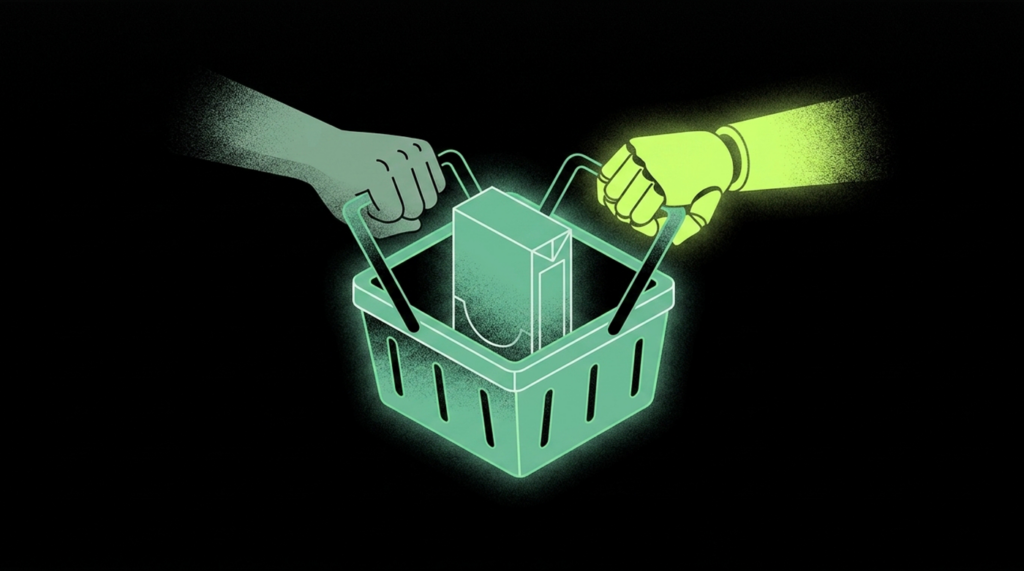
Products are no longer built only for human users. AI introduces a new kind of user: agents, automations, and machine actors that interact with products differently than people.
For decades, product teams have started with the human customer: their goals, pain points, workflows, attention, patience, and expectations. That remains essential. But in many enterprise contexts, we now design for a mixed environment where humans and agents both consume, interpret, and act on product capabilities.
That changes subtle but important assumptions. Take something as simple as search. A response time that feels instant to a human may be too slow for an agent operating inside a larger workflow. A UI element that helps a person understand context may be irrelevant to an agent, while structured metadata, API consistency, permissioning, traceability, and machine-readable semantics become more important.
So, the assumption I let go of is not “build for humans.” It is “humans are the only meaningful users.” AI adds a new user type with different constraints: speed, reliability, composability, observability, and context access.
Three pieces of advice for product leaders who are implementing AI
Here's my advice to product leaders:
- Do not treat AI as a procurement exercise. Buying tools, adding copilots, or deploying agents is not the transformation. The transformation is understanding how AI changes the decomposition of work, the boundaries between roles, the handoffs in the workflow, and the way value is created for customers.
- Optimize for effectiveness before efficiency. AI should not only reduce effort; it should help product teams solve problems that were previously too slow, too expensive, or too complex to address. The question should not just be, “Can we do this cheaper?” It should be, “Can we now create a better outcome that was previously out of reach?”
- Measure trusted outcomes, not AI activity. Counting prompts, tokens, copilots, agents, or prototypes can easily become productivity theater. Product leaders should instead ask: Did the customer get to value faster? Did the workflow improve? Did cycle time, quality, risk, compliance, or customer experience move in the right direction? Did we make a better decision, or just produce more artifacts?
Do not treat AI as a procurement exercise. Optimize for effectiveness before efficiency. Measure trusted outcomes, not AI activity. AI should push product leaders to become more ambitious, not merely more efficient…The opportunity is to redesign the system so intelligence can create accountable, measurable, and durable value.
In short: AI should push product leaders to become more ambitious, not merely more efficient. The opportunity is not to bolt intelligence onto the existing system. The opportunity is to redesign the system so intelligence can create accountable, measurable, and durable value.
Follow along
You can follow Lukas Egger's work on LinkedIn and X. And check out his podcast, Process Transformers.
More expert interviews to come on The CPO Club!