
Mevcut çok sayıda farklı yol haritası çözümü arasından hangisinin sizin için doğru olduğunu belirlemek zor olabilir. Ürününüz için sırada neler olduğunu ana hatlarıyla ortaya koymak, aynı zamanda bu çıktıların ve değerlerinin hem ekibinize hem de paydaşlarınıza iletilmesini sağlamak istediğinizi biliyorsunuz; ancak hangi aracın en iyi olduğunu bulmanız gerekiyor. Size yardımcı olacağım! Bu yazıda, büyük ekipler ve çeşitli ürünlerle kullandığım onlarca farklı araçtan edindiğim kişisel deneyimlerimi kullanarak en iyi ürün yönetimi yol haritası araçları arasından seçim yapmanızı kolaylaştıracağım.
Ürün Yönetimi Yol Haritası Araçları Nedir?
Ürün yönetimi yol haritası aracı, ürün geliştirme stratejisini ana hatlarıyla ortaya koyan görsel yol haritaları oluşturmaya ve paylaşmaya yardımcı olan bir yazılım çözümüdür. Bu araçlar, temel kilometre taşlarının, özelliklerin ve sürümlerin gösterilmesini sağlayarak kuruluş genelinde şeffaflığı ve uyumu destekler.
Genellikle özelleştirilebilir yol haritaları, iş birliği özellikleri, diğer araçlarla entegrasyon ve planlanan kilometre taşlarına göre ilerlemeyi takip etme olanağı gibi özellikler içeren bu araçlar, ürün ekiplerinin stratejilerini ifade etmelerini, görevleri önceliklendirmelerini ve ürün geliştirme sürecine ilişkin ortak bir anlayışı korumalarını sağlar.
Why Trust Our Software Recommendations
6,700+
Reviews
20
Industry experts
16+
Evaluation factors
14
Years
Our team has been testing and reviewing software since 2012. As product managers ourselves, we know how difficult—and important—it is to choose the right software.
For this guide, we evaluated tools using hands-on testing and independent research, scoring tools using our selection criteria.
Our reviews reflect our human editorial judgment, not a sales pitch.
Expert reviewers:
- Andrew LumbySenior TPM
- Cristiano ValimSenior UI/UX Lead


Ürün Yönetimi Yol Haritası Araçları Karşılaştırma Tablosu
Bu karşılaştırma tablosu, en iyi ürün yönetimi yol haritası aracı seçimlerimin fiyatlandırma ayrıntılarını özetlemektedir:
Score legend (out of 5)
- Excellent4.5–5
- Good4–4.4
- Average3–3.9
- Below average2–2.9
- Poor1–1.9
Sorted by: Default
| Tool | Starting Price | Website | |||||||
|---|---|---|---|---|---|---|---|---|---|
Best with live Jira-synced public roadmaps | 3.7 out of 5 | 5 | 5 | 4 | 3 | 4 | 1 | $1.10/user/month Free plan + 30-day trial + demo available | Website |
Best for pre-built templates | 3.0 out of 5 | 1 | 4 | 3 | 4 | 4 | 2 | $8/user/month Free plan + 14-day trial available | Book Demo |
Best for outcome-linked roadmap feedback loops | 3.7 out of 5 | 4 | 4 | 4 | 4 | 3 | 3 | $24/user/month 7-day free trial + free demo available | Website |
Best for multi-view roadmaps from one dataset | 3.5 out of 5 | 3 | 4 | 3 | 3 | 4 | 4 | $19/user/month 14-day free trial available | Website |
Best for product portfolio roadmapping | 4.0 out of 5 | 4 | 2 | 5 | 5 | 4 | 4 | Pricing upon request Free demo available | Website |
Best for customer-driven roadmap notifications | 4.0 out of 5 | 5 | 5 | 3 | 3 | 4 | 4 | $65/user/month 14-day free trial | Website |
Best for customer feedback-linked roadmaps | 3.7 out of 5 | 5 | 4 | 4 | 2 | 4 | 3 | $19/user/month Free plan + free demo available | Website |
Best training packages for product teams | 3.8 out of 5 | 3 | 4 | 4 | 4 | 4 | 4 | Pricing upon request Free demo available | Website |
Best for end-to-end strategy-to-roadmap planning | 4.0 out of 5 | 4 | 4 | 4 | 3 | 5 | 4 | $59/user/month 30-day free trial + free demo available | Website |
Best for Atlassian-native roadmap and delivery sync | 3.7 out of 5 | 4 | 3 | 4 | 3 | 4 | 4 | $10/user/month Free plan available | Website |


En İyi 10 Ürün Yönetimi Yol Haritası Aracına Genel Bakış
Her bir ürün yönetimi yol haritası yazılımının kısa açıklaması aşağıda yer alıyor. Bazı özellikleri öne çıkaran ekran görüntüleriyle birlikte her aracın en iyi yaptığı şeyi gösteriyoruz.
 Best with live Jira-synced public roadmaps
- Free plan + 30-day trial + demo available
- From $1.10/user/month
Visit WebsiteCustomer Rating:5/5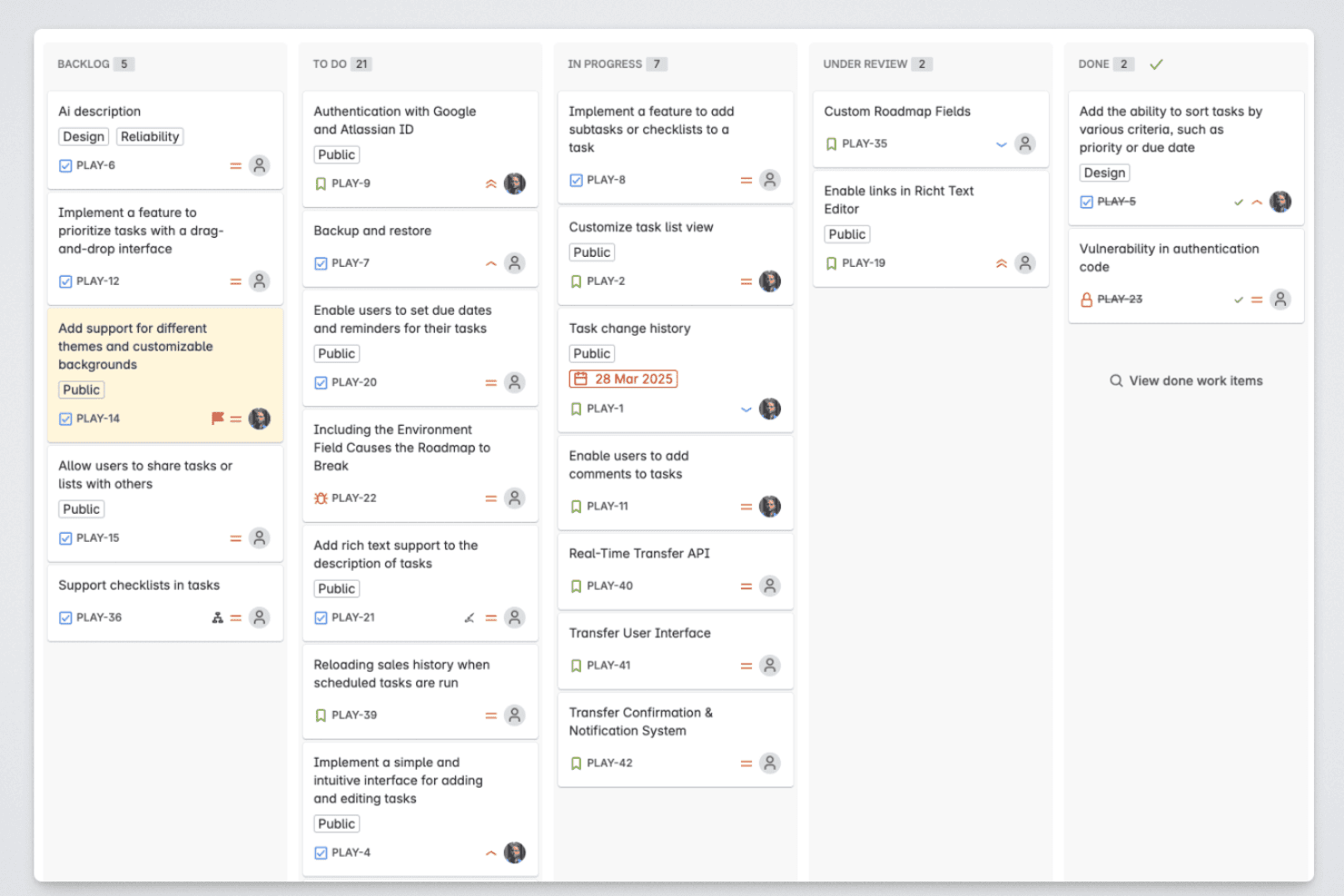
Released lets product managers organize roadmap items across backlog, in-progress, review, and completed stages. Released is an Atlassian-native roadmap and product communication tool that publishes live-synced public roadmaps, collects customer feedback, and generates AI-drafted release notes directly from your Jira and Jira Product Discovery data.
Who Is Released Best For?
Released is a natural fit for Jira-based product teams that want to share customer-facing roadmaps and changelogs without stepping outside the Atlassian ecosystem.
Why I Picked Released
Released earns its spot on my shortlist because it's the only roadmap tool that publishes directly from Jira without a separate database to maintain. I love that you can build cross-space roadmaps pulling from multiple Jira and Jira Product Discovery projects into a single unified view, then serve audience-specific versions to customers, executives, and GTM teams from that same source. When a ticket moves in Jira, the public roadmap updates automatically.
Released Key Features
- Branded changelog hub: Publish release notes to a dedicated changelog site with custom domain and styling.
- Feedback voting portal: Collect feature requests and upvotes from customers in a public or private portal.
- Slack feedback integration: Route product feedback from Slack channels directly into your roadmap and inbox.
- AI release note drafting: Automatically generate release note drafts from completed Jira tickets using built-in AI.
Released Integrations
Released offers native integrations with Jira, Jira Product Discovery, Confluence, and Slack.
Pros and Cons
Pros:
- AI drafts release notes from closed Jira tickets
- Supports audience-specific views from one source
- Roadmaps update live when Jira tickets move
Cons:
- Limited usefulness outside the Atlassian ecosystem
- Roadmap views lack deep prioritization framework support
Learn more about Released: 2Best for pre-built templates
Miro
- Free plan + 14-day trial available
- From $8/user/month (billed annually)
Visit WebsiteCustomer Rating:4.8/5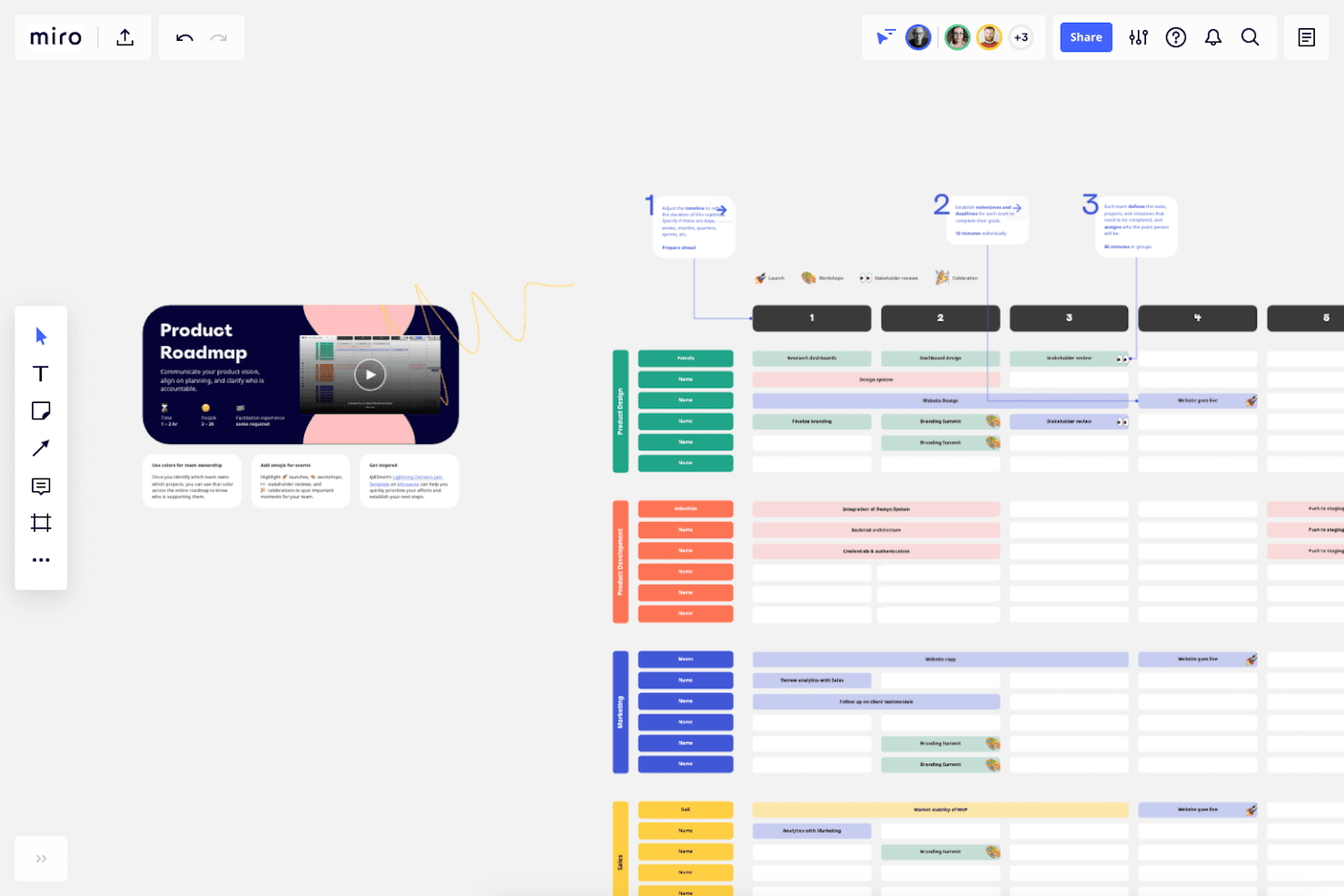
Users can access a selection of pre-designed templates that cover a variety of common roadmap styles and formats. Miro is a visual collaboration platform that lets product teams build and share roadmaps using a library of 60+ templates, timeline and table views, and two-way syncs with delivery tools like Jira, Asana, and Linear.
Who Is Miro Best For?
Miro is a strong fit for product managers and cross-functional teams who need to quickly build and share visually clear roadmaps without starting from scratch.
Why I Picked Miro
I picked Miro as one of the best because its template library is genuinely hard to beat—with 60+ product roadmap templates, I can go from blank board to a shareable Now/Next/Later or timeline roadmap in minutes. I especially like the audience-specific guidance baked in: Miro recommends timeline formats for sales and marketing stakeholders and portfolio roadmaps for executives, so you're not guessing which view fits which room. The Roadmap Tracking Blueprint even layers in AI-accelerated updates to keep the board current without manual effort.
Miro Key Features
- Two-way delivery tool sync: Connects to Jira, Asana, Linear, ClickUp, and Azure DevOps to keep roadmap items aligned with your engineering backlog in real time.
- Talktrack: Records a narrated walkthrough of your board so stakeholders can review your roadmap presentation asynchronously.
- AI Roadmap Strategist Sidekick: Suggests roadmap ideas and priorities based on your company's goals and insights, directly within the board.
- Tables and Timelines: Structures backlog items with statuses, nesting, and scheduling so you can manage and track initiatives without leaving the board.
Miro Integrations
Miro offers native two-way integrations with Jira, Asana, Linear, ClickUp, and Azure DevOps on Business and higher. It connects to more than 250 apps, including Microsoft, Slack, Google, and Adobe, plus Power BI, Looker, and Tableau data feeds.
Pros and Cons
Pros:
- Supports collaborative roadmap workshops
- Clarifies timelines for diverse stakeholders
- Offers 60-plus roadmap templates
Cons:
- Large portfolios become difficult to navigate
- Prioritization lacks built-in scoring frameworks
 Best for outcome-linked roadmap feedback loops
- 7-day free trial + free demo available
- From $24/user/month (billed annually)
Visit WebsiteCustomer Rating:4.2/5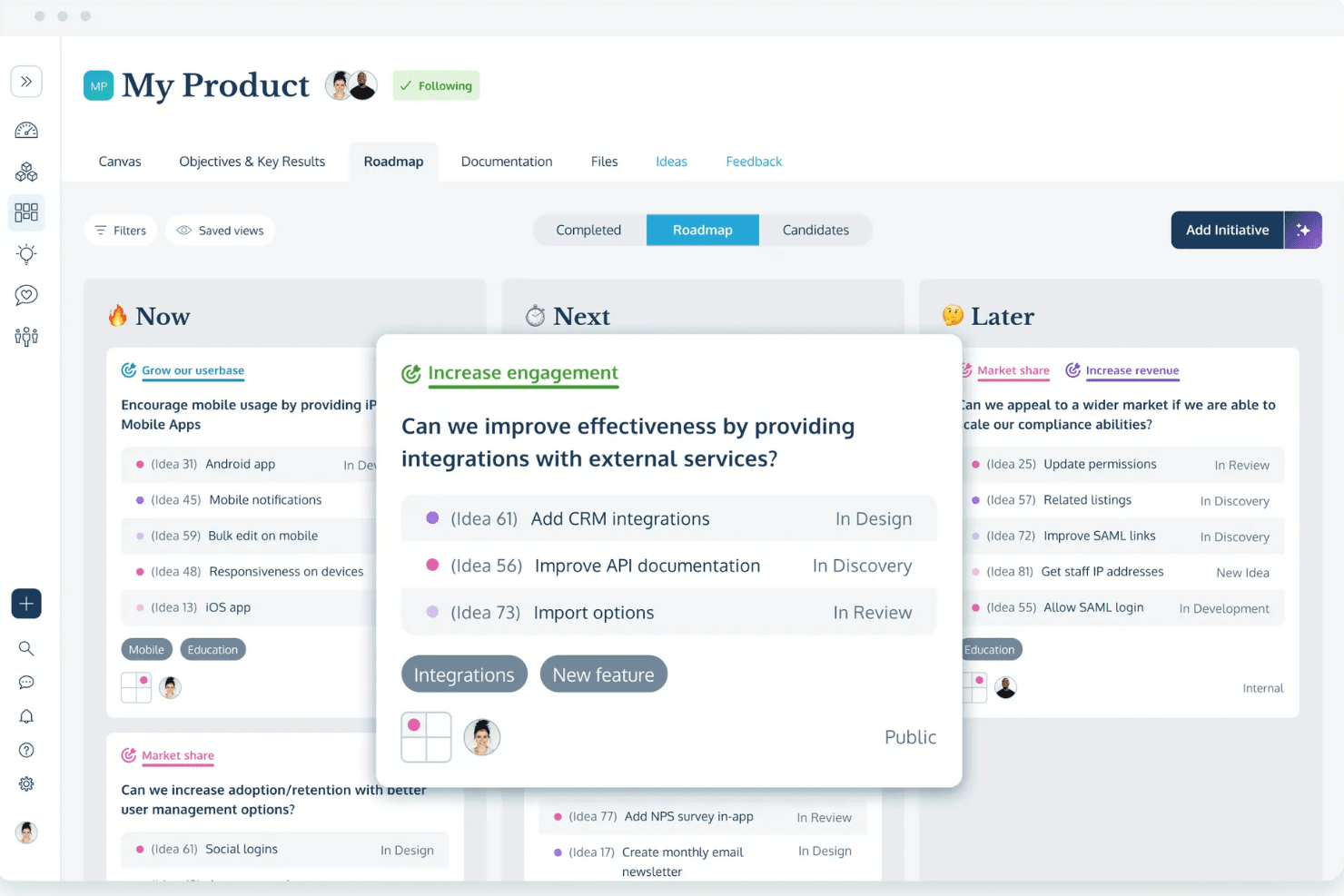
ProdPad's lean roadmaps allow you to focus more on achieving outcomes rather than specific timelines. ProdPad is a product management platform that combines Now-Next-Later roadmapping, idea and feedback intake, OKR tracking, and delivery tool integrations into a single connected workflow.
Who Is ProdPad Best For?
ProdPad suits product managers and product operations leads who want to connect customer feedback directly to their roadmap and track outcomes after release.
Why I Picked ProdPad
I've included ProdPad in my top picks because it's the only tool I've found that genuinely closes the loop between customer feedback and roadmap outcomes. When a requested feature ships, ProdPad notifies the customers who asked for it, and the OKR module lets you record actual results right next to the original decision. I also like how Signals surfaces feedback themes automatically, so you're not manually hunting for patterns before prioritizing your Now-Next-Later roadmap.
ProdPad Key Features
- Now-Next-Later roadmap publishing: Publish a single source roadmap as multiple audience-specific views for your board, internal teams, or customers.
- CoPilot PM AI assistant: Drafts specs from linked feedback, flags duplicate ideas, and summarizes customer themes using your team's own data.
- OKR module with outcome tracking: Links initiatives to objectives with a metric, baseline, and goal so you can record actual results after release.
- Two-way delivery tool sync: Keeps ideas and tickets in sync across Jira and Azure DevOps so your roadmap stays aligned with engineering execution.
ProdPad Integrations
ProdPad offers two-way integrations with Jira and Azure DevOps, plus integrations with Linear, GitHub, Trello, Slack, Microsoft Teams, Salesforce, Intercom, and Confluence. It also supports Zapier.
Pros and Cons
Pros:
- Publishes audience-specific Now-Next-Later roadmaps
- Tracks outcomes after initiatives ship
- Connects feedback directly to roadmap decisions
Cons:
- Offers limited capacity planning visibility
- Lacks dated timeline planning views
Learn more about ProdPad: Best for multi-view roadmaps from one dataset
- 14-day free trial available
- From $19/user/month (billed annually)
Visit WebsiteCustomer Rating:4/5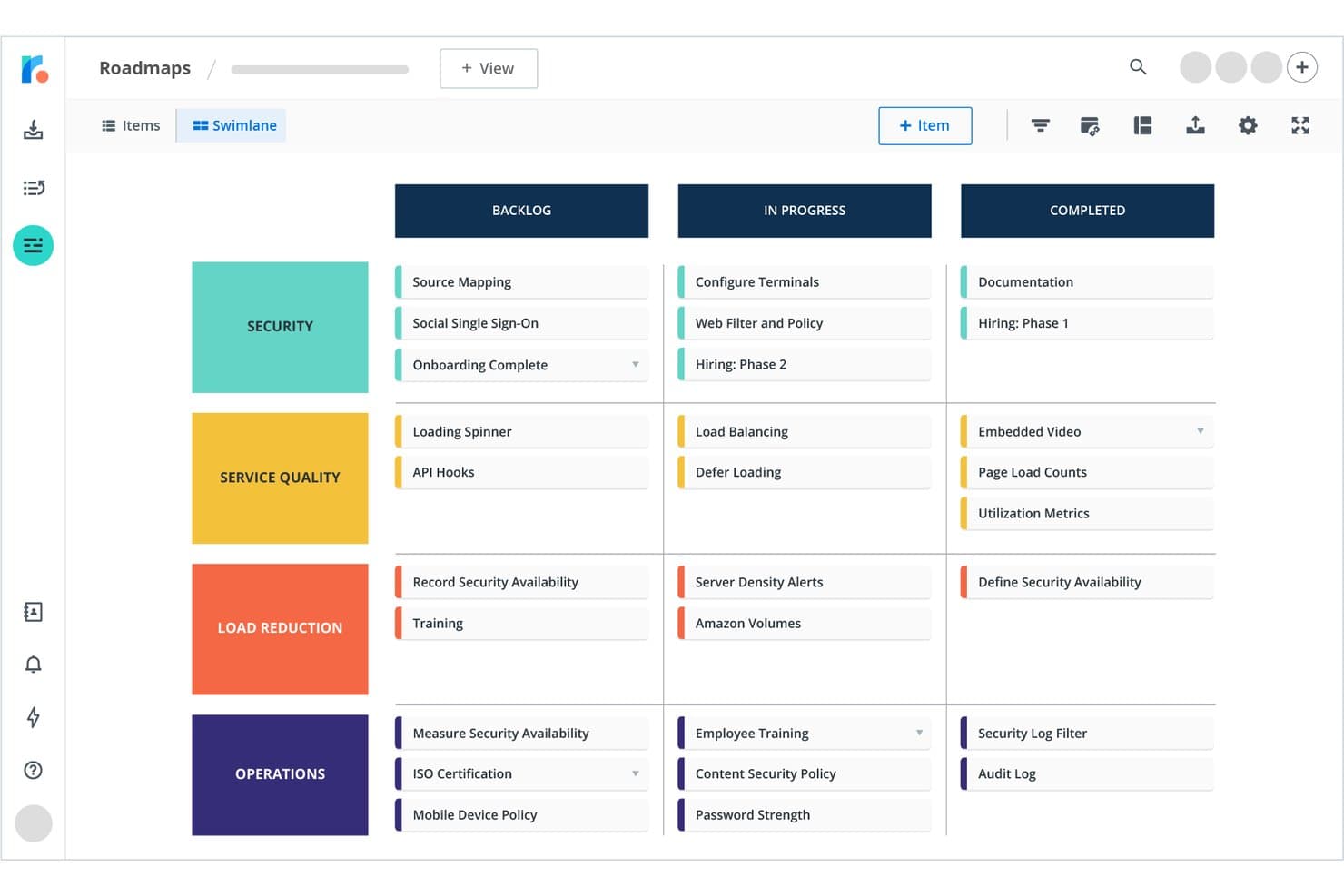
Tempo Roadmapping Software organizes tasks by swimlane across Backlog, In Progress, and Completed. Tempo Roadmapping Software (formerly Roadmunk) is a visual roadmap tool that lets product teams build timeline, swimlane, and table views from a single dataset, alongside idea management, prioritization frameworks, and stakeholder sharing features.
Who Is Tempo Roadmapping Software Best For?
Tempo Roadmapping Software suits product managers who need to present the same roadmap data in multiple formats for different audiences.
Why I Picked Tempo Roadmapping Software
Tempo Roadmapping Software earns its spot on my shortlist because it solves a problem most roadmap tools ignore: the same data needs to tell different stories to different audiences. I like that one dataset feeds into timeline, swimlane, and table views simultaneously, so I'm not maintaining separate files for engineering, executives, and customers. The swimlane view is especially useful for agile teams because it shows progress without locking items to fixed dates, and portfolio roadmaps roll multiple team roadmaps into a single high-level view for leadership.
Tempo Roadmapping Software Key Features
- Idea Manager: A prioritization workspace where you can score ideas using weighted scoring, value vs. effort, or RICE frameworks, then promote high-impact ideas directly onto the roadmap.
- Customer feedback portal: A customizable, customer-facing portal that collects feedback and links it to ideas, so your backlog reflects real user input.
- Reviewer role: A read-only seat type that lets stakeholders view roadmaps, leave comments, and submit feedback without needing a paid collaborator license.
- Jira and Azure DevOps sync: A two-way integration that connects roadmap items to delivery tickets, with custom JQL and WIQL query support on higher tiers.
Tempo Roadmapping Software Integrations
Tempo Roadmapping Software offers native integrations with Jira and Azure DevOps, including two-way sync on higher tiers. It also supports API access for custom integrations and imports from Asana, Monday.com, Shortcut, Trello, GitHub, and GitLab.
Pros and Cons
Pros:
- Portfolio rollups clarify cross-product priorities
- Polished roadmaps suit executive presentations
- Multiple views serve different stakeholder needs
Cons:
- Capacity planning requires a separate product
- Feedback intake lacks public voting boards
Learn more about Tempo Roadmapping Software: Best for product portfolio roadmapping
- Free demo available
- Pricing upon request
Visit WebsiteCustomer Rating:4.8/5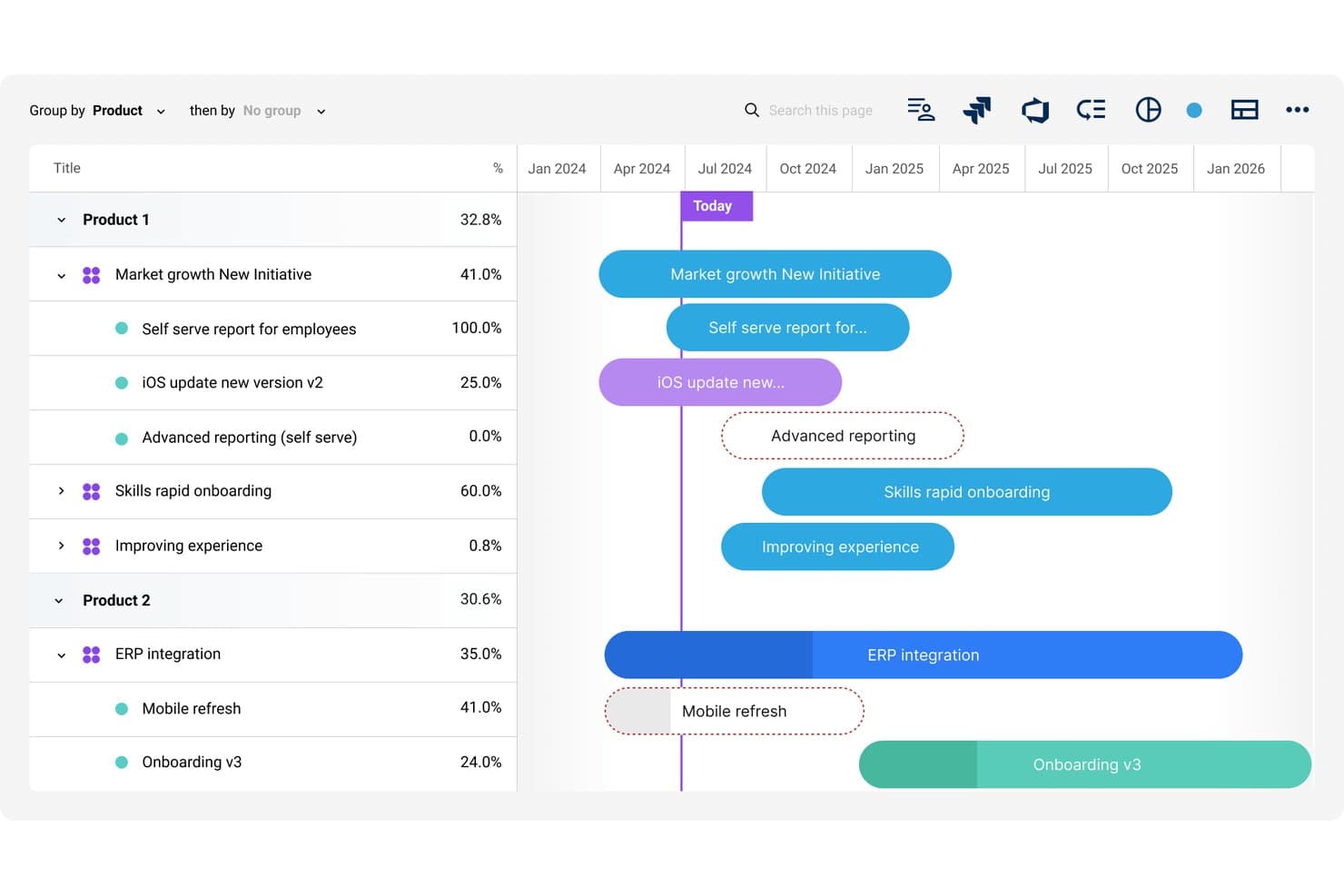
Dragonboat organizes multi-product roadmaps with timeline and progress tracking. Dragonboat is an AI-powered product portfolio management platform that combines strategy alignment, roadmapping, intake, capacity planning, and end-to-end product lifecycle tracking across a modular suite of apps.
Who Is Dragonboat Best For?
Dragonboat is a strong fit for product operations and portfolio teams managing multiple product lines who need strategy, roadmapping, and delivery tracking in one connected platform.
Why I Picked Dragonboat
Dragonboat earns its spot on my shortlist because it's built specifically for teams managing multiple product lines who need strategy, roadmaps, and delivery tracking connected in one place. I love how its hierarchy (strategic bets → initiatives → features → work items) keeps portfolio-wide roadmaps tied directly to business outcomes rather than just feature lists. The AI-powered trade-off graph is what really sets it apart: it surfaces dependencies and constraints across your portfolio so you're making prioritization calls with full visibility into consequences.
Dragonboat Key Features
- RICE scoring with custom fields: Score and rank initiatives using RICE methodology, extended with custom fields to match your team's prioritization criteria.
- Intake app with CRM integration: Collect customer feedback through customizable forms and connect to CRMs to quantify the revenue impact of each request.
- OKR and outcome-based funding: Set OKRs at multiple hierarchy levels and tie funding and investment allocation directly to strategic outcomes.
- Two-way delivery tool sync: Push strategic context down into Jira, Azure DevOps, Shortcut, and Asana, while scope, status, and risk flow back up in real time.
Dragonboat Integrations
Dragonboat supports 200+ integrations, including Jira, Azure DevOps, Rally, Shortcut, Asana, Monday.com, Slack, Microsoft Teams, Salesforce, and Zendesk. It also offers REST API and MCP connectivity for custom integrations.
Pros and Cons
Pros:
- Audit trails preserve human and AI activity
- Trade-off graphs expose downstream portfolio consequences
- Portfolio roadmaps tie strategy to execution
Cons:
- Some important features are difficult to find
- Enterprise positioning may overwhelm smaller teams
Learn more about Dragonboat: Best for customer-driven roadmap notifications
- 14-day free trial
- From $65/user/month
Visit WebsiteCustomer Rating:4.9/5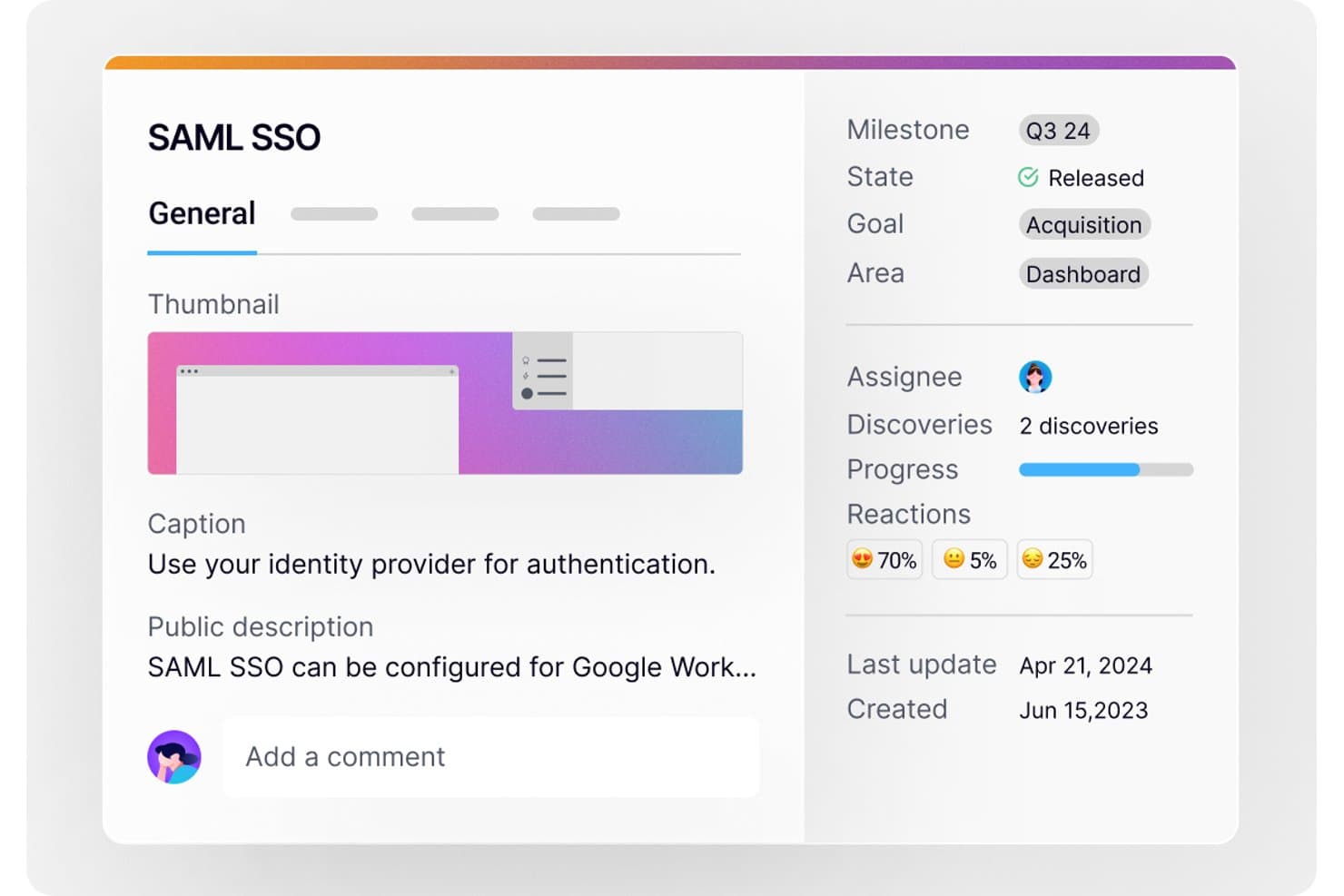
Harvestr lets users track feature details, progress, and reactions on a roadmap. Harvestr is a product feedback and roadmap platform for B2B SaaS teams that combines AI-driven feedback intake, revenue-based prioritization, and visual roadmapping across Kanban, Swimlane, and Timeline views.
Who Is Harvestr Best For?
Harvestr is a strong fit for B2B SaaS product teams that need to close the loop between customer feedback and roadmap updates automatically.
Why I Picked Harvestr
I picked Harvestr as one of the best because it's the only tool on my list that automatically notifies the people who submitted feedback the moment a roadmap item's status changes. That closed-loop notification system is a genuine differentiator: your sales and customer success teams don't have to manually chase down updates because Harvestr handles it. I also love that AI-driven feedback triage feeds directly into revenue-weighted prioritization, so you're not just closing the loop faster; you're closing it on the right things first.
Harvestr Key Features
- Multi-view roadmap builder: Create and switch between Kanban, Swimlane, and Timeline views, each with independent filtering, grouping, and card field settings.
- Revenue-weighted prioritization: Score and rank features using RICE or custom weighted criteria, with MRR data pulled from your CRM to size each opportunity.
- Branded public roadmap page: Publish a white-labeled, embeddable roadmap URL that updates live and supports smiley-face voting from external visitors.
- Delivery tool issue linking: Connect roadmap projects to tasks in Jira, Linear, GitHub, GitLab, or Trello so that progress bars update automatically as engineering work advances.
Harvestr Integrations
Harvestr lists 20+ integrations, including Jira, Linear, GitHub, GitLab, Trello, HubSpot, Salesforce, Slack, Microsoft Teams, and Zendesk. It also offers an API and Zapier.
Pros and Cons
Pros:
- Branded roadmaps support audience-specific stakeholder communication
- Revenue-weighted scoring connects priorities to business value
- Automatic notifications close the customer feedback loop
Cons:
- Public voting uses only simple smiley reactions
- No confirmed capacity planning or dependency mapping
Learn more about Harvestr: Best for customer feedback-linked roadmaps
- Free plan + free demo available
- From $19/user/month (billed annually)
Visit WebsiteCustomer Rating:4.5/5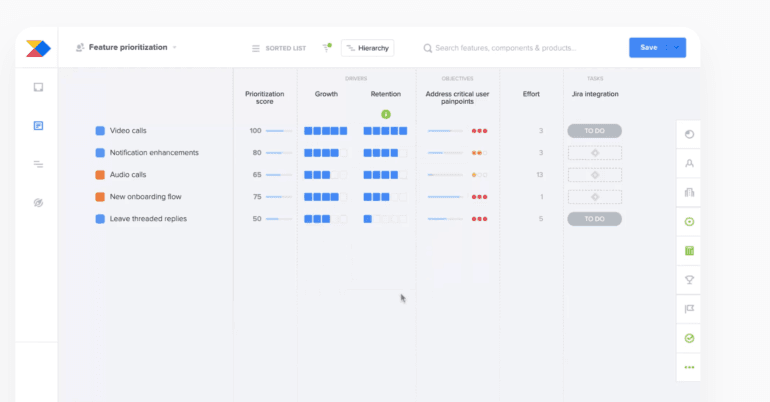
Productboard allows you to select from different roadmap layouts and visualizations. Productboard is a product management roadmap tool that combines visual roadmap building, customer feedback intake, feature prioritization, and stakeholder-facing sharing into a single connected workspace.
Who Is Productboard Best For?
Productboard is a strong fit for product managers at growth-stage and enterprise companies who need to connect customer feedback directly to roadmap decisions.
Why I Picked Productboard
Productboard earns its spot on my shortlist because of how tightly it connects customer feedback to the roadmap. I love that you can trace any feature directly back to the customer requests that drove it, and then close the loop by notifying those same customers when it ships. Custom prioritization formulas let you rank features by customer segment, so you're not guessing at what matters most.
Productboard Key Features
- Custom prioritization formulas: Build your own scoring models to rank features by business impact, customer segment, or request volume.
- OKR and objective tracking: Link objectives directly to initiatives and features, with a dedicated view for monitoring progress and risk.
- Customer portal with voting: Let customers see upcoming plans and vote on features, with options for localization and custom voting scales on higher tiers.
- Portfolio roadmap view: See all products and initiatives in a single unified view, giving leadership visibility across the entire product portfolio.
Productboard Integrations
Productboard offers 25+ native integrations, including Jira, Azure DevOps, Confluence, Google Drive, Notion, Figma, Miro, Amplitude, Mixpanel, and Salesforce. API access is available on Business and higher plans, and Productboard also integrates with Zapier.
Pros and Cons
Pros:
- Portfolio views keep executives aligned
- Customer voting closes feedback loops
- Feedback links explain roadmap decisions
Cons:
- Engineering execution visibility remains limited
- Objective hierarchies take time to master
Learn more about Productboard: Best training packages for product teams
- Free demo available
- Pricing upon request
Visit WebsiteCustomer Rating:4.4/5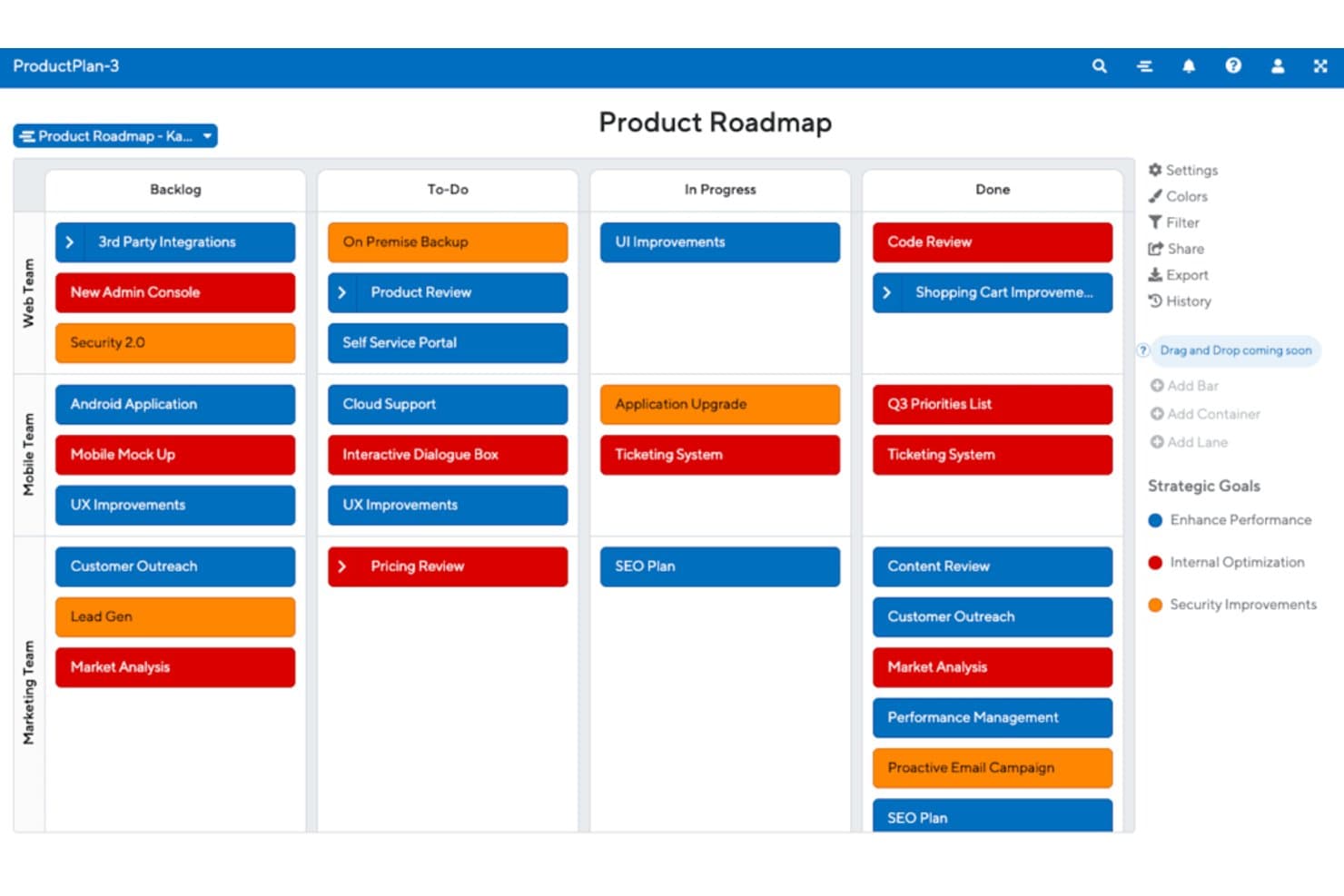
ProductPlan organizes tasks by team and status on a Kanban roadmap. ProductPlan is a product intelligence platform that combines visual roadmapping, AI-assisted idea intake, prioritization boards, and delivery tool sync for product teams.
Who Is ProductPlan Best For?
ProductPlan is a strong fit for product teams that want structured onboarding and hands-on support alongside their roadmapping tool.
Why I Picked ProductPlan
ProductPlan earns its spot on my shortlist because of the depth of support your team gets from day one. Every plan includes a dedicated Implementation Manager who handles Jira or Azure DevOps configuration and field mapping for you, plus a Customer Success Manager who runs quarterly business reviews after go-live. Free biweekly "Getting Started" webinars are open to your whole team, so new PMs can get up to speed without waiting on internal training resources.
ProductPlan Key Features
- AI Suggested Initiatives: Scans your idea backlog for patterns and surfaces up to 10 initiatives ranked by alignment with your company objectives.
- Portfolio views: Displays roadmaps across multiple products and teams in a single view for cross-team visibility.
- Secure live sharing links: Generates revocable links for internal and external stakeholders at no extra cost, with roadmaps set to private by default.
- Bi-directional Jira and Azure DevOps sync: Keeps your initiative, epic, and story hierarchy in sync across tools in real time, including text, dates, labels, and filters.
ProductPlan Integrations
ProductPlan has native integrations with Jira and Azure DevOps, plus integrations with GitHub, Trello, Confluence, Slack, and Microsoft Teams. It also supports Zapier and offers an API for custom integrations.
Pros and Cons
Pros:
- Portfolio views connect strategy across products
- Biweekly training webinars support team adoption
- Dedicated onboarding and ongoing success guidance
Cons:
- Limited capacity planning for resource-constrained teams
- Jira date synchronization can require manual adjustments
Learn more about ProductPlan: Best for end-to-end strategy-to-roadmap planning
- 30-day free trial + free demo available
- From $59/user/month (billed annually)
Visit WebsiteCustomer Rating:4.1/5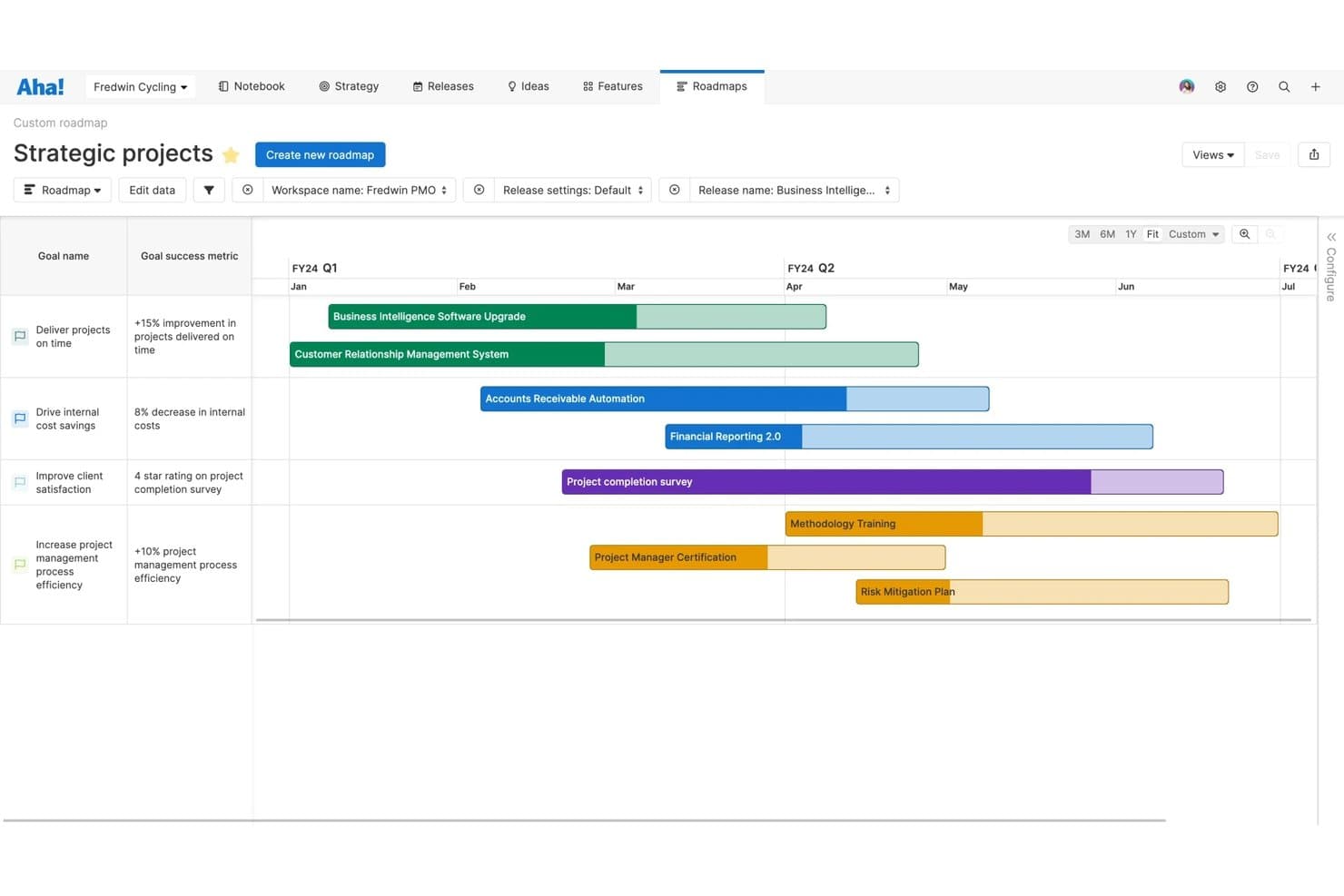
Aha Roadmaps aligns strategic goals with project timelines visually. Aha! Roadmaps is a product management platform that connects business strategy to visual roadmaps, combining goal-setting, idea intake, release planning, prioritization, and stakeholder sharing in one suite.
Who Is Aha! Roadmaps Best For?
Aha! Roadmaps is a strong fit for product teams at mid-size to enterprise companies that need to connect business strategy directly to a shareable, living roadmap.
Why I Picked Aha! Roadmaps
Aha! Roadmaps earns its spot on my shortlist because it's one of the few tools that treats strategy as the starting point, not an afterthought. I love how you can link OKRs directly to features and releases, so your roadmap always traces back to a business goal. Scorecards let you prioritize by value rather than gut instinct, and auto-updating presentations mean stakeholders always see a live view without you rebuilding slides before every review.
Aha! Roadmaps Key Features
- Ideas portal: A branded intake portal where customers or internal teams can submit, vote on, and track the status of product ideas.
- Release management: Plan and manage releases with dependency tracking, capacity calculations based on actual working days, and progress reporting.
- Auto-updating presentations: Build stakeholder presentations that pull live roadmap data, so slides stay current without manual rebuilding.
- Dev tool integrations: Connect directly to Jira, GitHub, GitLab, and Azure DevOps to track engineering execution alongside your product plan.
Aha! Roadmaps Integrations
Aha! Roadmaps offers integrations with 40+ tools, including Jira, Azure DevOps, GitHub, GitLab, Salesforce, Zendesk, Slack, Microsoft Teams, and Google Sheets. It also supports a REST API and Zapier.
Pros and Cons
Pros:
- Idea portals turn feedback into prioritized work
- Auto-updating presentations reduce stakeholder rework
- Links business goals to roadmap items
Cons:
- Setup demands substantial configuration before adoption
- Advanced planning requires higher-tier access
Learn more about Aha! Roadmaps: Best for Atlassian-native roadmap and delivery sync
- Free plan available
- From $10/user/month
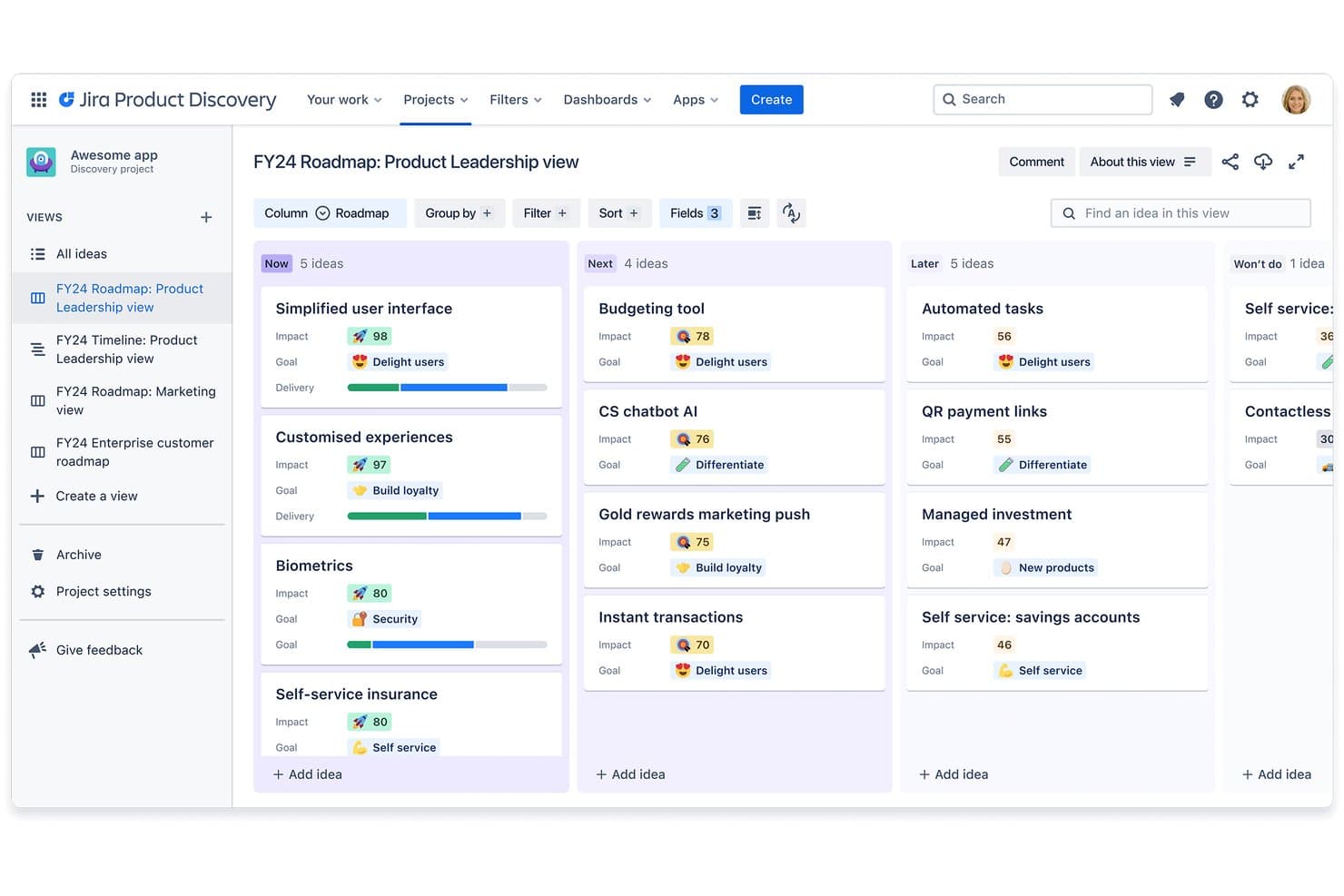
Jira Product Discovery organizes ideas into Now, Next, and Later roadmap columns. Jira Product Discovery is a product management roadmap tool from Atlassian that brings together idea capture, prioritization, and visual roadmapping across list, board, matrix, and timeline views—with native two-way sync to Jira for delivery tracking.
Who Is Jira Product Discovery Best For?
Jira Product Discovery is a natural fit for product teams already running delivery in Jira who want discovery and roadmapping to live in the same ecosystem.
Why I Picked Jira Product Discovery
Jira Product Discovery earns its spot on my shortlist because the bidirectional sync with Jira is genuinely best-in-class. When my team links a discovery idea to a Jira epic, delivery status updates flow back automatically, so the roadmap always reflects what engineering is actually shipping. I also rely on the formula fields to build RICE-style scoring directly in the tool, which keeps prioritization consistent across projects without a separate spreadsheet.
Jira Product Discovery Key Features
- Multiple roadmap views: Switch between list, board, matrix, and timeline views to plan and present work in the format that fits your audience.
- Custom field formulas: Build weighted scoring models like RICE directly in the tool using formula fields tied to any custom data you track.
- Insight connectors: Pull feedback from Zendesk, Salesforce, Pendo, Intercom, and Vivun and link it directly to ideas on your roadmap.
- Confluence embedding: Embed live roadmaps into Confluence pages so stakeholders across the org always see up-to-date priorities without leaving their workflow.
Jira Product Discovery Integrations
Jira Product Discovery offers native integrations with Jira, Confluence, Jira Service Management, Atlassian Goals, Atlassian Projects, Zendesk, Salesforce, Pendo, Intercom, and Vivun. It also provides a REST API for custom integrations.
Pros and Cons
Pros:
- Free contributors simplify stakeholder feedback
- Formula fields support RICE-style prioritization
- Four roadmap views support varied planning styles
Cons:
- Setup requires significant configuration time
- Hierarchy and aggregated views require Premium
Learn more about Jira Product Discovery:
Diğer Ürün Yönetimi Yol Haritası Araçları
En iyi araçlar listesine giremeyen birkaç araç daha şunlar:
- 11CannyBest for revenue-weighted roadmap prioritization
- 12airfocusBest for customizability
- 13Planview AdaptiveWorkBest for portfolio-scale roadmap reporting
- 14StoriesOnBoardBest for story map-driven roadmap planning
- 15Craft.ioBest for OKR-linked roadmap planning
- 16LinearBest for engineering-led roadmap execution
How I Evaluate Product Management Roadmap Tools
I split my evaluation into three parts: core functionality—whether a tool lets you build visual timelines and apply structured prioritization frameworks—carries the most weight. Then I look at standout features like customer feedback portals. Finally, I consider support quality and pricing value.
Core Functionality (Table Stakes For This List)
When I'm selecting tools for my list, I score each one on a scale from 0 (does not offer the functionality) to 5 (excels in this area) for each core functionality listed below. I then convert the total into a percentage to help assess each tool's overall fit, with extra weight on any functionalities I've deemed essential.
- Visual Roadmap Building (Essential): I check whether you can drag and drop items across timeline, board, and swimlane views rather than being locked into a single fixed layout.
- Prioritization Framework (Essential): I look for configurable scoring models like RICE or weighted criteria so you can compare features side by side instead of relying on gut feel.
- Stakeholder Sharing Views: Audience-specific share links matter here—I evaluate whether you can show executives a high-level view while giving engineering a detailed one.
- Initiative & Feature Tracking: Each item should carry status, owner, and custom fields so you can trace an initiative from idea through delivery without switching tools.
- Feedback & Idea Intake: I look for structured portals where customers or internal teams can submit and vote on ideas that link directly to roadmap items.
- Delivery Tool Integration: Two-way sync with tools like Jira or Azure DevOps is what I evaluate, so roadmap status reflects real engineering progress automatically.
Once I have a list of tools that meet the criteria, I consider what sets each platform apart.
Differentiating Factors (What Sets Vendors Apart)
Here's how I compare and contrast different vendors:
Standout Features
I look for a customer portal where users can submit and vote on feature requests, since it gives you a direct signal of demand rather than secondhand anecdotes filtered through sales. Capacity planning layered onto the roadmap is equally important—I check whether effort estimates flag over-allocation before you commit to a release. I also evaluate AI-driven prioritization, where tools like Productboard or Aha! surface recommendations based on customer impact and historical data, helping you move past gut-feel debates in planning sessions.
Beyond Features
I evaluate how easily non-technical stakeholders can adopt the tool. If a VP of sales can't parse the roadmap without a walkthrough, cross-functional alignment stalls. Ecosystem integrations also matter—I check for native connections to CRM, helpdesk, and communication tools like Slack so roadmap context travels where decisions happen. Finally, I look at data governance: SSO support, granular permissions, and compliance certifications protect sensitive strategy data, especially for teams in regulated industries.
Ürün Yönetimi Yol Haritası Araçlarındaki Trendler
Araştırmam sırasında farklı ürün yönetimi yol haritası yazılımı sağlayıcılarından sayısız ürün güncellemesi, basın bülteni ve sürüm günlüğü inceledim. Takip ettiğim yeni ortaya çıkan trendlerden bazıları şunlar:
- Yapay Zekâ Destekli İçgörüler: Araçlar, öngörücü analizler ve içgörüler sağlamak için giderek daha fazla yapay zekâ kullanıyor. Bu, ekiplerin pazar değişikliklerini öngörmesine ve stratejilerini proaktif biçimde uyarlamasına yardımcı oluyor. Bazı sağlayıcılar, kullanıcı geri bildirimlerini analiz etmek ve ürün yol haritalarını iyileştirmek için yapay zekâyı entegre ediyor.
- Geliştirilmiş İş Birliği Özellikleri: Farklı konumlardaki ekiplerin iş birliğini geliştiren özelliklere giderek daha fazla odaklanılıyor. Gerçek zamanlı düzenleme ve yorum işlevleri standart hâle geliyor; böylece ekiplerin daha etkili bir şekilde birlikte çalışması sağlanıyor.
- Kullanıcı Odaklı Tasarım: Sağlayıcılar, daha sezgisel arayüzler ve kullanıcı dostu tasarımlarla kullanıcı deneyimine öncelik veriyor. Bu trend, basitlik ve kullanım kolaylığına odaklanarak ekiplerin kapsamlı bir eğitim almadan yeni araçları benimsemesini kolaylaştırıyor.
- Veri Görselleştirme Araçları: Karmaşık bilgileri açık bir şekilde sunmak için gelişmiş veri görselleştirme standart hâline geliyor. Veri görselleştirme araçları, ham verileri kolay anlaşılır görsellere dönüştürerek ekiplerin veriye dayalı kararları hızlı bir şekilde almasına yardımcı oluyor.
- Sürdürülebilirlik Takibi: Daha fazla yol haritası, sürdürülebilirlik hedeflerini takip etmeye yönelik özellikler içeriyor. Bu trend, çevresel etkiye ilişkin artan iş öncelikleriyle örtüşüyor ve ekiplerin ürün stratejilerini sürdürülebilirlik hedefleriyle uyumlu hâle getirmesine olanak tanıyor.
Özellikler
Her iyi ürün yönetimi yol haritası yazılımında bulunması gereken temel özellikler şunlardır:
- Yol haritası görselleştirme: Ekiplerin ürün stratejilerinin görsel bir temsilini oluşturup paylaşmasına olanak tanıyarak planların paydaşlara iletilmesini kolaylaştırır.
- Görev ve kilometre taşı takibi: Ekiplerin proje ilerlemesini ve son teslim tarihlerini takip etmesine yardımcı olarak herkesin programa uygun ilerlemesini sağlar.
- Yapay zekâ destekli içgörüler: Ekiplerin değişiklikleri öngörmesine ve bilinçli kararlar almasına yardımcı olacak tahmine dayalı analizler sunar.
- İş birliği araçları: Farklı konumlardaki iletişimi ve ekip çalışmasını kolaylaştırarak üretkenliği ve uyumu artırır.
- Özelleştirilebilir iş akışları: Ekiplerin süreçleri kendi özel ihtiyaçlarına göre uyarlamasına olanak tanıyarak projeleri yönetmede esneklik sunar.
- Veri görselleştirme: Ham verileri anlaşılır görsellere dönüştürerek hızlı ve kolay karar almayı destekler.
- Senaryo planlaması: Ekiplerin farklı stratejileri ve sonuçları incelemesine olanak tanıyarak çeşitli olasılıklara hazırlanmalarına yardımcı olur.
- Sürdürülebilirlik takibi: Ekiplerin ürün stratejilerini çevresel hedeflerle uyumlu hâle getirmesine ve bu hedefleri izlemesine olanak tanır.
- Kullanıcı odaklı tasarım: Aracın sezgisel ve kullanımı kolay olmasını sağlayarak yeni kullanıcıların öğrenme sürecini kısaltır.
- Güvenlik önlemleri: Hassas bilgileri şifreleme ve veri düzenlemelerine uyum yoluyla koruyarak veri güvenliğini sağlar.
Ürün Yönetimi Yol Haritası Araçlarının Faydaları
Ürün yönetimi yol haritası araçlarını uygulamak ekibiniz ve işletmeniz için çeşitli faydalar sağlayabilir. Yararlanabileceğiniz faydalardan bazıları şunlardır:
Kullanım kolaylığı: Kullanıcı odaklı tasarım, aracın kolayca benimsenmesini sağlayarak eğitim süresini en aza indirir ve ekip genelinde yaygın kullanımı teşvik eder.
Geliştirilmiş uyum: Açık yol haritası görselleştirme ve iletişim araçlarıyla tüm ekip üyelerinin ve paydaşların aynı anlayışta olmasını sağlamaya yardımcı olur.
Geliştirilmiş karar alma: Yapay zekâ destekli içgörüler ve veri görselleştirme, bilinçli stratejik seçimler yapmak için gereken bilgileri sağlar.
Artan üretkenlik: İş birliği araçları ve görev takibi, herkesin koordineli olmasını ve son teslim tarihlerini karşılamaya odaklanmasını sağlar.
Daha fazla esneklik: Özelleştirilebilir iş akışları ve senaryo planlaması, ekiplerin değişen proje ihtiyaçlarına veya pazar koşullarına hızla uyum sağlamasına olanak tanır.
Daha iyi kaynak yönetimi: Görev ve kilometre taşı takibi gibi özellikler kaynakların daha etkili tahsis edilmesine yardımcı olarak israfı azaltır ve verimliliği optimize eder.
Sürdürülebilirliğe odaklanma: Sürdürülebilirlik hedeflerini izleyen araçlar, ürün geliştirmeyi çevresel hedeflerle uyumlu hâle getirmeye yardımcı olarak kurumsal sorumluluk çalışmalarını destekler.
Maliyetler ve Fiyatlandırma
Elbette herhangi bir yazılımı seçerken önemli bir husus, mevcut çeşitli fiyatlandırma modellerini ve planlarını anlamaktır. Doğal olarak maliyetler özelliklere, ekip büyüklüğüne, eklentilere ve daha birçok etkene göre değişir. Aşağıdaki tablo, genel bir çerçeve sunarak yaygın planları, ortalama fiyatlarını ve çoğu ürün yönetimi yol haritası çözümünde bulunan tipik özellikleri özetler:
Ürün Yönetimi Yol Haritası için Plan Karşılaştırma Tablosu
| Plan Türü | Ortalama Fiyat | Yaygın Özellikler |
|---|---|---|
| Plan TürüÜcretsiz Plan | Ortalama Fiyat$0 | Yaygın ÖzelliklerTemel yol haritası oluşturma, sınırlı iş birliği araçları ve temel raporlama. |
| Plan TürüKişisel Plan | Ortalama Fiyat$5-$25/kullanıcı/ay | Yaygın ÖzelliklerGeliştirilmiş görselleştirme, görev takibi ve sınırlı entegrasyonlar. |
| Plan Türüİşletme Planı | Ortalama Fiyat$30-$60/kullanıcı/ay | Yaygın ÖzelliklerGelişmiş iş birliği, özelleştirilebilir iş akışları ve veri görselleştirme. |
| Plan TürüKurumsal Plan | Ortalama Fiyat$70-$120/kullanıcı/ay | Yaygın ÖzelliklerYapay zekâ destekli içgörüler, tam entegrasyonlar ve gelişmiş güvenlik özellikleri. |
SSS
Ekibiniz bir ürün yönetimi yol haritası aracıyla çalışmayı düşünüyorsa muhtemelen bazı sorularınız vardır. Aşağıda ürün yönetimi, ürün yol haritaları ve ürün yönetimi araçlarıyla ilgili sık sorulan sorulardan bazılarını yanıtladım.
Ürün yol haritası yönetimi nedir?
Ürün yol haritası yönetimi, yeni veya mevcut bir ürünün geliştirilmesinin açıkça tanımlanmış bir plana göre devam etmesini sağlar. Çevik ekiplerin ve ilgili tüm tarafların projeyi ilerletmesine olanak tanırken üst yönetime görevler ve öncelikler hakkında net bir genel bakış sunar.
Ürün yol haritası yazılımı kullanmak, ürün geliştirmenizi yönetmenin harika bir yoludur. Ürün yol haritası araçları, ürün planınızı oluşturmak için sürükle ve bırak arayüzleri, önemli son teslim tarihlerinin karşılandığından emin olmak için zaman çizelgesi yönetimi araçları ve daha fazlasını sunar. Ekip üyelerinin üzerinde çalıştıkları hedefi net bir şekilde görmesine, paydaşların ise neleri bekleyebileceklerini açıkça anlamasına yardımcı olurlar.
Bir ürün yol haritası neleri içermelidir?
Bir ürün yol haritası oluşturmayı ilk kez öğreniyorsanız endişelenmeyin! Hiçbir ikisi tamamen aynı olmayacaktır, ancak aşağıdakiler gibi eklemek isteyeceğiniz birkaç şey vardır:
- Genel geliştirme yolunu tanımlayan bir ürün vizyonu,
- İstenen sonuçlara ulaşmak için bir strateji,
- Karşılanması gereken gereksinimlerin ana hatları,
- Yukarıdakilere ulaşmak için bir ürün planı,
- Programa bağlı kalmak için işaretleyiciler veya kilometre taşları ve
- İlerlemenizi ölçmek için kullanabileceğiniz ölçümler.
Keşfetmek ve kullanım durumunuz için doğru olanı belirlemek isteyebileceğiniz birkaç farklı ürün yol haritası türü vardır. Ancak özünde mesele, nihai hedeflerinizi, bu hedeflere doğru ilerlerken geçeceğiniz kontrol noktalarını ve yol boyunca önemli ayrıntıları haritalamaktır.
Teknoloji ve SaaS sektörü için en iyi ürün yönetimi yol haritası araçları hangileridir?
Teknoloji ve SaaS sektörlerinde çalışan yazılım geliştirme ekipleri ve ürün ekipleri, yol haritalarını yönetmek için bir yazılımda belirli özellikler veya işlevler arıyor olabilir. Bu kullanım alanları için en iyi ürün yol haritası araçları aşağıdaki gibi özellikler sunanlardır:
- Sprint planlama ve scrum panoları gibi Çevik metodolojiler ve çerçeveler,
- Özel entegrasyonlar oluşturmak için API’ler; böylece bunları ürününüzle veya mevcut teknoloji yığınınızla bağlayabilirsiniz,
- Yeni ürünlerin, yeni özelliklerin veya özellikle dijital ürünlerin (özellikle girişimler için) yol haritasını oluşturmada uzmanlaşmış araçlar,
- Jira, GitHub, Azure DevOps vb. temel yazılım geliştirme araçlarıyla entegrasyonlar,
- Yazılım ve uygulamalar gibi dijital ürünler oluşturmaya uygun ürün yol haritası şablonları sunan yazılımlar.
Ürün yönetimi yol haritası araçları finansal hizmet şirketlerinin ihtiyaçlarını nasıl karşılar?
Finansal hizmet sağlayıcılarının genellikle katı uyumluluk ve güvenlik gereksinimleri vardır. Bu nedenle veri güvenliği özellikleri açısından en iyi ürün yol haritası yazılımını bulmak önemli olacaktır. Aramanız gereken bazı özellikler şunlardır:
- GDPR, HIPAA ve SOC 2 uyumluluğu gibi belirli veri güvenliği düzenleyici yapılarına uyumluluk,
- Verilerin kuruluşunuzun güvenlik yetkilendirme düzeylerine göre uygun şekilde yönetilmesini sağlamak için gelişmiş kullanıcı erişim izinleri,
- Bilgilerin nasıl, ne zaman ve kim tarafından güncellendiğini takip etmek için denetim izleri,
- Bilgilerin şirketinizin standart işletim prosedürlerine uygun şekilde paylaşılmasını ve onaylanmasını sağlamak için özelleştirilebilir onay iş akışları.
Özünde, güvenlik söz konusu olduğunda beklentilerin ötesine geçen bir ürün arıyorsunuz. Bunlar, belirli ürün yönetimi yol haritası araçlarında bulabileceğiniz güvenlik özelliklerine yalnızca birkaç örnektir.
Ürün yol haritasının sahibi kimdir?
Genellikle ürün yol haritasının sahibi ürün yöneticisidir. Yol haritasının stratejik hedeflerle uyumlu olmasını sağlamak için paydaşlarla iş birliği yapar. Ürün yöneticisi ayrıca yol haritasını güncel tutar ve değişiklikleri ekibe iletir; böylece herkesin aynı anlayışta olmasını sağlar.