
10 Best Intercom Alternatives in 2026

Best Intercom Alternatives Shortlist


The best Intercom alternatives offer reliable multichannel support, automation options, and flexible integrations—so your team can manage conversations your way. If you’re searching for Intercom alternatives, you probably want better pricing, easier onboarding, or tools that fit your workflows. In this guide, I’ll break down standout alternatives and who each is best for, so you can find a solution that gives your team and customers what they actually need.
What Is Intercom?
Intercom is a customer messaging platform that helps you connect with users through live chat, automation, and targeted messages across web and mobile. It brings customer conversations, support tickets, and engagement tools together in one place. Many teams use Intercom to answer questions, resolve issues, and automate repetitive tasks so support agents can focus on more complex problems.
Best Intercom Alternatives Summary
This comparison chart summarizes pricing details for my top Intercom alternative selections to help you find the best one for your budget and business needs.
| Tool | Best For | Trial Info | Price | ||
|---|---|---|---|---|---|
| 1 | Best for in-app messaging and onboarding | 14-day free trial + free demo available | From $9.6/month | Website | |
| 2 | Best for all-in-one support with co-browsing | 14-day free trial + free plan available | From $45/month | Website | |
| 3 | Best for customizable customer data management | Free demo available | Pricing upon request | Website | |
| 4 | Best for AI-powered conversational marketing | Free demo available | Pricing upon request | Website | |
| 5 | Best for collaborative shared inbox for teams | 14-day free trial | From $25/user/month (billed annually) | Website | |
| 6 | Best for ecommerce chat automation | Free plan available | From $24.17/month (billed annually) | Website | |
| 7 | Best for personalized customer email experiences | Free plan available | From $25/user/month (billed annually) | Website | |
| 8 | Best for modern chat with automation features | 14-day free trial + free demo available | From $19/user/month (billed annually) | Website | |
| 9 | Best for easy multichannel ticket management | 14-day free trial | From $19/user/month (billed annually) | Website | |
| 10 | Best for enterprise-ready omnichannel support | 14-day free trial | From $19/agent/month (billed annually) | Website |


Why Trust Our Software Recommendations
Our team has been testing and reviewing software since 2012. As product managers ourselves, we know how difficult—and important—it is to choose the right software.
For this guide, we evaluated tools using hands-on testing and independent research, scoring tools using our selection criteria.
Our reviews reflect our human editorial judgment, not a sales pitch.
Best Intercom Alternatives Reviews
Below are my detailed summaries of the best Intercom alternatives that made it onto my shortlist. My reviews offer a detailed look at the features, best use cases, and integrations of each platform to help you find the best one for you.

Best for in-app messaging and onboarding
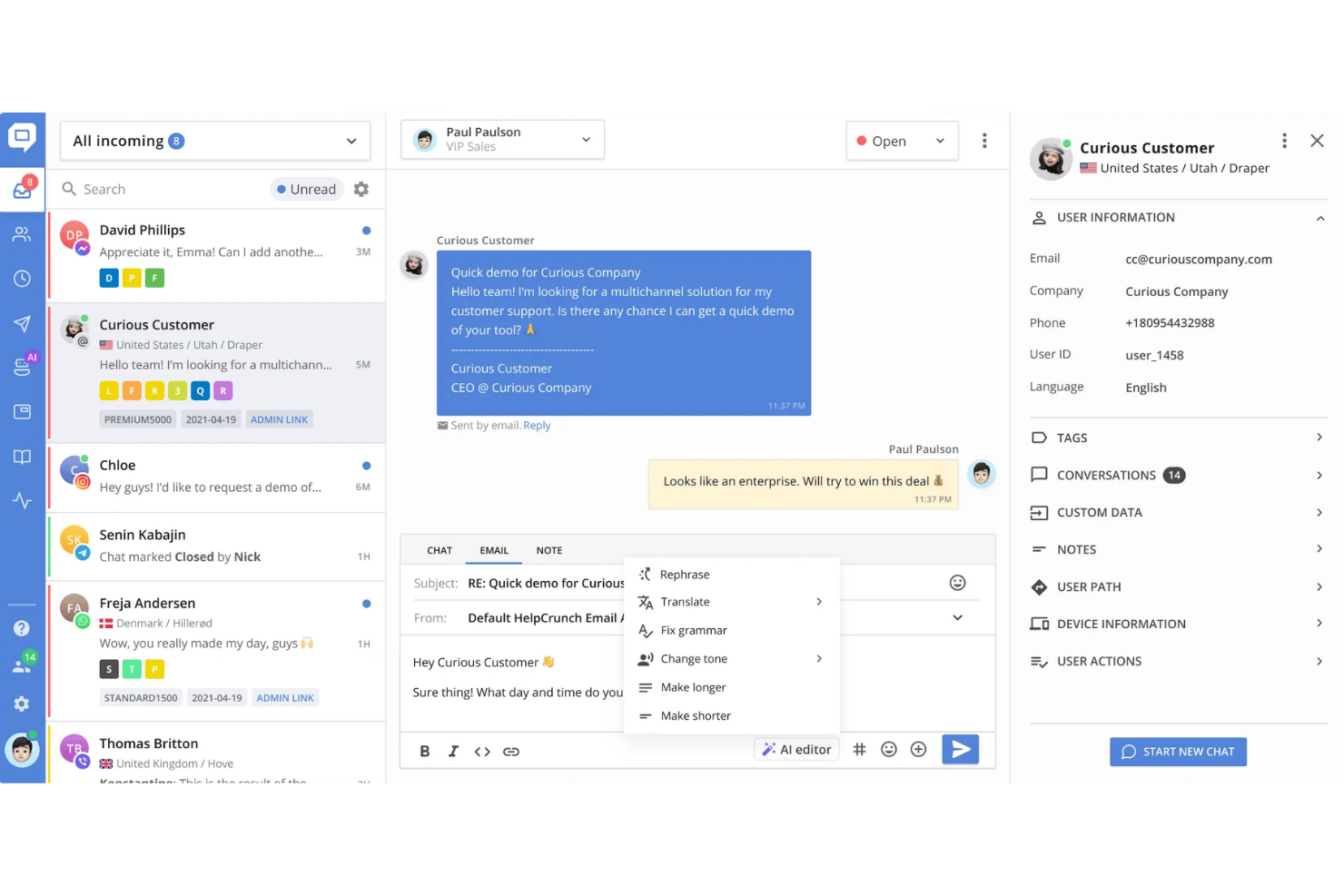
HelpCrunch is a customer communication platform for SaaS teams and growing businesses that want Intercom-level messaging, onboarding automation, and multi-channel support without the enterprise price tag.
Who Is HelpCrunch Best For?
HelpCrunch is a strong fit for small to mid-sized SaaS companies that need to run support, onboarding, and marketing from a single platform.
Why HelpCrunch Is a Good Intercom Alternative
I picked HelpCrunch as one of the best because it nails the two things Intercom is most known for: in-app messaging and onboarding automation. The mobile SDKs for iOS, Android, and React Native let my team trigger contextual messages directly inside the product based on user behavior. Pair that with event-driven email sequences and auto messages, and you get a complete onboarding flow without stitching together separate tools.
HelpCrunch Key Features
- Omnichannel shared inbox: Manage conversations from chat, email, WhatsApp, and social platforms in a unified agent workspace.
- Knowledge base builder: Create and organize branded self-serve help centers with multilingual support and analytics.
- Custom role permissions: Define agent roles, access, and approval flows to support team structure and security.
- Advanced tag automation: Set triggers and rules to auto-tag, assign, or escalate conversations based on message content or sentiment.
HelpCrunch Integrations
HelpCrunch offers native integrations with Slack, HubSpot, Facebook Messenger, Mailchimp, and Zapier. An API is available for custom integrations.
Pros and Cons
Pros:
- Flat per-seat pricing with no MAU-based fees
- Onboarding automation without third-party tools
- Behavior-triggered in-app messaging out of the box
Cons:
- Reporting lacks granular conversation analytics
- AI-powered bot capabilities are limited

Crisp
Best for all-in-one support with co-browsing
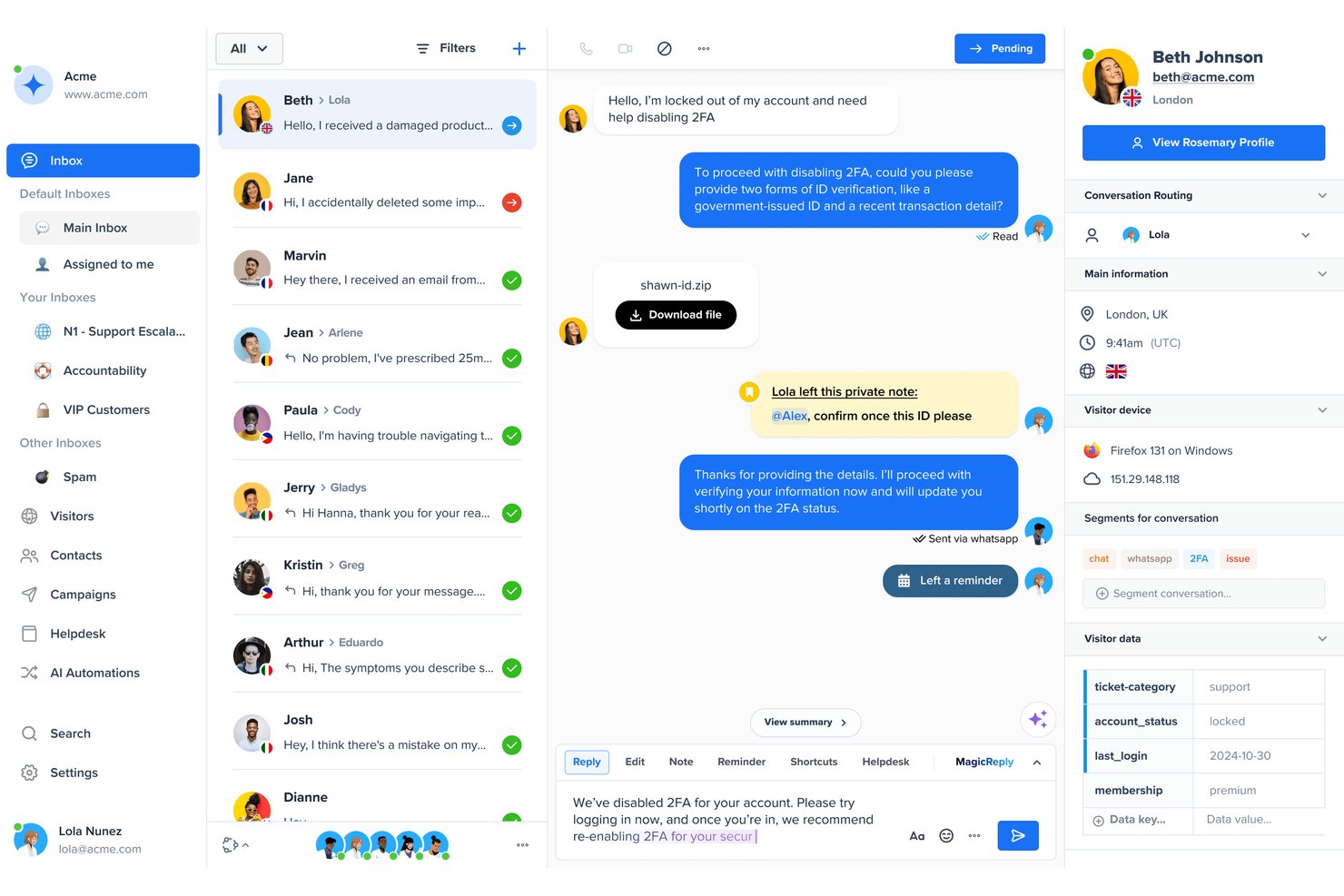
Crisp is an AI-powered customer support platform built for SMBs and growing teams that need omnichannel messaging, chatbot automation, and real-time co-browsing in a single, flat-rate workspace.
Who Is Crisp Best For?
Crisp suits startups and small businesses that need a user-friendly customer communication platform with predictable pricing.
Why Crisp Is a Good Intercom Alternative
I picked Crisp as one of the best because MagicBrowse lets support agents co-browse with a user and take live screen control without any plugin installs on their end. When a user gets stuck mid-flow in your product, I can step in instantly and walk them through it in real time. Paired with Hugo (Crisp's no-code AI agent) and an omnichannel inbox covering WhatsApp, Instagram, email, and SMS, Crisp handles the full support cycle from first message to resolution.
Crisp Key Features
- Shared omnichannel inbox: Route and manage conversations from live chat, email, social channels, SMS, and more in one workspace.
- Internal AI Copilot: Drafts replies, summarizes conversations, and assists agents during live support interactions.
- Knowledge base builder: Create a branded, multilingual help center with advanced search and article feedback options.
- Workflow automation builder: Design visual, no-code chatbot flows and automated triggers for qualifying and routing support inquiries.
Crisp Integrations
Crisp offers native integrations with Slack, HubSpot, WhatsApp, Messenger, Instagram, Shopify, WordPress, Google Analytics, Zapier, and provides an API for custom integrations.
Pros and Cons
Pros:
- Knowledge base supports multilingual article creation
- Hugo AI resolves tier-1 tickets autonomously
- Co-browsing requires no customer-side plugin installs
Cons:
- In-app product tours not natively supported
- Conversation analytics less granular than Intercom's

Kustomer
Best for customizable customer data management
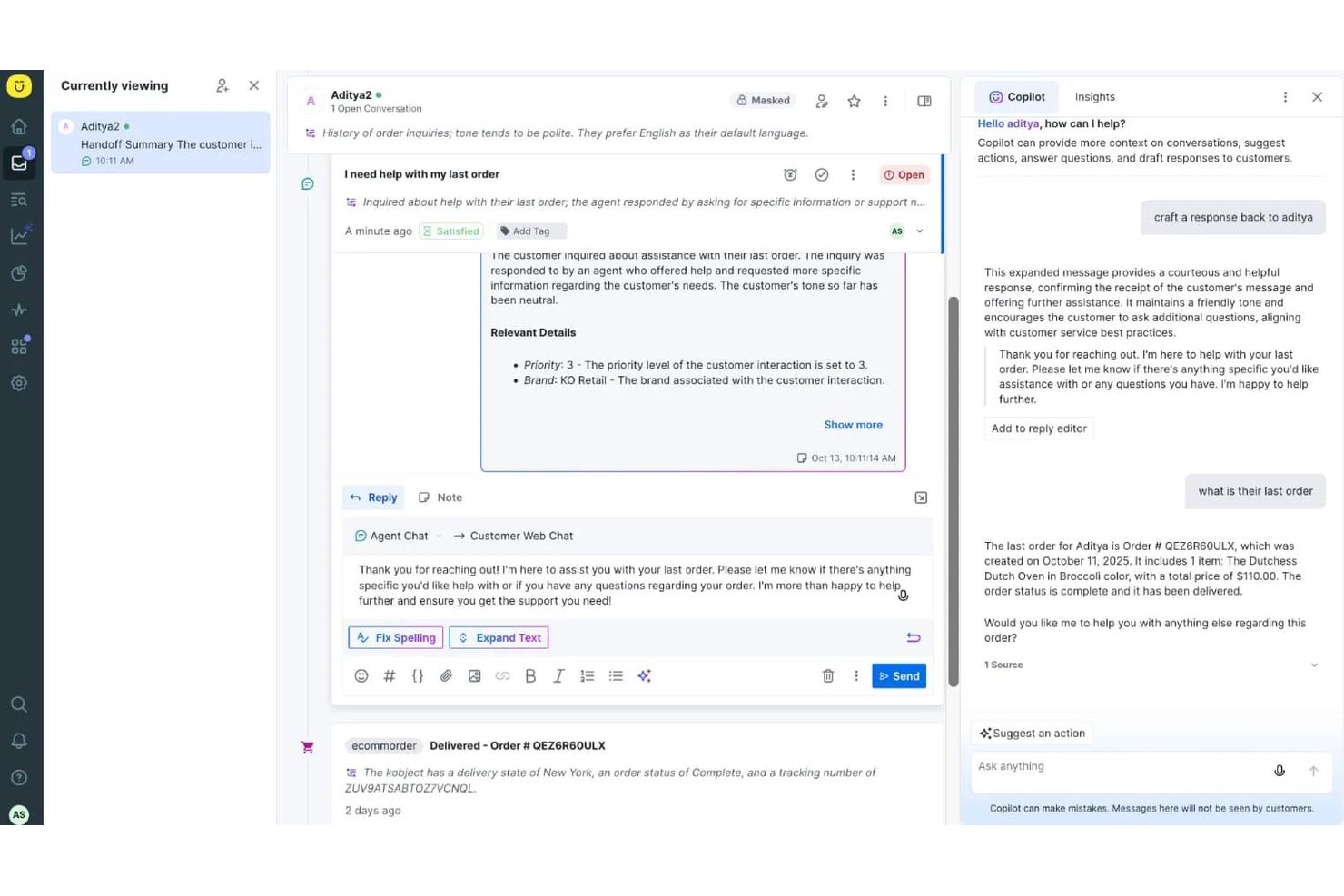
Kustomer is an AI-native customer service CRM that replaces ticket-centric workflows with a unified customer timeline, making it a strong fit for B2C support teams handling high-volume, omnichannel conversations.
Who Is Kustomer Best For?
Kustomer is well-suited to mid-market and enterprise B2C brands in retail, e-commerce, travel, and financial services that need a deeply customizable support platform to manage large volumes of customer interactions across multiple channels.
Why Kustomer Is a Good Intercom Alternative
I picked Kustomer as one of the best because its data model is genuinely unlike anything Intercom offers. Where Intercom organizes work around conversations, Kustomer builds everything around a fully customizable customer record, with custom objects, klasses, and up to 300 attributes per object class. I find this particularly valuable when support agents need instant access to order history, loyalty status, or flight details without switching tabs.
Kustomer Key Features
- Unified omnichannel inbox: Agents manage conversations from email, live chat, SMS, social, and voice in a single threaded workspace.
- AI-powered automation: AI agents and workflow tools autonomously classify, route, and resolve routine tickets across channels.
- Dynamic knowledge base: Teams create internal and customer-facing help centers with multi-language, article feedback, and smart search capabilities.
- Real-time conversation reporting: Supervisors track CSAT, ticket resolution time, and SLA performance with customizable dashboards and filters.
Kustomer Integrations
Kustomer offers native integrations with Salesforce, Shopify, Slack, Jira, Amazon Connect, Facebook Messenger, Instagram, WhatsApp, and Twilio, and provides an API for custom integrations.
Pros and Cons
Pros:
- AI agents autonomously resolve tier-1 tickets
- Unified customer timeline across all channels
- Fully customizable customer data model
Cons:
- No native in-app product tours
- Longer configuration time than most alternatives

Drift
Best for AI-powered conversational marketing
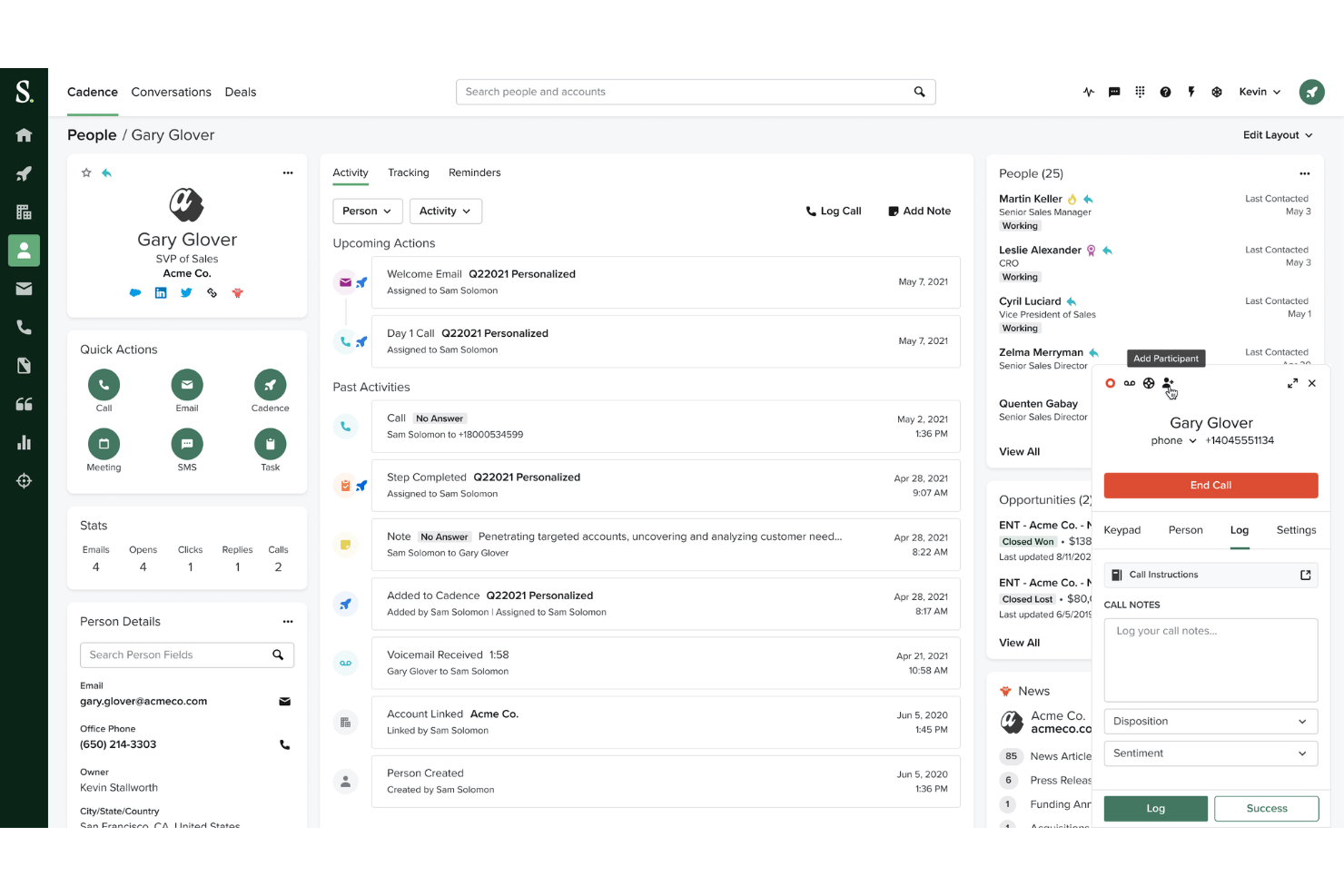
Drift is a conversational marketing platform, now part of Salesloft, built for B2B revenue and marketing teams who want to engage high-intent website visitors, qualify leads through AI chat, and route prospects to sales without manual follow-up.
Who Is Drift Best For?
Drift suits enterprise B2B companies running account-based marketing programs, particularly those already using Salesforce or Salesloft as their core revenue stack.
Why Drift Is a Good Intercom Alternative
I've included Drift in my top picks because its AI-powered chat agents go further than basic live chat, using real-time web activity and CRM data to personalize every visitor interaction before a rep even enters the conversation. Where Intercom routes by broad segment, Drift's ABM targeting identifies specific named accounts by IP and fires tailored playbooks instantly. I also rate its meeting-booking automation highly: a qualified prospect can go from first chat message to a booked calendar slot without any manual rep involvement.
Drift Key Features
- Salesforce integration: Syncs conversations, leads, and activity data directly with Salesforce for real-time sales workflows.
- Shared conversation inbox: Lets sales teams manage, assign, and track website conversations in a central workspace.
- ABM targeting: Identifies and personalizes messaging for named accounts using company IP and CRM data.
- Slack integration: Notifies reps instantly about new high-intent conversations or leads through connected Slack channels.
Drift Integrations
Drift offers native integrations with Salesforce, HubSpot, Marketo, Slack, Microsoft Teams, Google Analytics, 6sense, Clearbit, and Outreach. An API is available for custom integrations.
Pros and Cons
Pros:
- Meeting booking automated from first chat message
- ABM playbooks fire on named account visits
- AI chat agents qualify leads without reps
Cons:
- Built for sales, not customer support teams
- No native help center or knowledge base

Front
Best for collaborative shared inbox for teams
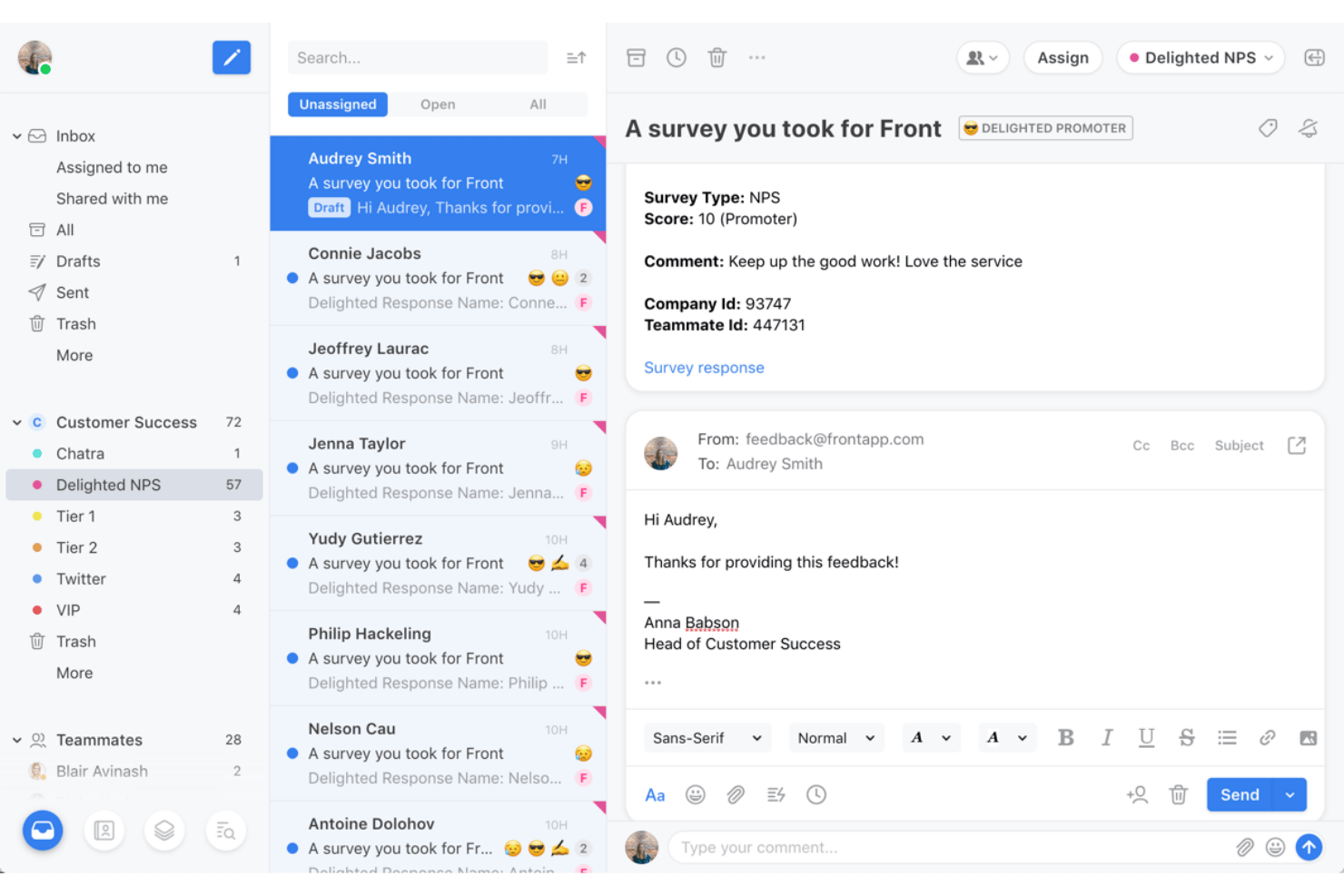
Front is an AI-powered customer operations platform built for CX and support teams who want to manage email, chat, SMS, and social in one shared, collaborative inbox rather than a traditional ticketing system.
Who Is Front Best For?
Front fits mid-sized support and customer success teams that handle high email volume and need visibility, ownership, and coordination across shared mailboxes.
Why Front Is a Good Intercom Alternative
I picked Front as one of the best because its collaborative shared inbox solves a problem Intercom doesn't prioritize: team coordination inside a conversation. I love that collision detection shows me who else is drafting a reply, which prevents duplicate responses from going out. Internal comments let my team discuss context or tone without the customer ever seeing it. Shared drafts take that further, letting us co-write a reply before it sends.
Front Key Features
- Omnichannel inbox: Manage customer conversations from email, SMS, WhatsApp, and social channels all in one shared workspace.
- Workflow automation: Build rules to automatically route, tag, or escalate messages based on keywords or channel.
- Integrated knowledge base: Provide public self-serve help articles and link them inside conversations.
- Granular workspace permissions: Set custom roles, workspace access, and approvals for teams with complex structures.
Front Integrations
Front offers 100+ native integrations, including Salesforce, HubSpot, Jira, Slack, Asana, Shopify, Aircall, Dialpad, Google Drive, and Microsoft Teams. An API is available for custom integrations.
Pros and Cons
Pros:
- Email-native inbox feels familiar to support teams
- Shared drafts enable real-time team co-authoring
- Collision detection prevents duplicate customer replies
Cons:
- Reporting lacks depth for SLA tracking
- Limited in-app messaging and product tour features

Tidio
Best for ecommerce chat automation
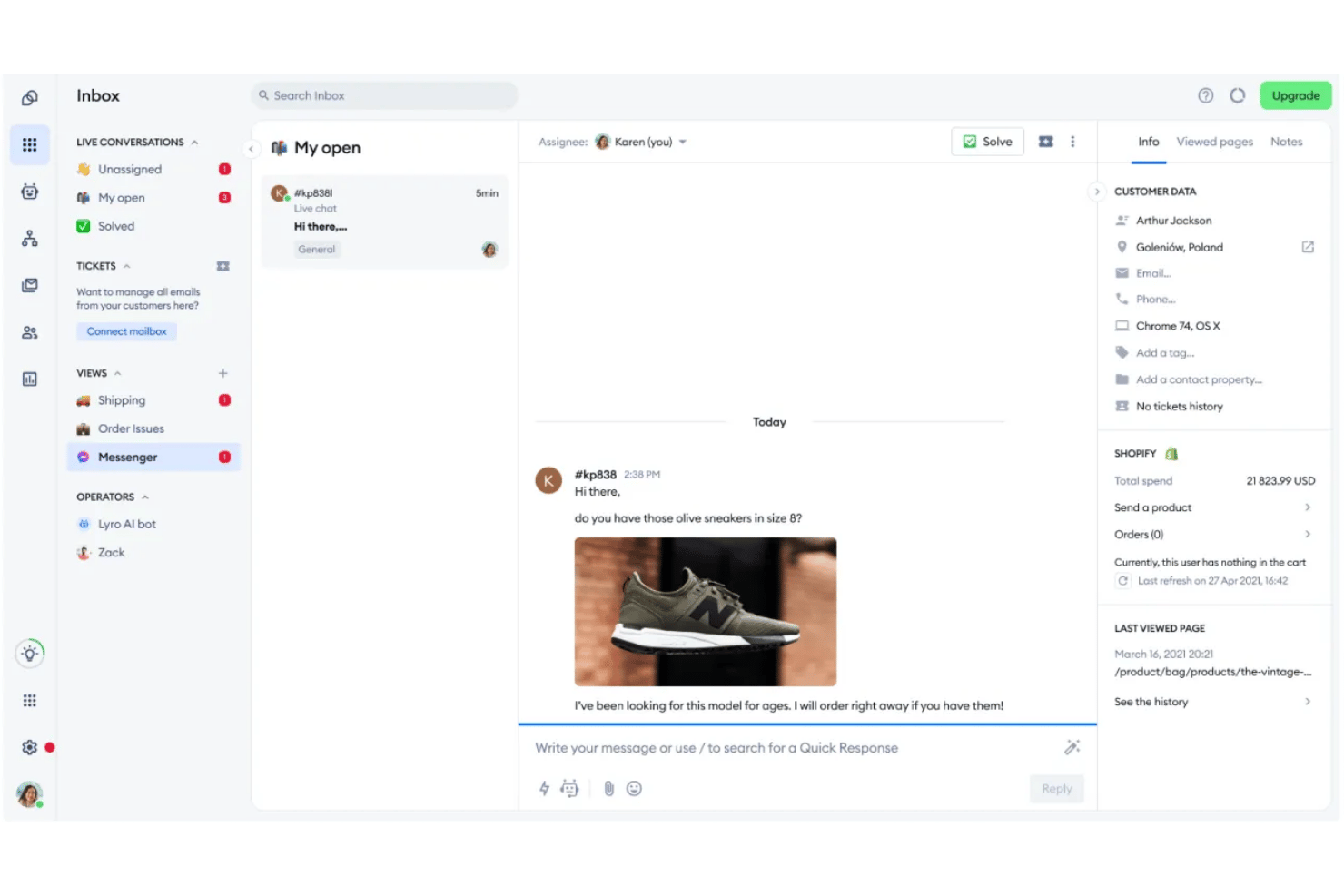
Tidio is a live chat and AI customer support platform built for e-commerce businesses that need to automate support, engage shoppers in real time, and reduce ticket volume without scaling their support team.
Who Is Tidio Best For?
Tidio is a natural fit for small and mid-sized e-commerce teams running Shopify or WooCommerce stores who want AI-powered chat support without enterprise-level complexity or cost.
Why Tidio Is a Good Intercom Alternative
I've included Tidio in my top picks because of how well its Lyro AI Agent and Flows work together for e-commerce support. Lyro handles repetitive questions (shipping, returns, order status) automatically, while Flows lets me set proactive chat triggers based on cart contents or pages viewed. On Shopify, agents can view cart details, issue refunds, and send product recommendations without ever leaving the chat window.
Tidio Key Features
- Unified inbox: Manage live chat, email, Messenger, Instagram, and WhatsApp conversations from a single dashboard.
- Shared team ticketing: Assign, prioritize, and collaborate on customer issues with tagging and internal notes.
- Visitor behavior tracking: See pages viewed, time on site, and browsing history to personalize support interactions.
- Open API and Zapier integrations: Connect Tidio to third-party apps and automate workflows with thousands of tools.
Tidio Integrations
Tidio offers native integrations with Shopify, WooCommerce, WordPress, Messenger, Instagram, WhatsApp, and Google Analytics. It also connects with Zapier and provides an API for custom integrations.
Pros and Cons
Pros:
- Shared inbox consolidates multiple messaging channels
- E-commerce-native chat triggers boost shopper engagement
- Lyro AI resolves tickets without human handoff
Cons:
- In-app messaging limited compared to Intercom
- Reporting lacks depth for enterprise teams

Best for personalized customer email experiences
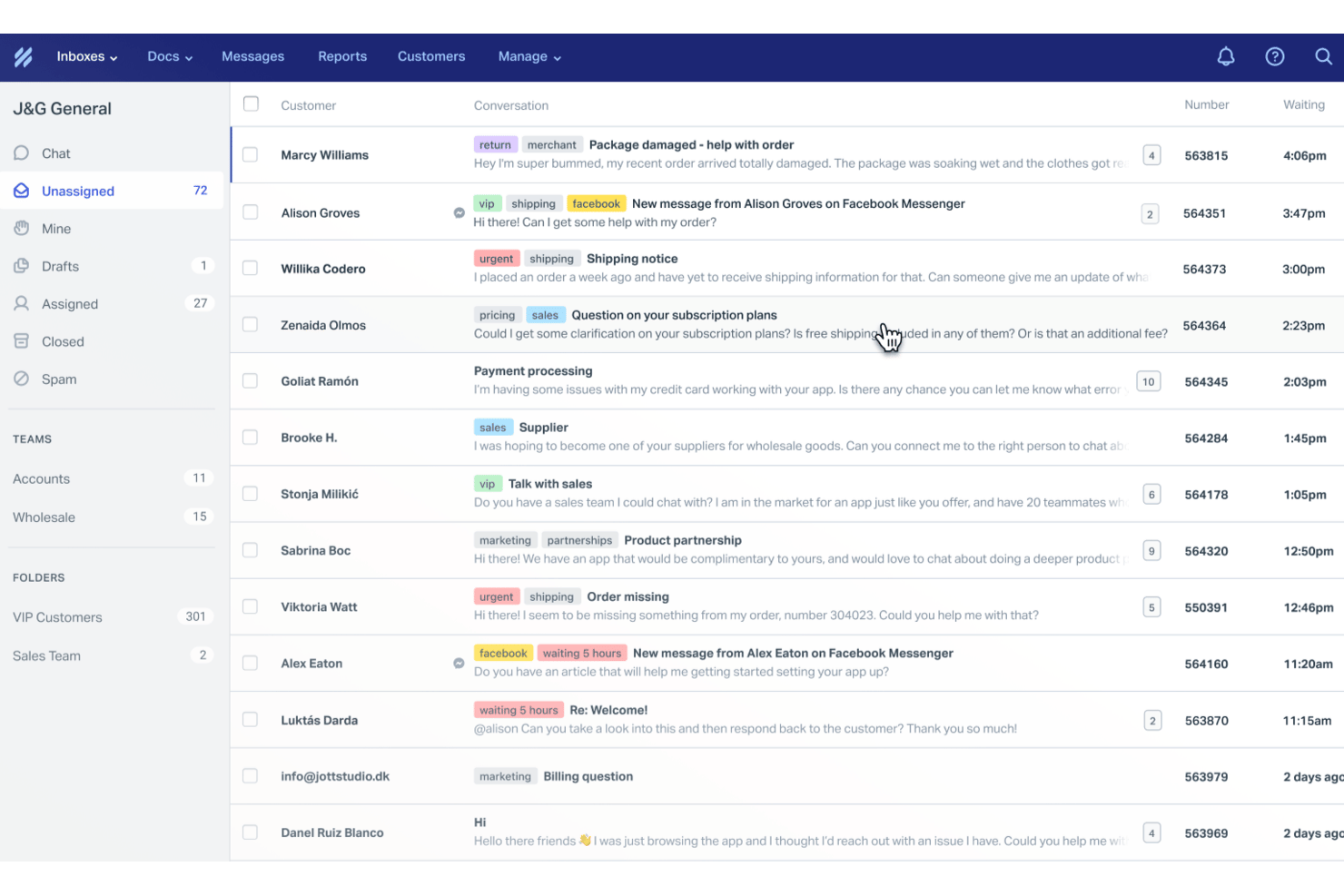
Help Scout is a customer support platform built for small-to-mid-sized teams that want email-first support with live chat and self-service tools—without the complexity or cost of enterprise-level platforms like Intercom.
Who Is Help Scout Best For?
Help Scout is a strong fit for lean support teams at startups and SMBs that handle most customer interactions over email and want a simple, affordable Intercom alternative.
Why Help Scout Is a Good Intercom Alternative
I picked Help Scout as one of the best because its email-first approach genuinely keeps customer conversations personal. Replies look like Gmail threads, not numbered tickets, which changes how customers experience your support. I also appreciate the collision detection feature: it shows when a teammate is already replying, so the same customer never gets two different responses. That kind of quiet coordination is what makes email feel personal at scale.
Help Scout Key Features
- Beacon in-app messenger: Embed live chat, knowledge base, and AI-powered answers directly in your product with a single widget.
- Docs knowledge base: Build and organize branded self-serve help centers with categories, search, and analytics.
- Workflow automation: Use rules to assign, tag, and prioritize incoming conversations automatically for efficient triage.
- Multi-channel inbox: Manage email, chat, and social messages from one place with collision detection and user assignment.
Help Scout Integrations
Help Scout offers native integrations with Slack, HubSpot, Salesforce, Jira, Shopify, Mailchimp, WooCommerce, and Microsoft 365. It also connects with Zapier and provides an API for custom integrations.
Pros and Cons
Pros:
- Collision detection prevents duplicate customer replies
- Beacon surfaces knowledge base inside your product
- Email conversations display as personal threads
Cons:
- Limited user segmentation for outbound campaigns
- No behavior-triggered in-app product tours
New Product Updates from Help Scout

Help Scout Adds Automatic Conversation Reassignment
Help Scout can now automatically unassign conversations when the assigned teammate has been away long enough, keeping replies moving so others can pick them up. For more information, visit Help Scout's official site.
 .
.
Best for modern chat with automation features
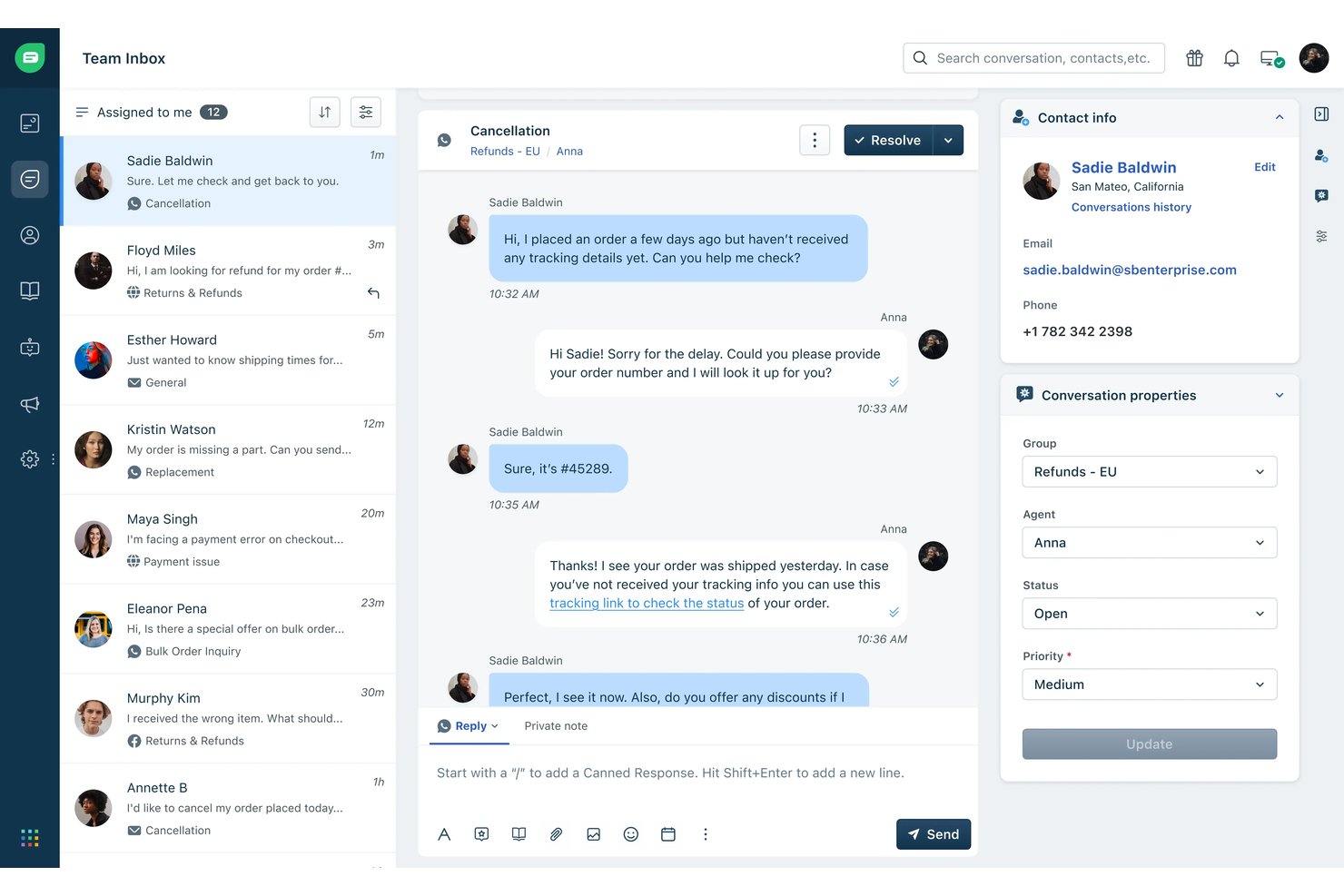
Freshchat is a customer messaging platform that gives support and product teams live chat, AI-powered bots, and a unified inbox across web, mobile, WhatsApp, and email—making it a strong fit for teams that want Intercom-style functionality at a more accessible price point.
Who Is Freshchat Best For?
Freshchat is a natural fit for customer support and CX teams at small to mid-sized businesses that need omnichannel messaging without the cost of enterprise platforms.
Why Freshchat Is a Good Intercom Alternative
I've included Freshchat in my top picks because Freddy AI Agent handles full conversation resolution, not just routing or deflection. I can build bot flows that reference customer properties, trigger based on behavior, and hand off to a human agent mid-conversation without losing context. The automation runs across web, mobile, WhatsApp, and Instagram from a single workflow builder, so I'm not maintaining separate bot logic per channel.
Freshchat Key Features
- Unified inbox across channels: Agents can manage conversations from live chat, email, SMS, WhatsApp, and social DMs in one workspace.
- Behavior-based user segmentation: Create dynamic segments triggered by user properties or actions for more targeted outreach.
- Integrated analytics dashboard: Access real-time reporting on conversation metrics, agent workload, and customer satisfaction scores.
- Multi-language conversation support: Handle customer messages in over 30 languages with automatic translation and language detection.
Freshchat Integrations
Freshchat offers native integrations with Salesforce, HubSpot, Slack, Shopify, Mailchimp, WhatsApp, Facebook Messenger, Google Analytics, Segment, and Jira. An API is available for custom integrations.
Pros and Cons
Pros:
- Built-in CSAT scoring and agent performance reporting
- Bots run natively across WhatsApp and Instagram
- Freddy AI resolves tier-1 tickets autonomously
Cons:
- Limited help center AI search capabilities
- In-app product tours not natively supported

Best for easy multichannel ticket management
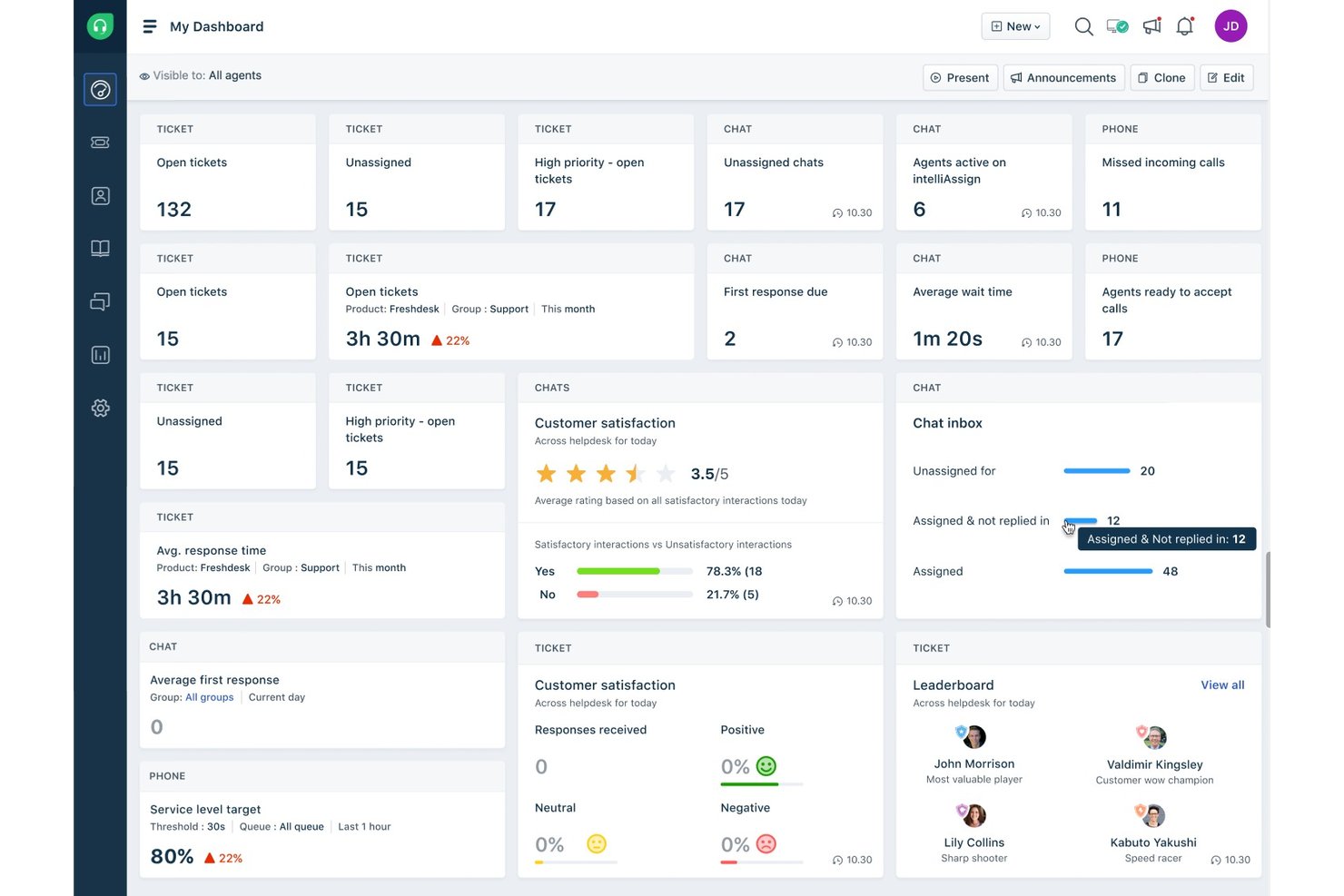
Freshdesk is a customer support platform from Freshworks that helps support teams manage high-volume customer conversations across email, chat, phone, and social from a single shared inbox.
Who Is Freshdesk Best For?
Freshdesk is a strong fit for small to mid-sized support teams that need structured, multichannel ticket management without the complexity of enterprise platforms.
Why Freshdesk Is a Good Intercom Alternative
I picked Freshdesk as one of the best because of how it pulls every customer message into one structured ticket queue. Whether a request comes in via email, WhatsApp, Instagram, or phone, it lands in the shared inbox as a ticket with SLA tracking attached. Freddy AI then handles routing using skill-based or round-robin assignment, so agents never need to manually triage the queue.
Freshdesk Key Features
- Integrated knowledge base: Build self-service articles, FAQs, and community forums with multi-language support and analytics.
- Freddy AI Copilot: Get AI-powered response suggestions, live translation, and conversation summaries for every ticket.
- Custom workflows: Automate repetitive processes using visual workflow design, triggers, and rules without code.
- Marketplace integrations: Connect with over 650 apps including Slack, Shopify, Salesforce, and HubSpot directly from the Freshdesk workspace.
Freshdesk Integrations
Freshdesk offers over 650 marketplace integrations, including Salesforce, HubSpot, Slack, Shopify, Jira, Microsoft Teams, Mailchimp, Zoho CRM, Trello, and Zapier. An API is available for custom integrations.
Pros and Cons
Pros:
- Multichannel inbox covers WhatsApp, email, and social
- SLA tracking on every inbound ticket
- Skill-based routing via Freddy AI
Cons:
- Custom reporting locked behind higher-tier plans
- In-app messaging lacks behavioral trigger depth
New Product Updates from Freshdesk

Freshdesk Adds Voice AI Agents in Freshcaller
Freshdesk introduces Voice AI Agents available through Freshcaller Marketplace apps to handle routine calls and reduce queues. This feature enables automated call handling with real-time, conversational support. For more information, visit Freshdesk's official site.

Zendesk
Best for enterprise-ready omnichannel support
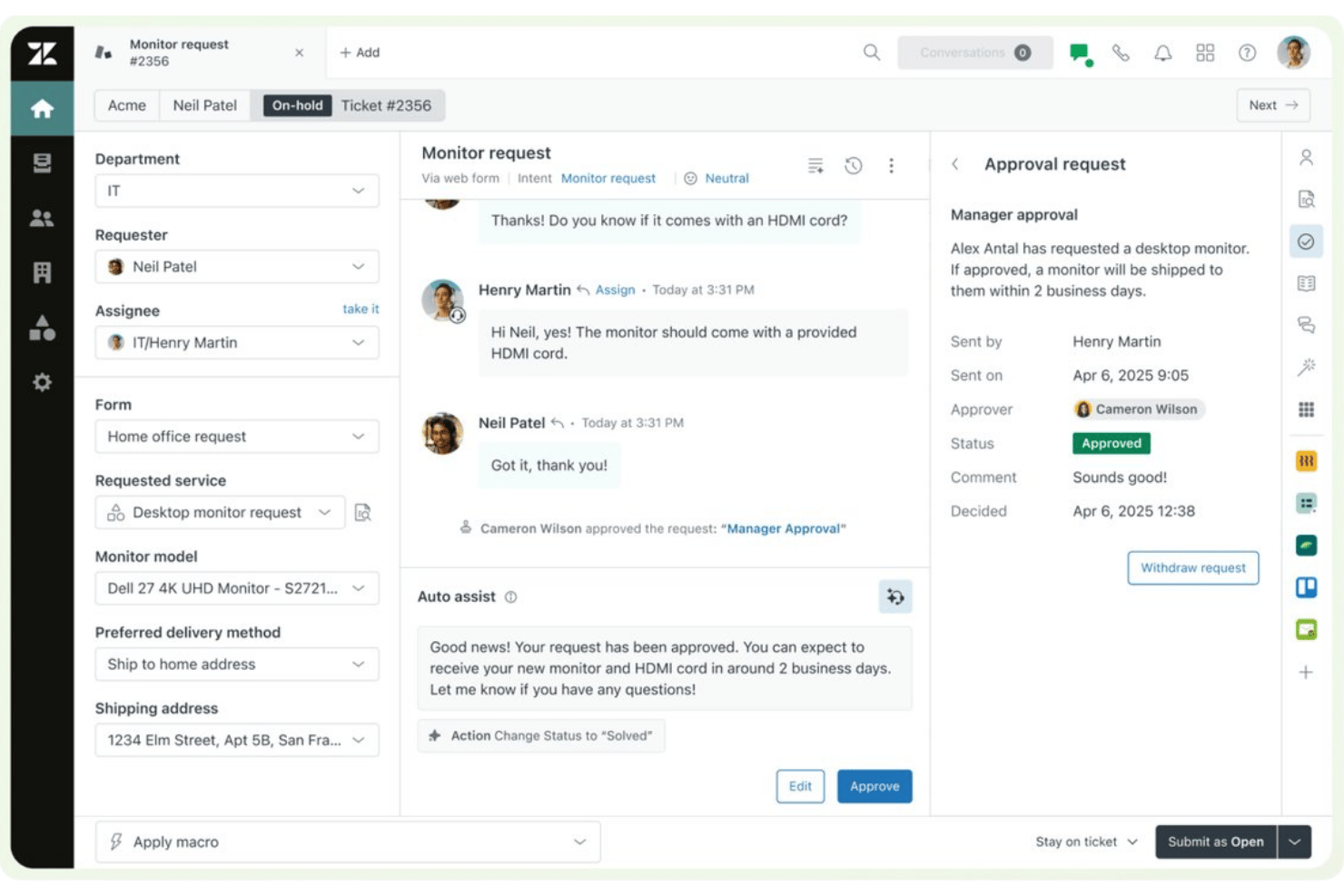
Zendesk is a customer service platform built for support teams that need to manage high volumes of conversations across email, chat, voice, and social—while keeping agents, workflows, and reporting in one place.
Who Is Zendesk Best For?
Zendesk is a strong fit for mid-market and enterprise support teams that need to standardize and scale customer service operations across multiple channels.
Why Zendesk Is a Good Intercom Alternative
I've included Zendesk in my top picks because it handles true omnichannel support in a way Intercom isn't built for at scale. Where Intercom is chat-first, Zendesk unifies email, voice, social, and live chat into a single Agent Workspace, with skills-based routing and SLAs managing traffic intelligently across all channels. The AI Agents can autonomously resolve conversations across 80+ languages, including voice calls with live transcription.
Zendesk Key Features
- AI-powered analytics: Provides predictive insights and granular reporting on CSAT, agent performance, and service levels.
- Integrated knowledge base: Lets teams create branded, multi-language self-serve help centers with article search and categorization.
- Workforce management tools: Offers agent scheduling, capacity forecasting, and built-in quality assurance workflows.
- Flexible marketplace integrations: Supports hundreds of prebuilt integrations for CRM, telephony, collaboration, and e-commerce platforms.
Zendesk Integrations
Zendesk offers native integrations with Salesforce, HubSpot, Jira, Slack, Shopify, WhatsApp, Facebook Messenger, Google Analytics, Mailchimp, and Zoom, and provides an API for custom integrations.
Pros and Cons
Pros:
- AI agents autonomously resolve tier-1 tickets
- Enterprise-grade SLA tracking and compliance controls
- Handles voice, email, social, and chat natively
Cons:
- Initial setup and configuration takes weeks
- Product tour features lag behind Intercom
New Product Updates from Zendesk
Zendesk Updates AutoQA Tone Scoring
Zendesk updates AutoQA tone scoring to focus on professional conduct instead of inferred emotions. This gives QA teams a more concrete basis for evaluating agent responses. For more information, visit Zendesk’s official site.
Other Intercom Alternatives
Here are some additional Intercom alternatives options that didn’t make it onto my shortlist, but are still worth checking out:
- HubSpot Service Hub
For integrated CRM and support workflows
- LiveAgent
For help desk with advanced automation
- Gist
For unified marketing and support
- Userpilot
For behavior-based in-app onboarding
- Appcues
For personalized product adoption
- Pendo
For product analytics and adoption
- Gorgias
For ecommerce support automation
- Userflow
For no-code onboarding flows
- Chatwoot
For open-source customer engagement
- Chameleon
For embedded product guidance


How I Evaluate Intercom Alternatives
I split Intercom alternatives into two layers: core Intercom features a tool must match and differentiators that set platforms apart. I look for live chat, in-app messaging, and ticketing as the baseline, then consider pricing and AI depth.
Core Functionality (Table Stakes for This List)
When I'm selecting tools for my list, I rank each one on a scale from 0 (does not offer the functionality) to 5 (excels in this area) for each core functionality listed below. Then, I calculate the tool's total score into a percentage. Each tool needs to achieve a minimum total score of 75% to be considered for inclusion.
- Live Chat & Messaging: I evaluate whether a platform supports real-time and async conversations across web and mobile, including email continuity for when users leave the app.
- In-App Messaging: I look for targeted messages triggered by user behavior, like showing a tooltip when someone visits a feature page for the third time.
- Help Center/Knowledge Base: A good knowledge base surfaces answers inside chat, so I check for AI-powered search, article categorization, and in-app contextual suggestions.
- Chatbots & Automation: I evaluate bot builders for conditional logic and routing, like qualifying leads before handoff or auto-resolving common billing questions.
- User Segmentation & Targeting: Dynamic segments based on events and attributes matter here, such as targeting users who signed up last week but haven't completed onboarding.
- Shared Inbox & Ticketing: I look for a unified inbox that pulls in conversations from multiple channels with assignment rules, SLAs, and internal collaboration tools.
Once I have a list of tools that meet the criteria, I consider what sets each platform apart.
Differentiating Factors (What Sets Vendors Apart)
Here's how I compare and contrast different vendors:
Standout Features
AI agent autonomy is a major differentiator. I look for platforms where AI can independently resolve tier-1 tickets, like password resets or subscription changes, rather than just routing them to a human. Proactive outbound messaging also matters—behavior-triggered tours or banners during a feature launch can cut inbound volume before it spikes. I evaluate conversation analytics too, checking for CSAT tracking, resolution time breakdowns, and AI deflection rates that help teams measure real support impact.
Beyond Features
I compare per-seat and flat-rate pricing, the availability of a free plan, and the cost of add-ons. Tech stack integrations also weigh heavily—product teams need native connections to tools like Jira, Amplitude, or Segment to keep support data flowing into product decisions. I also consider migration support, specifically whether a vendor offers guided data imports for conversation history, macros, and help center articles to minimize downtime during the switch.
Why Look For an Intercom Alternative?
Intercom combines customer support, customer engagement, and in-app messaging, but it may not suit every team’s budget or workflow. Some businesses need more predictable pricing, stronger ticket management, deeper reporting, or broader support for email, phone, and social media. You might be looking for an Intercom alternative because…
- More transparent and predictable pricing
- Stronger product and analytics integrations
- More configurable automation and AI tools
- More granular roles and permissions
- Better multilingual customer support
- Easier migration of tickets and help content
If any of these sound like you, you’ve come to the right place. My list contains several Best Intercom Alternatives options that are better suited for teams facing these challenges with Intercom and looking for alternative solutions.
Intercom Key Features
Here are some of Intercom’s key features to help you compare it with alternative solutions.
Customer Communication and Engagement
- Live chat and messaging: Engage users in real time through synchronous and asynchronous web and mobile conversations.
- In-app messaging: Deliver targeted banners, tooltips, and popups based on user behavior or attributes.
- Help center knowledge base: Provide self-service articles, FAQs, and AI-powered search within the chat widget or a standalone help center.
- Unified shared inbox: Manage customer conversations from web, mobile app, email, and integrations in one workspace.
- User segmentation and targeting: Create segments based on customer data, product activity, and other attributes.
- Multilingual support: Provide localized messaging, help center content, and automated workflows for a global customer base.
Automation, Analytics, and Integrations
- Chatbots and automation: Use an AI chatbot, customizable bots, and routing workflows to qualify leads and resolve support tickets.
- Proactive outbound campaigns: Send email marketing sequences, push notifications, and banners based on lifecycle events.
- Team performance analytics: Track customer satisfaction, response time, support quality, and agent activity through dashboards and custom reports.
- API and integrations: Connect Intercom with CRMs, analytics platforms, collaboration tools, and other add-ons through its API and marketplace.
- AI features: Assist support agents with suggested responses, conversation summaries, and repetitive tasks across customer interactions.