
10 Best Free Product Management Software I’ve Tried In 2026

Best Free Product Management Software Shortlist


With so many different free product management software available, figuring out which is right for you is tough. You need all of the essential features for roadmap planning, task management, documentation, team collaboration, and integration with other tools, but you still have to stick to a limited budget. I've got you! In this post I'll help make your choice easy, sharing my personal experiences using multiple free tools with larger teams and dozens of product launches on a tight budget, with my picks of the best free product management software.
What is free product management software?
Free product management software is a type of tool that helps teams to plan, organize, and optimize the product development process.
Free product management software will offer limitations in its features unless you are dealing with open-source software. Expect limitations in the level of customer support, the number of products you can build roadmaps for, users who can access the software, and available integrations. Most of the tools on this list offer the ability to join for free, and then upgrade to a paid plan as your needs change or your team grows.
Why Trust Our Software Reviews
We’ve been testing and reviewing product management software since 2020. As product managers ourselves, we know how critical and difficult it is to make the right decision when selecting software.
We invest in deep research to help our audience make better software purchasing decisions. We’ve tested more than 2,000 tools for different product management use cases and written over 1,000 comprehensive software reviews. Learn how we stay transparent & our software review methodology.
Best Free Product Management Software Comparison Chart
Here is a table where you can compare all the tools we just covered in the overviews.
| Tool | Best For | Trial Info | Price | ||
|---|---|---|---|---|---|
| 1 | Best for customizable work management | 14-day free trial + free plan available | From $10/user/month (billed annually) | Website | |
| 2 | Best for seamless collaboration and visualization | Free plan available | From $8/user/month (billed annually) | Website | |
| 3 | Best for collaborative brainstorming | Free plan available | From $16/user/month | Website | |
| 4 | Best free product management software for startups | Free plan available | From $4/user/month (billed annually) | Website | |
| 5 | Best product management software for integrations | Free trial + free plan + free demo available | From $10/doc maker/month (billed annually) | Website | |
| 6 | Best no-code, open-source database platform | Free trial + free plan available | From $10/user/month (billed annually) | Website | |
| 7 | Best product issue and bug tracking | 30-day free trial and free plan available | From $35/month | Website | |
| 8 | Best free product management software for collaboration | Free plan available | From $10.99/user/month (billed annually) | Website | |
| 9 | Best for software development teams | 7-day free trial | From $8.15/user/month (billed annually) | Website | |
| 10 | Best project template library | Free trial + free plan available | From $5.42/user/month | Website |


Overviews of the Best Free Product Management Software
Here’s a brief description of the best software and free version of paid tools that can help you get started.

Wrike
Best for customizable work management

Wrike is a project and product management software designed to cater to the needs of different teams and industries through its customizable work management platform. It provides a variety of features that allow users to tailor their workspace, automate workflows, and integrate with over 400 apps, positioning it as a versatile solution for managing work processes.
I chose this platform for its robust customization capabilities, which allow it to adapt to a variety of project needs and user preferences. What makes it different is its user-friendliness coupled with how comprehensive of a solution it is. It's easy to use without sacrificing features or functionalities. You can easily switch between Kanban boards, drag-and-drop Gantt charts, and traditional workload views. This lets product teams choose how to view their work. You can also break down tasks with task lists, subtasks, task dependencies, shared workflows, file sharing, and real-time collaboration.
A free plan is available and a free trial is offered for premium plans.
New Product Updates from Wrike

Wrike AI Agents Create Full Blueprints and Formatted Items
Wrike’s AI Agent can now create full blueprints (parent items plus subtasks) in one step and generate richer, formatted descriptions. This makes automated workflow creation more complete. For more information, visit Wrike’s official site.

Miro
Best for seamless collaboration and visualization

Miro is a digital whiteboard platform that caters to teams focused on collaboration and brainstorming within product management. It's particularly suited for remote teams, offering a space where ideas can be expressed through various formats like sticky notes, diagrams, numbers, images, and videos. Its infinite canvas removes the limitations of physical space, allowing for continuous expansion of ideas.
Integration with tools like Confluence, Notion, Jira, and Asana ensures a cohesive workflow, linking essential resources and tools directly within the platform. Miro also supports asynchronous teamwork through comments, reactions, and TalkTrack, a feature that lets team members record explanations of process maps or project details. This combination of visual freedom, tool integration, and communication features positions Miro as a platform for teams to collaboratively manage product development tasks.
New Product Updates from Miro
Miro Adds Japan Data Residency for Enterprise Customers
Miro has introduced Japan data residency for enterprise customers, offering in-region storage for production data, backups, and metadata, plus in-region compute infrastructure. For more information, visit Miro's official site.

FigJam
Best for collaborative brainstorming

FigJam by Figma is an online whiteboard tool designed to support team collaboration, allowing for strategic planning and brainstorming in a shared digital space. It stands out due to its real-time collaboration capabilities, customizable features, and seamless integration with Figma, positioning it as a comprehensive whiteboard solution for teams that require a closely integrated environment for their design and planning workflows.
What I find compelling about FigJam is its ability to bring together teammates, ideas, and tools in one place, facilitating real-time collaboration with features like audio calls and voiceovers. This makes it an ideal tool for product management, where communication and the alignment of various moving parts are crucial. Plus, the availability of free templates for different workflows, including Agile and remote design, positions FigJam as a versatile tool for various project management scenarios.

Taskade
Best free product management software for startups

Taskade is a free product management tool that works with iOS, Android, macOS, Windows, Linux, and all popular internet browsers. The tool can help users do everything from mind mapping to meeting planning. Their versatility is something all startups need.
Taskade also has a whole host of startup-oriented literature and information, including an ideas checklist, reading list, business pitch ideas, investor wishlist trackers, cofounder questionnaire, and more.

Coda
Best product management software for integrations

Coda is a product management tool used by the likes of product titans like The New York Times, Doordash, Spotify, and Uber. They specifically champion all-in-one documents for all of your product data and planning.
Coda offers a RESTful API with which savvy programmers can connect to third-party apps of their making or choosing. Additionally, they boast a full connection with Zapier (paid plan required) to integrate with over 200 apps and tools.

Baserow
Best no-code, open-source database platform
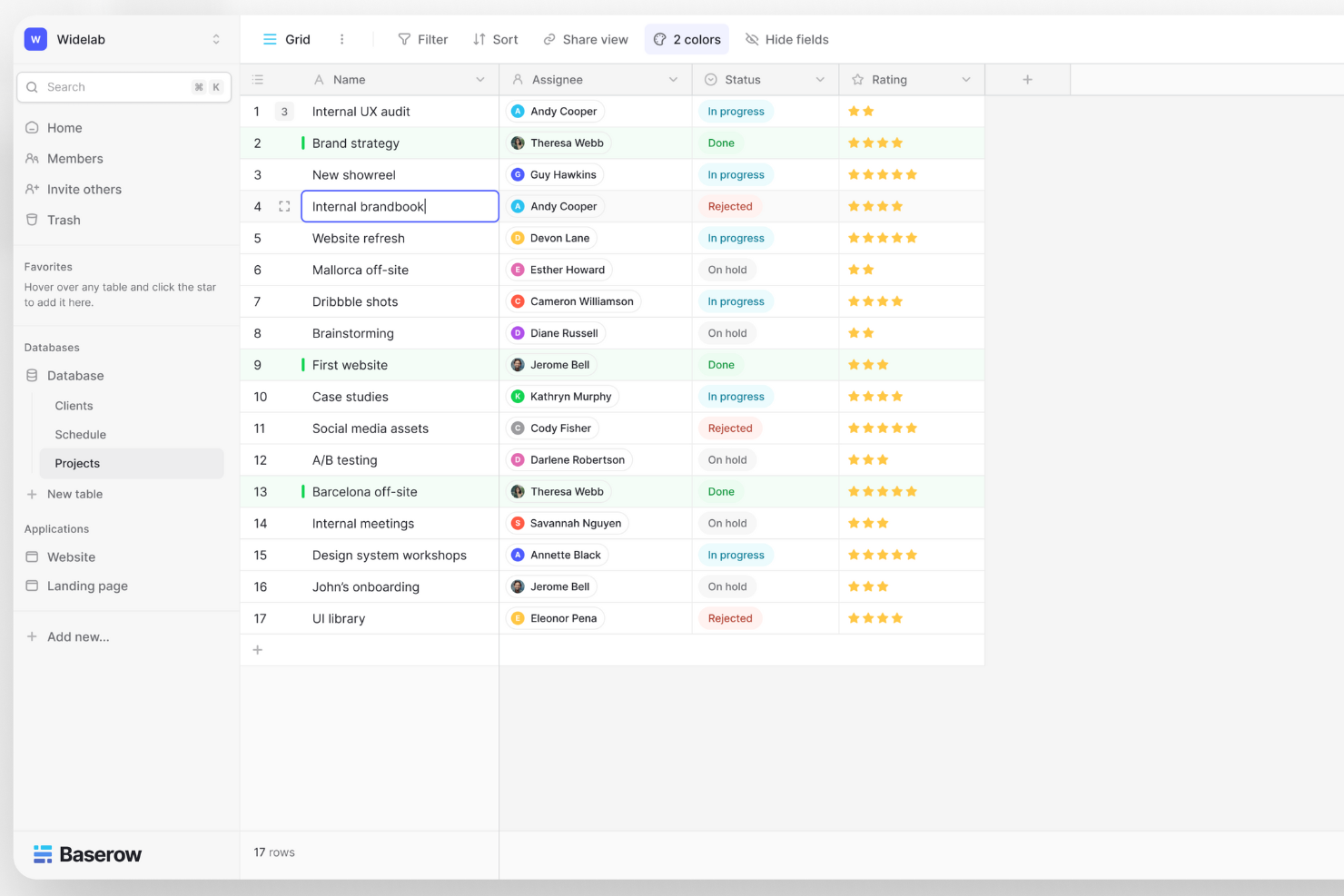
Baserow is a no-code platform designed to bring structure and clarity to various projects, ideas, or business processes. It is particularly useful for those who find themselves juggling multiple tools for a single job. The platform is user-friendly, especially for those familiar with spreadsheets, as it employs a similar operational style. Baserow allows users to manage diverse data sets, ranging from customer databases to product inventories and even airplane fleets, providing a versatile tool for organizing and streamlining information.
The software is highly flexible, tailored to meet the specific needs of its users. It offers a single interface for managing different types of data, ensuring that information is clear and accessible to all team members. Baserow stands out for its real-time collaboration capabilities, allowing unlimited rows and boasting impressive speed. Additionally, it can be easily integrated with other software, enhancing its utility and adaptability in various business environments.
Baserow positions itself as an open-source, no-code database and a viable alternative to platforms like Airtable. It empowers users with developer-like capabilities without the need to leave the browser, making it an accessible tool for a wide range of users. Its open-source nature not only fosters a community-driven development approach but also ensures transparency and flexibility in its usage and customization.
Backlog
Best product issue and bug tracking

Backlog bills itself as a project and code management platform but, really, it handles a lot of product management needs very well. Highlight-worthy features include boards, Gantt charts, burndown charts, Git graphs, milestones, and versions.
Backlog does issue and bug tracking particularly well. For example, users can create Backlog issues in bulk via their native Google Sheets integration.
They also encourage tracking progress via pull-requests right from issue cards.
Asana
Best free product management software for collaboration

Asana is more of a general project management tool than a dedicated product development app. However, it boasts a whole range of features that product managers and their teams will find useful.
In particular, users can tap into their product roadmap templates, simplify sprint planning, and collect user feedback pre- and post-launch.
They make collaboration particularly engaging with social-media-esque messaging, easy file uploading, and flexible notifications.

Jira
Best for software development teams

Jira bills itself as the #1 software development tool used by agile teams—and for good reason. They boast features for user stories and tracking issues, distributing tasks, and smart data visualization.
They offer out-of-the-box workflows or fully customizable solutions for product planning, shipping, and iteration.
They can also help software product devs to boost their CI/CD with robust pipelines and monitor build status. Jira integrates with thousands of other apps.

Confluence
Best project template library

Confluence is an intuitive team workspace with a flare for keen product management. Product teams will, for example, enjoy their take on actionable meeting notes and collaborative content management.
Confluence has a library of templates to assist with product planning.
Browse through dozens of template options like product requirements, marketing plans, email drip campaigns, incident communication, competitive analysis, and product requirements.
Other Free Product Management Software Options
Here are a few more that didn’t make the top list but are worth your consideration.
- ProdPad
For outcome-driven roadmaps
- Bitrix24
CRM dashboards
- Visor
Free product management software for Jira users
- Odoo
Free open source product management software
- LoopedIn
To collect product feedback from your audience
- monday AI Workspace
With AI-powered project planning
- PathPro
For community-driven development
- ClickUp
(free 100MB storage) — Best mobile apps
- Zenhub
(free on public, academic, or open-source repositories) — Best Kanban boards
- Zoho Desk
(free 3 users) — Best workflow automation
- Zepel
(free 5 users) — Best Jira alternative
- Qualtrics CoreXM
(1 product survey, 100 responses max) — Best product survey tool
- Indicative
(free 3 users) — Best customer analytics
- Pivotal Tracker
(free 5 projects) — Best guided iteration planning
- Yodiz
(free 3 users) — Best product backlog analytics
- Roadmap
Visual product roadmaps
- Meister Task
(free for 3 projects) — Best product strategy mind mapping


How I Evaluate Free Product Management Software
I evaluate free PM tools on two levels: whether a tool's free tier supports real PM work—roadmaps, backlogs, prioritization—and the differentiators that make one tool the right fit over another.
Core Functionality (Table Stakes For This List)
When I'm selecting tools for my list, I rank each one on a scale from 0 (does not offer the functionality) to 5 (excels in this area) for each core functionality listed below. Then, I calculate the tool's total score into a percentage. Each tool needs to achieve a minimum total score of 65% to be considered for inclusion.
- Roadmap Planning: I look for visual roadmap views—timelines, Kanban boards, swimlanes—that let a PM map out quarterly initiatives and share them with leadership.
- Backlog & Feature Management: A structured backlog where you can log feature ideas, tag them by theme, and track status matters more than a basic to-do list.
- Prioritization Frameworks: I check whether the tool supports scoring models like RICE or value-vs-effort matrices instead of relying solely on manual drag-and-drop ordering.
- Free Plan Availability: The free tier needs to support real PM workflows—not just a 14-day trial—so a solo PM or small startup can use it as their daily driver.
- Collaboration & Sharing: I evaluate how teams interact inside the tool: commenting, mentions, shared views, and whether stakeholders can access roadmaps without a paid seat.
- Dev & Work Tool Integrations: Connecting to tools like Jira, GitHub, or Slack on the free plan matters because PMs rarely work in isolation from engineering and design.
Once I have a list of tools that meet this criteria, I consider what sets each platform apart.
Differentiating Factors (What Sets Vendors Apart)
Here's how I compare and contrast different vendors:
Standout Features
Public roadmap portals are a big differentiator for startup founders who want to share what's shipping next with early adopters and collect upvotes on planned features. I also look for built-in feedback capture that links requests directly to backlog items—this saves a PM from manually copying support messages into a spreadsheet. AI-assisted workflows are worth evaluating too, especially for solo PMs who need help drafting user stories or summarizing a backlog full of feedback into actionable themes.
Beyond Features
Free plan generosity matters a lot here. I check how many users, projects, and integrations you actually get before hitting a paywall—some tools gate roadmap views or prioritization behind paid tiers, which defeats the purpose. Team size and stage fit is another factor I weigh. A solo PM evaluating tools needs something lightweight, while a five-person startup team needs room to grow without migrating to a new platform six months later. Data export options also factor in, especially for teams treating a free tool as a stepping stone—you want CSV or API access to pull your backlog out cleanly if you switch.
Free Product Management Software FAQs
Find answers to common questions other people ask about this topic.
Why are product management tools important?
Product management tools help teams structure their product strategy. Within these solutions you can house all the tools, documents, and presentations pertaining to product information. Free production manager software provides a single repository to house all of this up-to-date information, without having to pay a monthly or annual fee.
How is free product management software used in small businesses?
Small businesses have small teams. Workloads can easily become overwhelming as a company grows, without dedicated team members to complete each task. Free team management tools help small businesses organize the myriad tasks involved in the product development life cycle, including timelines, customer analytics, and strategy.
In addition to these tools, we suggest checking out these free product management resources to help your small team achieve more in less time!
What are the benefits of free product management software?
Product management software ensures that development teams are making strategic decisions and optimizing task completion times. These tools help development teams to understand and remain up to date on customer needs, and to use real-time data to improve the contribution of product lines.
What is the difference between product management software and project management software?
Product management software helps product managers and their teams to develop, organize, and communicate the product strategy throughout the product life cycle. Project management software helps project managers and their teams track the execution of a product strategy.
What are some open source product management tools?
As listed above, Odoo is a great option for open source product management software. However, it’s not the only one. Here are some open source product management apps you can pick from:
- Akeneo PIM Software (Paid)
- StrikeTru (Paid)
- OpenProject (Free Community Edition)
- OpenPLM (Free)
Can I integrate free product management software with other tools we use?
Integration capabilities in free product management software may vary. While the free versions generally support basic integrations, it’s essential to assess whether they align with your team’s specific needs. Look for compatibility with tools crucial to your workflow, such as version control systems (e.g., Git), communication platforms (e.g., Slack), or document sharing services (e.g., Google Drive). Some free versions might have limitations on the number or types of integrations available, so it’s crucial to verify that the software can seamlessly work with your existing toolset. This ensures a smoother and more efficient workflow for your team.
If advanced integrations are critical to your processes, you may need to consider whether upgrading to a paid plan offers more comprehensive integration options.
What's Next?
Learn about the product life cycle management stages and 15 product feature prioritization frameworks that can help you become more proficient in product management. However, if you are looking for something more advanced, we have a great article on product strategy where we highlight 5 key elements of a product development strategy you cannot miss.
Related tool lists:
- Best Product Roadmap Software
- Free product analytics tools
- Rapid prototyping tools
- Free user onboarding software
To stay in-the-know with product management thought leadership, be sure to sign up for The CPO Club newsletter.