

Las herramientas de pruebas A/B con IA utilizan la inteligencia artificial para automatizar el diseño de experimentos, analizar resultados y optimizar experiencias digitales más rápido que los métodos manuales. Si buscas formas de mejorar las tasas de conversión, reducir las conjeturas y tomar decisiones más inteligentes con tu sitio web o producto, estas herramientas pueden ayudar a tu equipo a realizar más experimentos con menos esfuerzo. En esta lista encontrarás plataformas de pruebas A/B con IA de confianza que abordan desafíos comunes, como los recursos limitados, el análisis lento y la necesidad de obtener información práctica, para que puedas elegir la solución adecuada para los objetivos de tu empresa.
Por qué confiar en nuestras recomendaciones de software
6,700+
Reviews
20
Industry experts
16+
Evaluation factors
14
Years
Nuestro equipo lleva probando y evaluando software desde 2012. Como gestores de producto, sabemos lo difícil —y lo importante— que es elegir el software adecuado.
Para esta guía, evaluamos las herramientas mediante pruebas prácticas e investigación independiente, puntuando las herramientas según nuestros criterios de selección.
Nuestras reseñas reflejan nuestro criterio editorial humano, no un discurso de ventas.
Revisores expertos:
 Hannah ClarkSenior TPM
- Cristiano ValimSenior UI/UX Lead

Tabla comparativa de herramientas de pruebas A/B con IA
Esta tabla comparativa resume los detalles de precios de mi selección de las mejores herramientas de pruebas A/B con IA:
| Tool | Best For | Trial Info | Price | ||
|---|---|---|---|---|---|
| 1 | La mejor opción con segmentación conductual en tiempo real | Prueba gratuita de 30 días | Desde $495/mes | Website | |
| 2 | Ideal para la colaboración de equipos de marketing | Demostración gratuita disponible | Precios bajo solicitud | Website | |
| 3 | La mejor opción para la experimentación con indicadores de funciones | Plan gratuito + prueba gratuita de 14 días + demostración gratuita disponible | Desde $10/mes (facturado anualmente) | Website | |
| 4 | Ideal para controles empresariales de gobernanza de experimentos | Demostración gratuita disponible | Precios bajo solicitud | Website | |
| 5 | Ideal para flujos de trabajo de experimentación liderados por desarrolladores | Plan gratuito disponible | Desde $250/mes | Website | |
| 6 | Ideal para personalización omnicanal | Demo gratuita disponible | Precios a consultar | Website | |
| 7 | Ideal para analizar rápidamente las implementaciones de funcionalidades | Plan gratuito disponible | Desde $150/mes | Website | |
| 8 | Ideal para pruebas de código abierto nativas del almacén de datos | Plan gratuito + demostración gratuita disponible | Desde 40 $/usuario/mes | Website | |
| 9 | La mejor opción para la personalización bayesiana a escala empresarial | Demostración gratuita disponible | Precio bajo solicitud | Website | |
| 10 | Plan gratuito disponible | Precio bajo solicitud | Website |


Reseñas de herramientas de pruebas A/B con IA
A continuación se muestran mis resúmenes detallados de las mejores herramientas de pruebas A/B con IA que llegaron a mi lista de selección. Mis reseñas ofrecen un análisis detallado de las funciones, los mejores casos de uso y las integraciones de cada plataforma para ayudarte a encontrar la mejor opción para ti.
 La mejor opción con segmentación conductual en tiempo real
- Prueba gratuita de 30 días
- Desde $495/mes
Visit WebsiteCustomer Rating:4.7/5This rating combines scores from multiple user review sites to reflect overall customer sentiment about the product.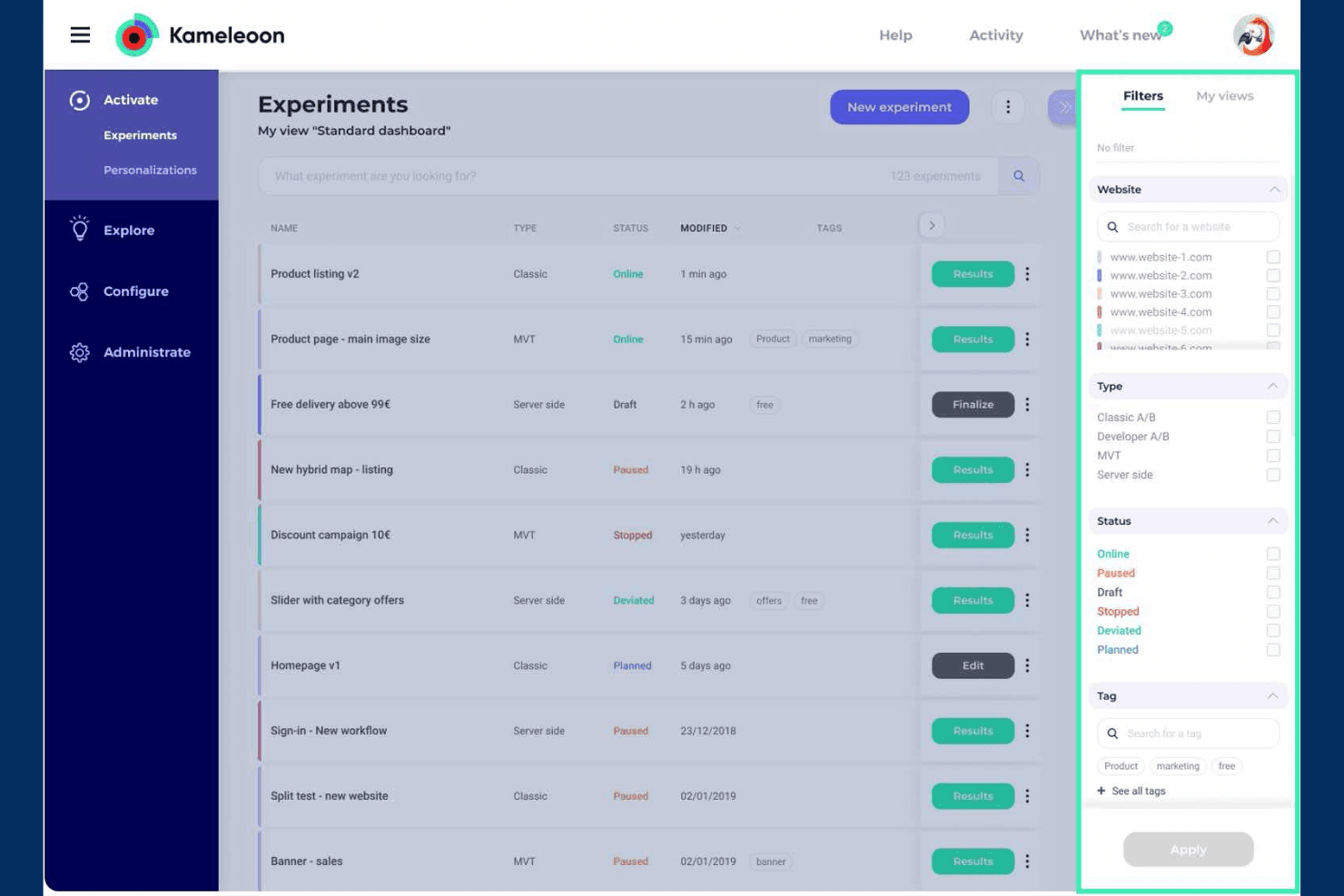
Kameleoon ayuda a los equipos a realizar pruebas A/B y personalizar las experiencias digitales. Kameleoon es una plataforma de pruebas A/B y experimentación impulsada por IA que admite pruebas web, móviles, del lado del servidor y de indicadores de funcionalidades, además de segmentación conductual en tiempo real, personalización y creación de variantes mediante indicaciones.
¿Para quién es más adecuado Kameleoon?
Kameleoon es una opción muy adecuada para especialistas en CRO y equipos de producto de empresas medianas y grandes que necesitan una segmentación conductual avanzada junto con un conjunto completo de herramientas de experimentación.
Por qué elegí Kameleoon
Kameleoon está en mi lista de favoritos por la forma en que su modelo de segmentación mediante IA gestiona los datos conductuales en tiempo real. Asigna a cada visitante una puntuación basada en la probabilidad de conversión, que se vuelve a entrenar cada 10 minutos, y agrupa las sesiones activas en segmentos dinámicos en lugar de depender de reglas estáticas. También me gusta la detección de oportunidades mediante IA, que identifica subsegmentos con un alto nivel de confianza cuando el resultado de una prueba no es concluyente, para que no te quedes sin conclusiones tras un experimento sin resultados.
Características principales de Kameleoon
- Constructor de experimentos mediante indicaciones: Describe un cambio en lenguaje sencillo y la IA de Kameleoon crea la variante directamente en tu sitio activo, para ordenadores de escritorio, tabletas y móviles.
- Compatibilidad con SDK multiplataforma: Implementa experimentos en la web, iOS, Android, Flutter, React Native, entornos del lado del servidor y entornos periféricos desde una única plataforma compartida.
- Experimentación con indicadores de funcionalidades: Realiza implementaciones progresivas con reversión automática basada en indicadores clave de rendimiento, flujos de aprobación, registros de auditoría y entornos ilimitados.
- Reducción de la varianza mediante CUPED: Aplica CUPED junto con métodos estadísticos frecuentistas y bayesianos, pruebas secuenciales y detección de SRM para obtener resultados más fiables con mayor rapidez.
Integraciones de Kameleoon
Kameleoon ofrece más de 100 integraciones, entre ellas Google Analytics, Adobe Analytics, Amplitude, Contentsquare, Snowflake, Segment, Datadog, Jira y Figma. También ofrece API de JavaScript, datos y automatización para integraciones personalizadas, además de Zapier.
Pros and Cons
Pros:
- La segmentación conductual en tiempo real se adapta a la intención del visitante
- PBX genera y crea variantes de prueba
- CUPED mejora la confianza en los resultados de los experimentos
Cons:
- Los desarrolladores siguen siendo necesarios para implementaciones avanzadas
- La segmentación mediante IA requiere un volumen de tráfico y un historial considerables
Learn more about Kameleoon: Ideal para la colaboración de equipos de marketing
- Demostración gratuita disponible
- Precios bajo solicitud
Visit WebsiteCustomer Rating:4.5/5This rating combines scores from multiple user review sites to reflect overall customer sentiment about the product.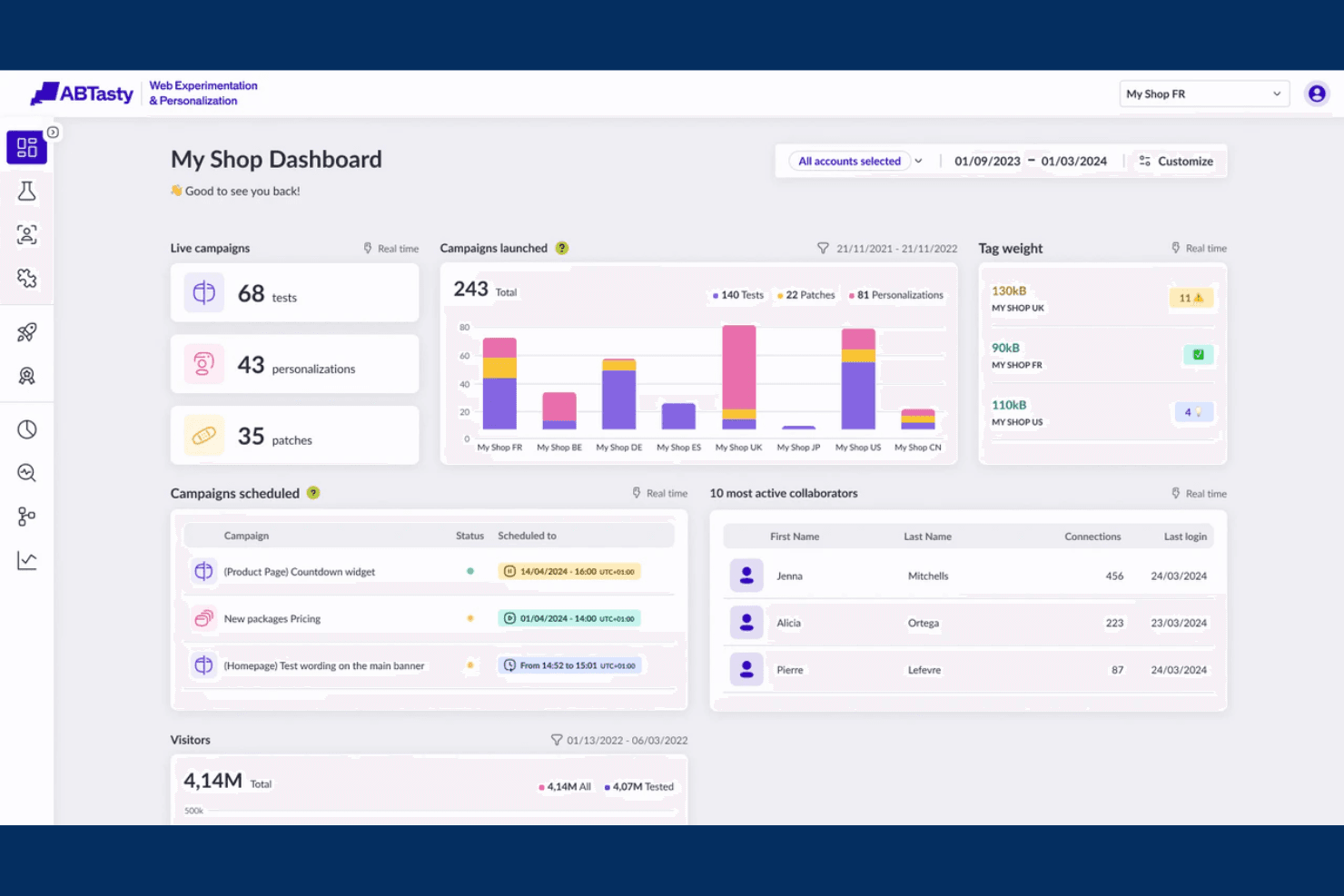
AB Tasty ayuda a los equipos a realizar pruebas A/B y personalizar las experiencias digitales. AB Tasty es una plataforma de experimentación basada en IA que admite pruebas A/B, multivariantes y de URL dividida, además de la gestión de indicadores de funcionalidades, la generación de hipótesis y textos asistida por IA, y la segmentación de audiencias según su comportamiento.
¿Para quién es más adecuado AB Tasty?
AB Tasty es una opción adecuada para equipos de marketing que quieren realizar pruebas A/B, campañas de personalización y experimentos sin depender del equipo de ingeniería para cada cambio.
Por qué elegí AB Tasty
He incluido AB Tasty entre mis principales opciones porque es una de las pocas plataformas de experimentación diseñadas teniendo realmente en cuenta la colaboración de los equipos de marketing. El flujo de aprobación permite a los equipos revisar y aprobar los experimentos antes de publicarlos, y los espacios de trabajo mantienen organizadas varias campañas sin que se superpongan. También me gusta el conjunto de herramientas Evi, donde los especialistas en marketing pueden generar hipótesis, redactar textos para las variaciones e interpretar los resultados sin tener que recurrir a un analista de datos para cada prueba.
Funciones clave de AB Tasty
- Ideas de Evi: Genera ideas de pruebas CRO a partir de capturas de pantalla o GIF, basándose en las mejores prácticas de UX y en principios de sesgos cognitivos para sugerir qué probar a continuación.
- Segmentación de EmotionsAI: Agrupa a los visitantes en perfiles de necesidades emocionales según su comportamiento en el sitio web, lo que permite dirigir los experimentos a segmentos de audiencia específicos.
- Asignación de bandido multibrazo: Desplaza automáticamente el tráfico de las pruebas hacia la variación con mejor rendimiento, por lo que resulta útil para pruebas breves o páginas con seis o más variaciones.
- Gestión de indicadores de funcionalidades: Admite despliegues progresivos, lanzamientos programados e interruptores de emergencia automatizados que revierten una funcionalidad cuando las métricas clave disminuyen.
Integraciones de AB Tasty
AB Tasty ofrece integraciones nativas con Adobe Analytics, Amplitude, Google Analytics 4, Contentsquare, FullStory, Heap, Matomo, Salesforce Marketing Cloud, Microsoft Clarity y Tealium. Su API admite integraciones personalizadas, cuyo acceso depende del plan.
Pros and Cons
Pros:
- Los equipos de marketing pueden lanzar pruebas visuales
- Evi facilita las hipótesis, los textos y el análisis
- La segmentación según el comportamiento mejora la personalización
Cons:
- Las pruebas avanzadas requieren experiencia técnica
- La entrega del lado del cliente puede provocar parpadeo
Learn more about AB Tasty: La mejor opción para la experimentación con indicadores de funciones
- Plan gratuito + prueba gratuita de 14 días + demostración gratuita disponible
- Desde $10/mes (facturado anualmente)
Visit WebsiteCustomer Rating:4.5/5This rating combines scores from multiple user review sites to reflect overall customer sentiment about the product.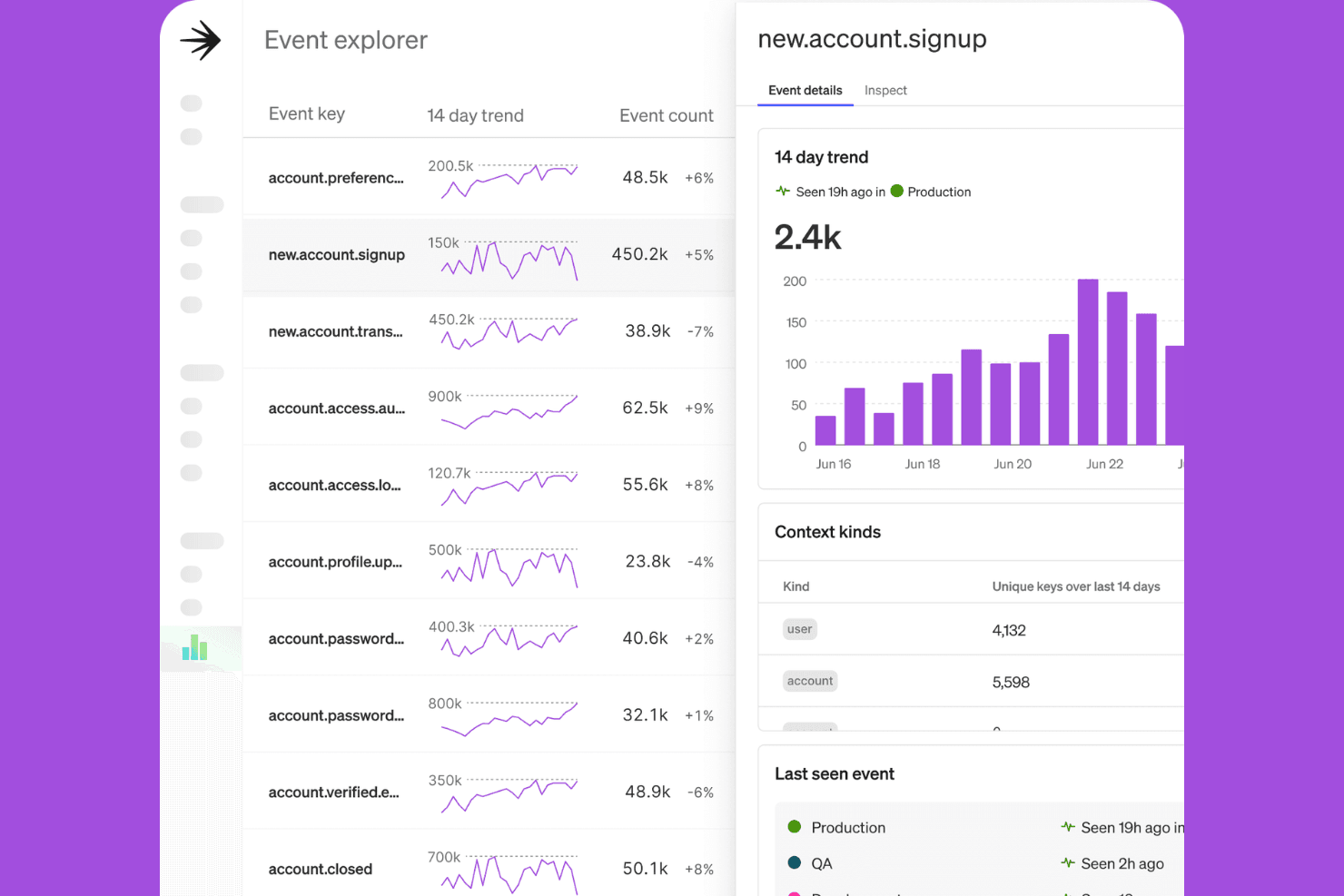
LaunchDarkly ayuda a los equipos a probar y gestionar lanzamientos de funciones con control. LaunchDarkly es una plataforma de indicadores de funciones y experimentación que permite a los equipos de ingeniería ejecutar pruebas A/B/n, bandidos de múltiples brazos, grupos de control retenidos y experimentos de embudo en entornos web, móviles, de servidor y de borde desde una única interfaz.
¿Para quién es más adecuado LaunchDarkly?
LaunchDarkly está diseñado para equipos de ingeniería que quieren ejecutar experimentos directamente dentro de su flujo de trabajo de indicadores de funciones, sin cambiar de herramienta.
Por qué elegí LaunchDarkly
LaunchDarkly ocupa un lugar en mi lista de favoritos porque es la única herramienta en la que las pruebas A/B viven de forma nativa dentro del flujo de trabajo de indicadores de funciones. Me encanta que puedas ejecutar pruebas A/B/n, bandidos de múltiples brazos y experimentos con grupos de control retenidos directamente sobre los indicadores, y después lanzar la variante ganadora con un clic y sin volver a desplegar. La plataforma también admite experimentos de configuración de IA, lo que permite probar indicaciones y modelos en tiempo de ejecución y dirigir automáticamente el tráfico hacia el que ofrece mejores resultados.
Características principales de LaunchDarkly
- Análisis de experimentos nativo del almacén de datos: Ejecuta análisis de experimentos directamente en Snowflake, Redshift, Databricks o BigQuery mediante métricas SQL personalizadas y tus propios datos.
- Experimentos mutuamente excluyentes y en capas: Ejecuta varios experimentos simultáneamente sin contaminación del tráfico mediante controles de aislamiento de experimentos.
- Pruebas secuenciales con reducción de la varianza CUPED: Reduce los tamaños de muestra necesarios y supervisa los resultados continuamente sin aumentar las tasas de falsos positivos.
- Asignación de tráfico mediante bandidos de múltiples brazos: Desvía automáticamente el tráfico hacia las variantes ganadoras durante un experimento activo sin esperar a que concluya una prueba con duración fija.
Integraciones de LaunchDarkly
LaunchDarkly ofrece más de 70 integraciones nativas, incluidas Snowflake, BigQuery, Redshift, Databricks, Amplitude, Segment y FullStory. También admite un servidor MCP, proveedores de OpenFeature y una API para integraciones personalizadas.
Pros and Cons
Pros:
- Los experimentos con indicadores de funciones abarcan todas las plataformas
- Las pruebas estadísticas incluyen CUPED y bandidos
- Los agentes de IA pueden gestionar los flujos de trabajo de experimentación
Cons:
- Los ingenieros deben crear las variaciones en el código
- La IA no genera textos ni diseños
Learn more about LaunchDarkly: Ideal para controles empresariales de gobernanza de experimentos
- Demostración gratuita disponible
- Precios bajo solicitud
Visit WebsiteCustomer Rating:4.2/5This rating combines scores from multiple user review sites to reflect overall customer sentiment about the product.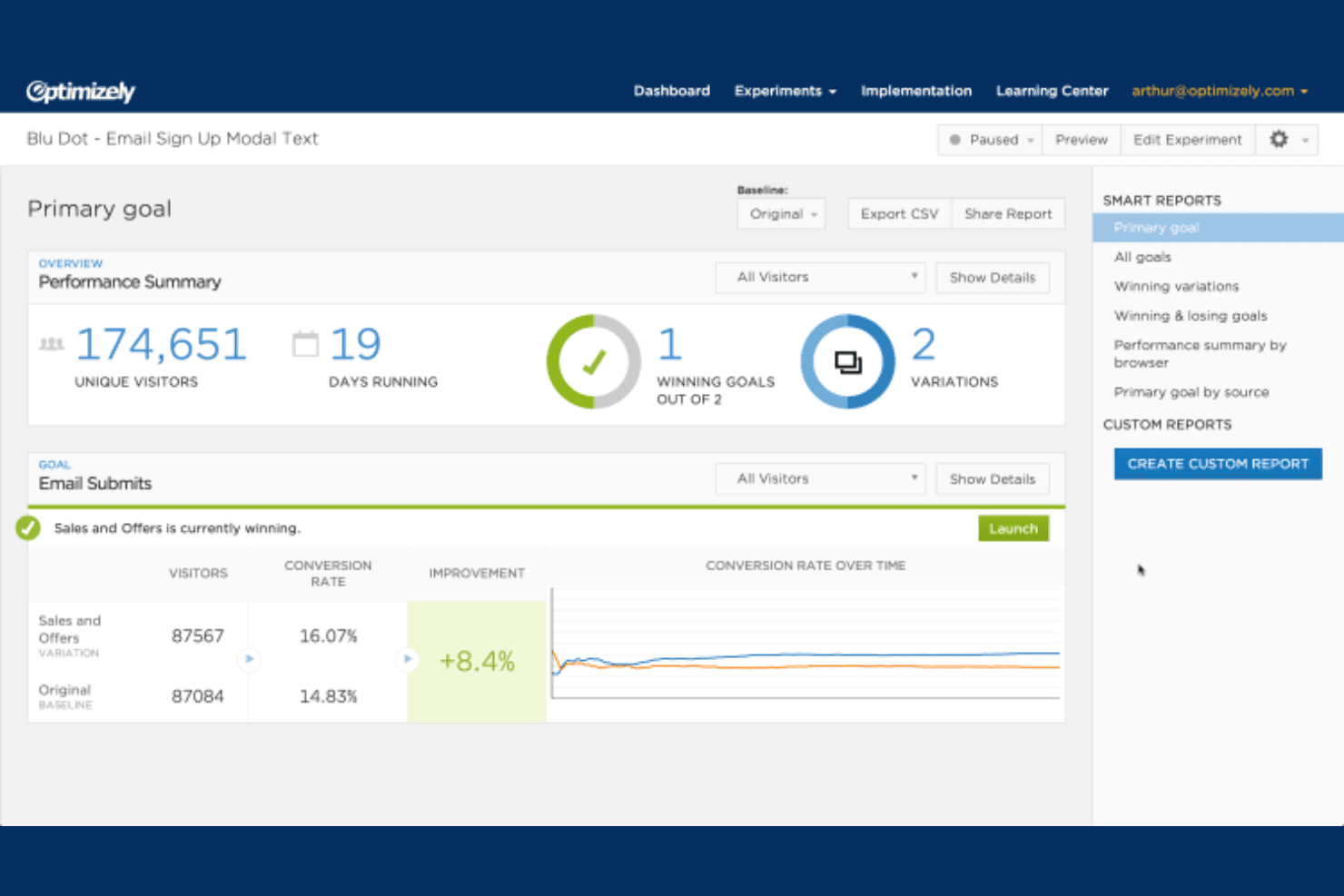
Optimizely ayuda a las empresas a ejecutar experimentos digitales y optimizar los recorridos de los usuarios. Optimizely es una plataforma empresarial de experimentación que admite pruebas A/B, multivariantes, de indicadores de funcionalidades y del lado del servidor, junto con una capa de agentes de IA que abarca la ideación de experimentos, la creación de variaciones, el análisis estadístico y la optimización automatizada del tráfico.
¿Para quién es más adecuado Optimizely?
Optimizely es adecuado para equipos empresariales de producto e ingeniería que necesitan ejecutar experimentos a gran escala con flujos de trabajo formales de aprobación, permisos basados en equipos y requisitos de cumplimiento integrados.
Por qué elegí Optimizely
Optimizely ocupa un lugar en mi lista de favoritos por la seriedad con la que aborda la gobernanza de experimentos a gran escala. Me impresiona especialmente su sistema de aprobación de cambios, que envía los cambios en los indicadores, las actualizaciones de asignación de tráfico y las modificaciones de audiencias a los aprobadores designados antes de que nada llegue a producción. Combinado con los permisos basados en equipos y los campos de Hipótesis y Plan de pruebas integrados directamente en las reglas A/B, ofrece el tipo de estructura que los equipos empresariales que ejecutan experimentos en varias marcas o unidades de negocio realmente necesitan.
Funciones clave de Optimizely
- Pruebas de bandidos con múltiples opciones contextuales: Utiliza IA para redirigir automáticamente el tráfico hacia la variación con mejor rendimiento según los atributos individuales de cada visitante en tiempo real.
- Análisis nativo del almacén de datos: Se conecta directamente con Snowflake, BigQuery, Databricks y Redshift para ejecutar análisis de experimentos sobre tus datos existentes sin escribir SQL.
- Generador de ideas de Opal: Analiza la URL de una página, los mapas de calor y los datos de pruebas anteriores para generar ideas de experimentos estructuradas con una hipótesis, un planteamiento del problema y fuentes de respaldo.
- Implementación de SDK multiplataforma: Ejecuta experimentos en entornos web, móviles, del lado del servidor y de borde, con evaluación local de decisiones en menos de un milisegundo y SDK de código abierto.
Integraciones de Optimizely
Optimizely se integra con Google Analytics 4, Adobe Analytics, Amplitude, Segment, Snowflake, BigQuery, Databricks, Redshift, Salesforce y Figma. También admite MCP, webhooks, SDK de código abierto y API para integraciones personalizadas.
Pros and Cons
Pros:
- Flujos de trabajo de aprobación de nivel empresarial para experimentos
- La IA ayuda desde la ideación hasta los resúmenes de resultados
- Las pruebas multiplataforma abarcan web, móvil y entornos de borde
Cons:
- Las implementaciones avanzadas requieren conocimientos técnicos
- Los métodos bayesianos y frecuentistas siguen en fase beta
Learn more about Optimizely: Ideal para flujos de trabajo de experimentación liderados por desarrolladores
- Plan gratuito disponible
- Desde $250/mes
Visit WebsiteCustomer Rating:4.5/5This rating combines scores from multiple user review sites to reflect overall customer sentiment about the product.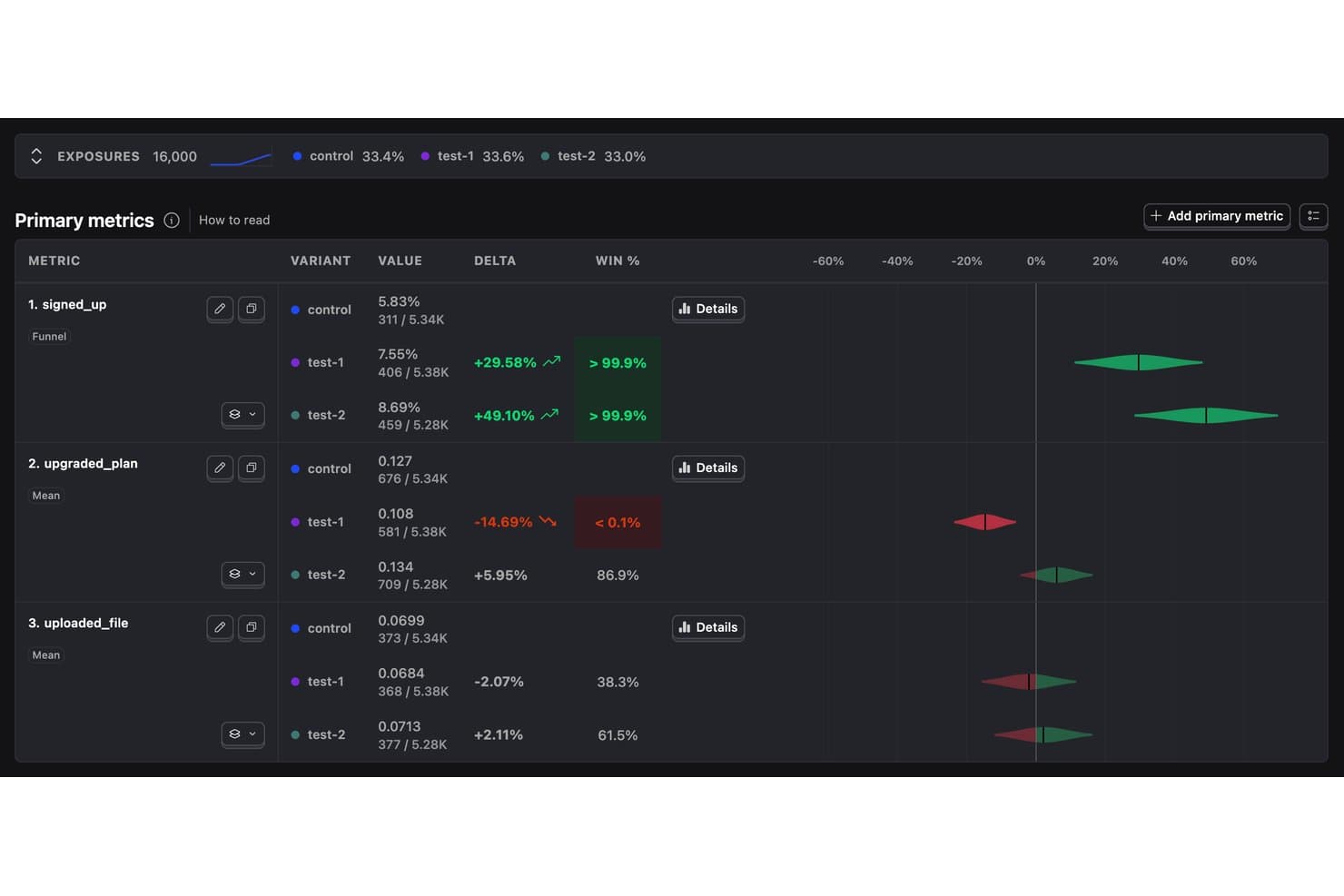
PostHog registra el rendimiento de las variantes de las pruebas A/B en las métricas de registro y conversión. PostHog es una plataforma de análisis de productos y experimentación que combina pruebas A/B, multivariantes, con grupo de control y de URL dividida con la gestión de banderas de funcionalidades, la reproducción de sesiones y una capa de IA que genera la configuración de experimentos y el código de variantes a partir de indicaciones en inglés sencillo.
¿Para quién es más adecuado PostHog?
PostHog se adapta a equipos de producto liderados por ingeniería que quieren ejecutar experimentos directamente desde su editor de código sin cambiar de herramienta.
Por qué elegí PostHog
He incluido PostHog entre mis principales opciones porque está diseñado en torno a un flujo de trabajo de experimentación liderado por desarrolladores de una forma que pocas herramientas ofrecen. Cada experimento se ejecuta mediante una bandera de funcionalidades, por lo que implementar una variante ganadora consiste simplemente en activar un interruptor en tu base de código. La integración con el servidor MCP permite crear, lanzar y consultar los resultados de los experimentos directamente desde Cursor o Claude Code, sin abrir en ningún momento la interfaz de usuario de PostHog.
Funciones principales de PostHog
- Pruebas con grupo de control: Reserva un porcentaje de usuarios de todos los experimentos para medir el impacto a largo plazo sin exponerlos a ninguna variante.
- Reproducción de sesiones por variante: Observa sesiones de usuarios grabadas y filtradas por variante del experimento para comprender el comportamiento detrás de tus resultados.
- Estadísticas bayesianas y frecuentistas: Elige tu motor estadístico preferido para cada experimento, con umbrales de confianza configurables y reducción opcional del ruido mediante CUPED.
- Métricas del almacén de datos: Obtén las métricas de los objetivos del experimento directamente de tablas de almacenes de datos conectados, como los datos de pedidos de Stripe o Shopify.
Integraciones de PostHog
PostHog se conecta con más de 50 destinos mediante su CDP, incluidos Braze, Customer.io, Salesforce, HubSpot y Slack. También admite fuentes de datos de Stripe, Shopify, Snowflake y BigQuery, además de una API REST e integraciones MCP para Cursor y Claude Code.
Pros and Cons
Pros:
- La IA genera la configuración del experimento a partir de indicaciones
- Las banderas de funcionalidades simplifican la implementación de la variante ganadora
- Las reproducciones de sesiones explican el rendimiento de las variantes
Cons:
- No permite cambiar automáticamente el tráfico entre variantes
- El editor visual presenta dificultades con las aplicaciones de una sola página
Learn more about PostHog: Ideal para personalización omnicanal
- Demo gratuita disponible
- Precios a consultar

Adobe Target ofrece pruebas y personalización impulsadas por IA. Adobe Target es una solución de nivel empresarial diseñada para equipos que necesitan pruebas avanzadas y personalización en canales digitales. Resulta atractiva para organizaciones con recorridos de cliente complejos que desean optimizar experiencias utilizando automatización impulsada por IA y direccionamiento avanzado. Si buscas unificar la experimentación y la personalización a escala, Adobe Target responde a estas necesidades centrándose en la toma de decisiones basada en datos.
¿Para quién es Adobe Target?
Adobe Target es ideal para grandes empresas y equipos de marketing digital que necesitan ofrecer experiencias personalizadas a través de múltiples canales.
Por qué elegí Adobe Target
Elegí Adobe Target porque destaca por ofrecer una verdadera personalización omnicanal, esencial para organizaciones que realizan pruebas A/B potenciadas por IA en web, móvil, correo electrónico y más. Su motor de personalización automatizada utiliza aprendizaje automático para adaptar el contenido y las ofertas a cada usuario en tiempo real, lo que permite optimizar cada punto de contacto. También valoro su capacidad para ejecutar pruebas multivariadas y direccionamiento basado en reglas de forma simultánea, permitiendo que los equipos experimenten con recorridos de usuario complejos y experiencias específicas para segmentos. Para las empresas que necesitan coordinar experimentos y personalización a gran escala, el enfoque unificado de Adobe Target representa una excelente opción.
Funciones clave de Adobe Target
Otras funciones que hacen a Adobe Target valiosa para las pruebas A/B impulsadas por IA incluyen:
Pruebas con asignación automática: Desvía automáticamente el tráfico a experiencias de mayor rendimiento a medida que se obtienen resultados de las pruebas.
Editor visual de experiencias: Permite a los equipos crear y modificar variaciones de pruebas sin programar.
Biblioteca de audiencias: Centraliza los segmentos de audiencia para una orientación coherente en todas las campañas.
Suite de informes integral: Ofrece análisis detallados sobre el rendimiento de las pruebas y el comportamiento del usuario.
Integraciones de Adobe Target
Las integraciones incluyen Adobe Analytics, Adobe Experience Platform, Adobe Commerce, Salesforce, Microsoft Dynamics y Mixpanel.
Pros and Cons
Pros:
- Personalización automatizada
- Análisis visual profundo con IA
- Procesamiento de datos masivo
Cons:
- Requiere un equipo dedicado
- Interfaz extremadamente compleja
Learn more about Adobe Target : Ideal para analizar rápidamente las implementaciones de funcionalidades
- Plan gratuito disponible
- Desde $150/mes
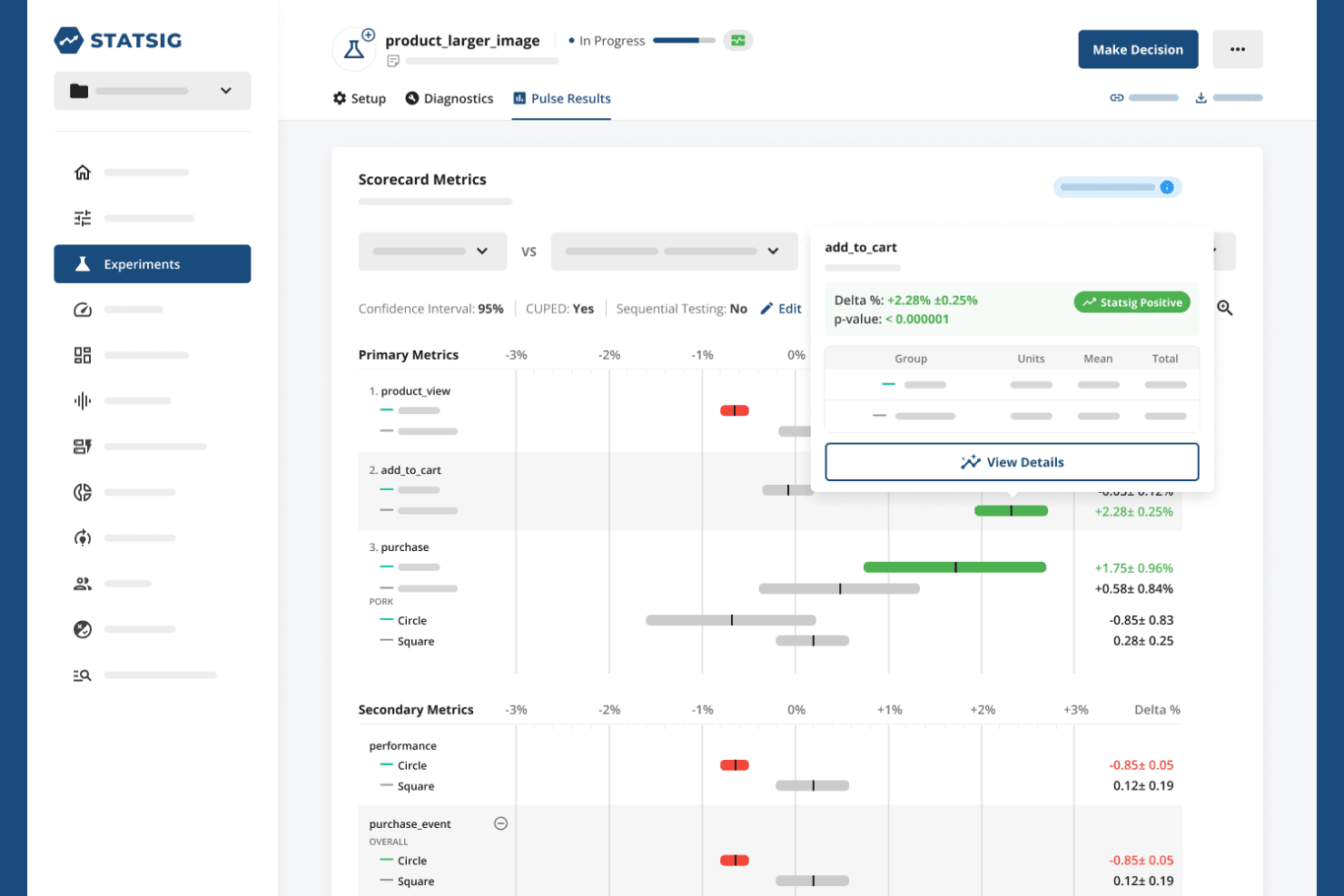
Statsig ayuda a los equipos a ejecutar experimentos y analizar el impacto de las funcionalidades. Statsig es una plataforma de experimentación y gestión de indicadores de funcionalidad que combina pruebas A/B/n, pruebas multivariantes, análisis estadístico y resúmenes de experimentos generados por IA con una arquitectura basada en indicadores para ejecutar y analizar experimentos en entornos web, móviles y de servidor.
¿Para quién es más adecuada Statsig?
Statsig es adecuada para equipos de producto orientados a la ingeniería que realizan experimentos mediante indicadores de funcionalidad y necesitan un análisis estadístico riguroso integrado en el mismo flujo de trabajo.
Por qué elegí Statsig
Statsig está en mi lista de opciones principales porque es la única plataforma en la que los indicadores de funcionalidad y los experimentos comparten un único modelo de datos, lo que significa que puedo lanzar una implementación gradual de un indicador y convertirla en un experimento medido sin reconstruir nada. Me gusta especialmente el sistema Layers, que evita que los experimentos superpuestos contaminen los resultados de los demás, algo fundamental cuando se ejecutan cientos de pruebas simultáneamente. Los resúmenes de experimentos generados por IA van más allá de mostrar simplemente el impacto; generan una recomendación de publicación con las métricas clave destacadas, para que mi equipo tome decisiones más rápidas sobre qué implementar a continuación.
Funciones principales de Statsig
- Resúmenes de experimentos generados por IA: Produce automáticamente un resumen de cada experimento completado, incluida una recomendación de publicación y los aspectos destacados de las métricas clave, exportable como PDF.
- Bandido de múltiples brazos Autotune: Desplaza automáticamente el tráfico hacia la variante ganadora con el tiempo, optimizando una única métrica objetivo sin intervención manual.
- Reducción de la varianza CUPED: Aplica un ajuste de covariables previo al experimento para reducir el ruido y aumentar la sensibilidad estadística de los resultados del experimento.
- Más de 30 SDK de código abierto: Abarca entornos de cliente, servidor y periféricos, incluidos React, Swift, Android, Python, Go y Rust, con evaluación de indicadores en menos de un milisegundo después de la inicialización.
Integraciones de Statsig
Statsig ofrece integraciones documentadas con Snowflake, Databricks, BigQuery, Redshift, Athena, Microsoft Fabric, Segment, mParticle, RudderStack y Census. También proporciona API para integraciones personalizadas y una implementación nativa del almacén de datos.
Pros and Cons
Pros:
- Los indicadores de funcionalidad conectan las implementaciones graduales con los experimentos
- Los resúmenes de IA recomiendan decisiones de publicación
- Autotune desplaza el tráfico hacia las variantes ganadoras
Cons:
- La IA de hipótesis no crea variantes
- La configuración orientada a ingenieros ralentiza a los equipos no técnicos
Learn more about Statsig: Ideal para pruebas de código abierto nativas del almacén de datos
- Plan gratuito + demostración gratuita disponible
- Desde 40 $/usuario/mes
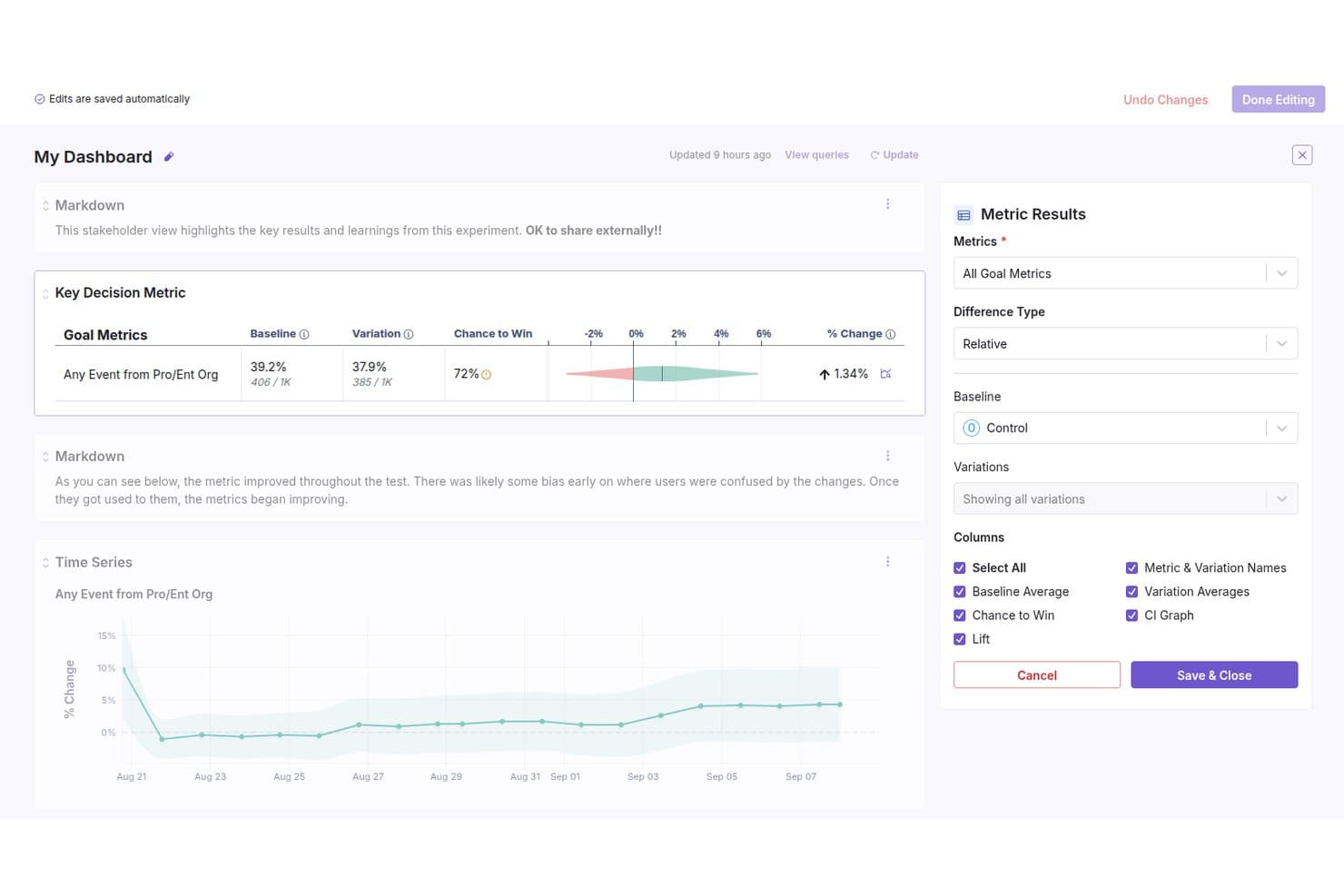
GrowthBook permite a los usuarios crear paneles de pruebas A/B compartibles con resultados de métricas. GrowthBook es una plataforma de código abierto para pruebas A/B y gestión de indicadores de funcionalidad que admite la creación de experimentos, la creación de variaciones asistida por IA, el análisis de métricas nativo del almacén de datos y las pruebas con bandidos de múltiples brazos en entornos web, móviles y de servidor.
¿Para quién es más adecuado GrowthBook?
GrowthBook es una opción ideal para gerentes de producto y desarrolladores de equipos técnicamente maduros que desean tener un control total sobre sus datos de experimentación sin abandonar su almacén de datos existente.
Por qué elegí GrowthBook
GrowthBook ocupa un lugar destacado en mi lista porque está diseñado en torno a tu almacén de datos existente en lugar de utilizar su propia capa de datos propietaria. Me encanta que las métricas de los experimentos se calculen directamente desde Snowflake, BigQuery o Redshift mediante SQL que realmente puedes leer y verificar. Si a eso le sumas los motores bayesiano y frecuentista, la reducción de varianza CUPED y las pruebas secuenciales, obtienes una capa estadística que compite realmente con la infraestructura de experimentación desarrollada internamente, a una fracción del coste de desarrollo.
Características principales de GrowthBook
- Editor visual de IA: Una extensión de Chrome que permite describir cambios en lenguaje natural y previsualizar variaciones de página generadas por IA antes de lanzar una prueba.
- Bandidos de múltiples brazos y contextuales: Cambia automáticamente el tráfico hacia las variantes ganadoras mediante el muestreo de Thompson, mientras que los bandidos contextuales adaptan las variantes a los atributos individuales de cada usuario.
- Más de 24 SDK para web, móvil, servidor y perímetro: Implementa experimentos en cualquier lugar donde se ejecute tu producto, con indicadores evaluados localmente y sin necesidad de llamadas de red.
- Lista de comprobación de experimentos previa al lanzamiento: Ejecuta comprobaciones automatizadas y manuales antes de activar cualquier experimento, con acceso a la API para los equipos que quieran integrar las comprobaciones en sus propios flujos de trabajo.
Integraciones de GrowthBook
GrowthBook se conecta con Snowflake, BigQuery, Databricks, Redshift, ClickHouse, Segment, RudderStack, Slack, GitHub y Datadog. También ofrece una API REST, webhooks, proveedores de OpenFeature y un servidor MCP para Claude, Cursor y VS Code.
Pros and Cons
Pros:
- Las métricas nativas del almacén de datos mantienen el SQL auditable
- Los bandidos dirigen el tráfico hacia las variantes más eficaces
- Los SDK son compatibles con web, móvil, servidor y perímetro
Cons:
- Las variaciones de IA requieren configurar las claves del proveedor
- El editor visual excluye las aplicaciones móviles nativas
Learn more about GrowthBook: La mejor opción para la personalización bayesiana a escala empresarial
- Demostración gratuita disponible
- Precio bajo solicitud
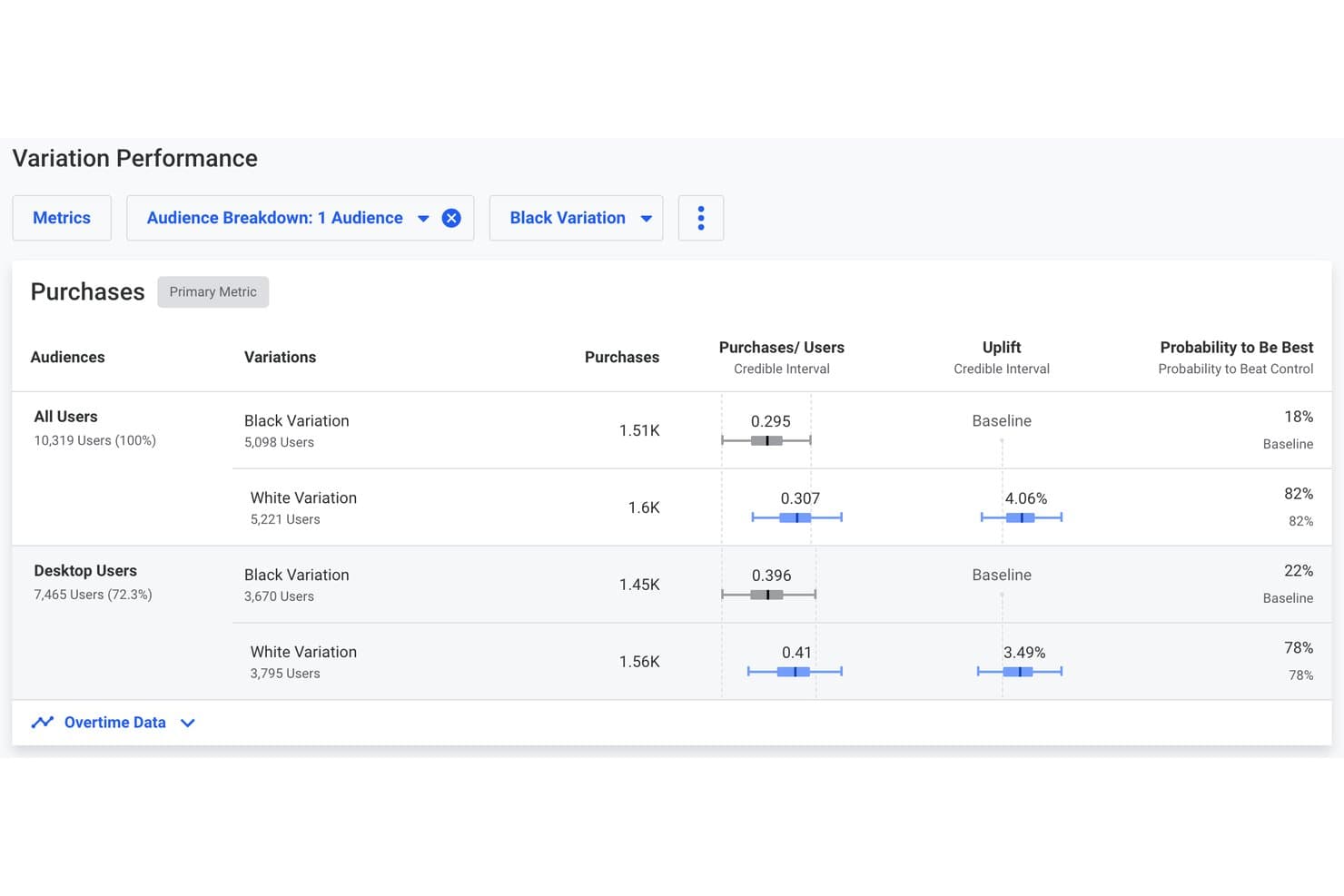
Dynamic Yield compara el rendimiento de las variaciones A/B con métricas de aumento y compras. Dynamic Yield es una plataforma de personalización y experimentación potenciada por IA que admite pruebas A/B, multivariantes, con algoritmos de bandidos y del lado del servidor, además de segmentación de audiencias, creación de variaciones asistida por IA y despliegue multicanal en sitios web, aplicaciones, correo electrónico y búsquedas.
¿Para quién es más adecuado Dynamic Yield?
Dynamic Yield es una opción excelente para equipos empresariales de marketing y optimización de la tasa de conversión en los sectores del comercio electrónico, el comercio minorista o los servicios financieros que necesitan experimentación bayesiana y una personalización profunda en una sola plataforma.
Por qué elegí Dynamic Yield
Dynamic Yield se gana un lugar en mi lista de finalistas porque su motor bayesiano va más allá de un simple veredicto de ganador o perdedor: informa la probabilidad de ser la mejor opción, los intervalos creíbles y las métricas secundarias de forma simultánea, de modo que puedo detectar efectos secundarios antes de declarar un resultado. También confío en su asignación por afinidad, que dirige a cada usuario a la variación que coincide con su perfil de comportamiento en lugar de dividir el tráfico a ciegas. Después, el agente Analista supervisa los resultados cada noche y señala anomalías con respecto a una referencia de 28 días, lo que mantiene la integridad de los experimentos a escala empresarial.
Características principales de Dynamic Yield
- Pruebas de campañas multitoque: Ejecuta experimentos en varias páginas o etapas del embudo, con hasta 20 puntos de contacto por variación comparada con un grupo de control.
- Asignación dinámica del tráfico: Un algoritmo de bandidos de múltiples brazos que desplaza automáticamente el tráfico hacia la variación con mejor rendimiento a medida que llegan los resultados.
- Indicadores de funcionalidad para lanzamientos: Integra el código en indicadores de funcionalidad, publica para un porcentaje de usuarios, mantiene un grupo de control y revierte los cambios al instante si es necesario.
- Resúmenes de resultados generados por IA: El agente Analista resume los resultados de las pruebas, incluido el aumento, la significación y el impacto empresarial proyectado, y genera informes del programa de pruebas para ejecutivos.
Integraciones de Dynamic Yield
Dynamic Yield ofrece integraciones nativas con Google Analytics 4, Contentsquare, mParticle, Shopify y Stability.AI. Las API de experiencia y los SDK móviles para Kotlin, Swift y React Native permiten conexiones personalizadas.
Pros and Cons
Pros:
- Los informes bayesianos revelan efectos secundarios en las métricas secundarias
- La asignación por afinidad personaliza la exposición a las variaciones
- Los agentes de IA generan variaciones de campaña aprobadas
Cons:
- La personalización avanzada requiere una participación considerable de desarrolladores
- Los diseños generados por agentes actualmente admiten campañas limitadas
Learn more about Dynamic Yield:
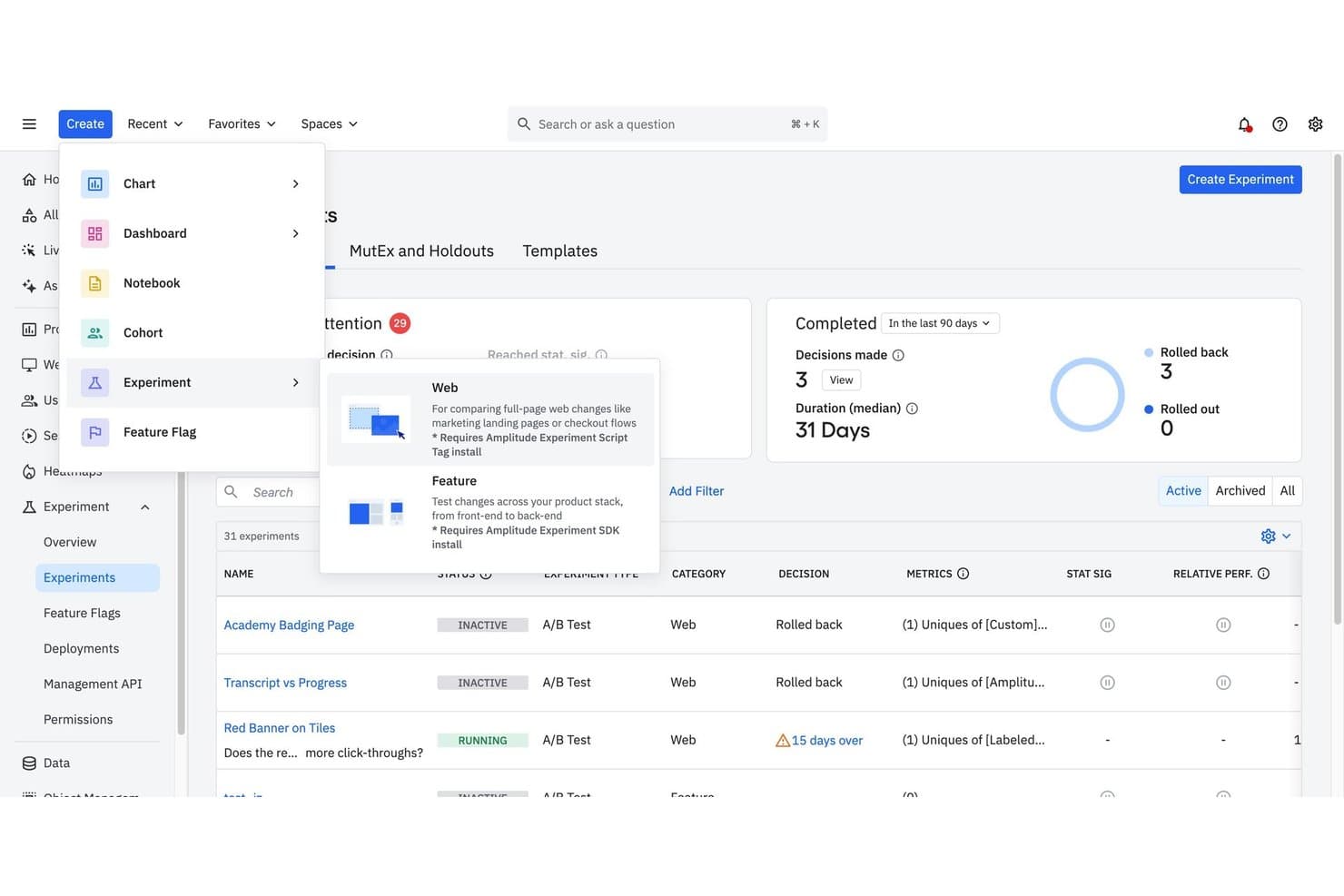
Amplitude Feature Experimentation permite a los usuarios crear pruebas A/B web o de funcionalidades. Amplitude Feature Experimentation es una plataforma de pruebas A/B y de indicadores de funcionalidad que admite experimentos A/B, A/B/n y multivariantes en entornos web, móviles y del lado del servidor mediante un editor visual sin código y SDK en 11 idiomas.
¿Para quién es más adecuada Amplitude Feature Experimentation?
Los equipos de producto que ya trabajan con Amplitude Analytics son quienes más provecho obtendrán de esta herramienta, ya que los experimentos, las cohortes y los paneles comparten el mismo modelo de datos.
Por qué elegí Amplitude Feature Experimentation
Elegí Amplitude Feature Experimentation porque los experimentos, las cohortes y las métricas de comportamiento utilizan el mismo modelo de datos que Amplitude Analytics, lo que significa que puedes lanzar una prueba directamente desde un panel o una reproducción de sesión sin tener que reconstruir tu audiencia ni tus métricas desde cero. Me gusta especialmente el motor de pruebas secuenciales: combina la reducción de la varianza CUPED con diagnósticos de SRM y la generación de informes de intervalos de confianza, por lo que detectas divisiones defectuosas y reduces el ruido al mismo tiempo. El estimador de duración, basado en tus propios datos históricos, también permite definir el alcance de las pruebas de forma mucho más fundamentada que mediante estimaciones.
Funciones principales de Amplitude Feature Experimentation
- Pruebas con bandidos de múltiples brazos: Redistribuye automáticamente el tráfico cada hora, día o semana mediante el muestreo de Thompson, y dirige a los usuarios hacia la variante con mejor rendimiento.
- Agente de conversión de sitios web: Un agente de IA que analiza tus páginas, propone estrategias de experimentación con niveles de confianza y genera variantes preliminares listas para su revisión y lanzamiento.
- Compatibilidad con SDK multiplataforma: Ejecuta experimentos en entornos web, móviles y del lado del servidor mediante SDK en 11 idiomas, con opciones de evaluación local y remota.
- Orientación por cohortes grupales: Segmenta y orienta los experimentos a nivel de cuenta o empresa, lo que permite realizar pruebas de estilo B2B agrupadas mediante identificadores de grupo, como el ID de empresa.
Integraciones de Amplitude Feature Experimentation
Amplitude ofrece 159 integraciones, entre ellas Segment, Snowflake, BigQuery, Braze, LaunchDarkly y Optimizely. Las API de procesamiento por lotes, HTTP, perfiles y transmisión de eventos admiten conexiones personalizadas y flujos de trabajo de CI/CD.
Pros and Cons
Pros:
- Las cohortes nativas de Analytics afinan la orientación de las pruebas
- Los diagnósticos de CUPED y SRM mejoran la confianza
- 11 SDK admiten experimentos en el código del producto
Cons:
- El agente de conversión de sitios web sigue en acceso anticipado
- El estilizador de IA no detecta los widgets integrados
Learn more about Amplitude Feature Experimentation:
Otras herramientas de pruebas A/B con IA
Estas son algunas opciones adicionales de herramientas de pruebas A/B con IA que no llegaron a mi lista de selección, pero que aun así vale la pena consultar:
- 11UnbounceIdeal para creación de variantes con arrastrar y soltar
- 12OmniconvertIdeal para crear variantes de indicaciones a código
- 13Convert ExperiencesLa mejor opción para la experimentación web a gran escala centrada en la privacidad
- 14Split by HarnessIdeal para el análisis de experimentos con indicadores liderado por ingeniería
- 15IntelligemsIdeal para contenido y pruebas de precios enfocados en las ganancias de Shopify
- 16
Cómo Evalúo las Herramientas de Pruebas A/B con IA
Cada herramienta en esta lista debe ir más allá de simplemente colocar una etiqueta de IA sobre pruebas divididas básicas; busco plataformas donde la IA realmente acorte el camino desde la hipótesis hasta la decisión de producto validada. Divido mi evaluación en la funcionalidad esencial que toda herramienta debe brindar y los factores diferenciadores que separan las buenas opciones de las excelentes para equipos de producto.
Funcionalidad Esencial (Condiciones Indispensables para Esta Lista)
Cuando selecciono herramientas para mi lista, califico cada una en una escala del 0 (no ofrece la funcionalidad) al 5 (sobresale en esta área) para cada funcionalidad esencial que aparece a continuación. Luego, calculo la puntuación total de la herramienta como un porcentaje. Cada herramienta debe alcanzar una puntuación mínima total del 65% para ser considerada.
- Generación de Variantes Impulsada por IA: Compruebo si la IA puede producir variantes de prueba útiles—como reescrituras de titulares o cambios de diseño—sin que mi equipo deba construir cada una manualmente.
- Análisis Estadístico Automatizado: La plataforma debe encargarse de los cálculos de significancia y mostrar los ganadores automáticamente, similar a cómo Optimizely y VWO automatizan los reportes.
- Pruebas A/B y Multivariadas: Busco soporte nativo tanto para divisiones estándar A/B como para configuraciones multivariadas a través de flujos, componentes de funciones y elementos de interfaz.
- Personalización Impulsada por IA: Aquí importa la asignación adaptativa—las herramientas que usan algoritmos de Multi-Armed Bandits o segmentación por ML para dirigir el tráfico en función del comportamiento en tiempo real destacan.
- Perspectivas Predictivas y Recomendaciones: Evalúo si la IA puede pronosticar los resultados de las pruebas o sugerir próximos experimentos, y no solo mostrar paneles estáticos después del hecho.
- Seguimiento y Reporte de Experimentos: Un panel centralizado para gestionar pruebas en vivo y revisar resultados pasados es clave, especialmente cuando la IA resume los aprendizajes de varios experimentos.
Una vez que tengo una lista de herramientas que cumplen con este criterio, considero qué distingue a cada plataforma.
Factores Diferenciadores (Qué Distingue a los Proveedores)
Así es como comparo y contrasto diferentes proveedores:
Características Destacadas
Las hipótesis generadas automáticamente son un gran diferenciador. Busco herramientas que escaneen los puntos de abandono en el embudo y datos de comportamiento para sugerir proactivamente dónde experimentar a continuación, en vez de esperar a que un PM detecte el problema. La integración con feature flags también es importante, ya que vincular experimentos a implementaciones progresivas brinda a los equipos una vía más segura para lanzar productos del lado del servidor. También evalúo el aprendizaje entre experimentos: una IA que sintetiza patrones de pruebas pasadas ayuda a evitar experimentos redundantes y orienta las prioridades del roadmap.
Más Allá de las Características
El ecosistema de integraciones es de lo primero que reviso. Una herramienta que se conecta nativamente con plataformas como Amplitude, Mixpanel o Segment garantiza que los datos de experimentación fluyan dentro de los flujos de trabajo existentes sin la necesidad de canalizaciones personalizadas. La privacidad de datos y la gobernanza de IA también merecen atención; evalúo si las plataformas ofrecen cumplimiento con SOC 2, residencia de datos configurable y transparencia sobre cómo los datos de los clientes alimentan sus modelos de IA. La estructura de precios también moldea mi evaluación, especialmente si una herramienta escala de manera predecible a medida que crece el volumen de experimentación en productos y equipos.
Cómo elegir herramientas de pruebas A/B con IA
Es fácil perderse entre largas listas de funciones y estructuras de precios complejas. Para ayudarte a mantenerte enfocado mientras avanzas en tu proceso particular de selección de software, aquí tienes una lista de factores que debes tener en cuenta:
| Factor | Qué debes considerar |
|---|---|
| FactorEscalabilidad | Qué debes considerar¿La herramienta podrá gestionar el volumen de experimentos, el tráfico y el tamaño del equipo actuales y previstos? |
| FactorIntegraciones | Qué debes considerar¿Se conecta de forma nativa con tus plataformas de análisis, comercio electrónico o marketing sin trabajo adicional? |
| FactorPersonalización | Qué debes considerar¿Puedes adaptar los parámetros de los experimentos, los informes y los flujos de trabajo para que coincidan con los procesos de tu empresa? |
| FactorFacilidad de uso | Qué debes considerar¿Tu equipo podrá lanzar e interpretar pruebas sin una formación extensa ni ayuda técnica? |
| FactorImplementación e incorporación | Qué debes considerar¿Cuánto tiempo llevará ponerla en marcha y qué recursos o asistencia se proporcionan? |
| FactorCoste | Qué debes considerar¿Los niveles de precios son claros y se ajustan a tus patrones de uso y restricciones presupuestarias? |
| FactorMedidas de seguridad | Qué debes considerar¿La herramienta cumple tus requisitos de privacidad de datos, control de acceso y conformidad normativa? |
| FactorDisponibilidad de asistencia | Qué debes considerar¿Hay asistencia rápida disponible en tu zona horaria y a través de tus canales preferidos? |
¿Qué son las herramientas de pruebas A/B con IA?
Las herramientas de pruebas A/B con IA son plataformas de software que utilizan la inteligencia artificial para automatizar, optimizar y analizar experimentos digitales que comparan dos o más variantes. Estas herramientas ayudan a los equipos a diseñar pruebas, identificar resultados estadísticamente significativos y descubrir patrones de comportamiento de los usuarios más rápido que los métodos manuales. Al aprovechar la IA, pueden sugerir nuevos experimentos, interpretar datos complejos y reducir el tiempo y los conocimientos necesarios para ejecutar campañas de optimización eficaces.
Funciones
Al seleccionar herramientas de pruebas A/B con IA, presta atención a las siguientes funciones clave:
- Sugerencias de experimentos basadas en IA: Utiliza el aprendizaje automático para analizar los datos de los usuarios y recomendar nuevas ideas de pruebas, ayudando a los equipos a identificar oportunidades de gran impacto que, de otro modo, podrían pasar por alto.
- Análisis estadístico automatizado: Calcula la significancia estadística y los niveles de confianza de los resultados de las pruebas, reduciendo los cálculos manuales y el riesgo de interpretar incorrectamente los datos.
- Editor visual de experimentos: Permite a los usuarios crear y modificar variantes de pruebas mediante una interfaz de arrastrar y soltar, haciendo que la configuración de pruebas sea accesible para los miembros del equipo sin conocimientos técnicos.
- Segmentación de usuarios: Permite dirigirse a grupos de usuarios o comportamientos específicos para los experimentos, de modo que puedas probar hipótesis en audiencias relevantes.
- Paneles de informes en tiempo real: Proporciona métricas y visualizaciones actualizadas sobre el rendimiento de los experimentos, lo que permite a los equipos supervisar los resultados y tomar decisiones oportunas.
- Grabaciones de sesiones integradas: Captura y reproduce las sesiones de los usuarios para cada variante de prueba, proporcionando a los equipos información cualitativa sobre el comportamiento de los usuarios y los puntos de fricción.
- Mapas de calor: Visualiza dónde hacen clic, se desplazan e interactúan los usuarios en las páginas de prueba, ayudando a los equipos a comprender los patrones de interacción y optimizar los diseños.
- Compatibilidad con pruebas multivariantes: Permite probar varias variables simultáneamente, para que puedas analizar el impacto combinado de varios cambios en un solo experimento.
- Programación de experimentos y controles de implementación: Ofrece opciones para programar pruebas, controlar la asignación del tráfico y pausar o finalizar experimentos según criterios predefinidos.
- Informes y exportaciones personalizables: Permite a los usuarios adaptar los informes y exportar datos en diversos formatos para realizar análisis adicionales o compartirlos con las partes interesadas.
Beneficios
Implementar herramientas de pruebas A/B basadas en IA ofrece varios beneficios para tu equipo y tu empresa. Estos son algunos de los que puedes esperar:
- Ciclos de experimentación más rápidos: Las sugerencias basadas en IA y el análisis automatizado ayudan a los equipos a lanzar, supervisar e interpretar las pruebas más rápidamente que con los métodos manuales.
- Mayor precisión en las decisiones: Los cálculos estadísticos automatizados y los paneles en tiempo real reducen los errores humanos y respaldan las decisiones basadas en datos.
- Conocimientos más profundos sobre los usuarios: Las grabaciones de sesiones integradas y los mapas de calor muestran cómo interactúan los usuarios con las variantes de prueba, revelando puntos de fricción y oportunidades.
- Uso eficiente de los recursos: Los editores visuales y los flujos de trabajo automatizados permiten a los miembros del equipo sin conocimientos técnicos ejecutar experimentos, liberando tiempo de desarrolladores y analistas.
- Optimización personalizada: Las funciones de segmentación de usuarios permiten realizar experimentos dirigidos, para que puedas adaptar las experiencias a audiencias específicas y maximizar el impacto.
- Pruebas escalables: La compatibilidad con experimentos multivariantes y de alto tráfico garantiza que la plataforma pueda crecer junto con las necesidades de tu empresa.
- Informes prácticos: Los informes personalizables y las opciones de exportación facilitan compartir los hallazgos con las partes interesadas y orientar estrategias de optimización más amplias.
Costos & precios
Seleccionar herramientas de pruebas A/B basadas en IA requiere comprender los diversos modelos de precios y planes disponibles. Los costos varían según las funciones, el tamaño del equipo, los complementos y otros factores. La siguiente tabla resume los planes habituales, sus precios promedio y las funciones que suelen incluir las soluciones de herramientas de pruebas A/B basadas en IA:
Tabla comparativa de planes para herramientas de pruebas A/B basadas en IA
| Tipo de plan | Precio promedio | Funciones habituales |
|---|---|---|
| Tipo de planPlan gratuito | Precio promedio$0 | Funciones habitualesPruebas A/B básicas, experimentos limitados, puestos de usuario restringidos e informes básicos. |
| Tipo de planPlan personal | Precio promedio$19-$99/mes | Funciones habitualesExperimentos ilimitados, editor visual, segmentación básica, asistencia por correo electrónico y análisis estándar. |
| Tipo de planPlan empresarial | Precio promedio$139-$250/mes | Funciones habitualesSegmentación avanzada, pruebas multivariantes, integraciones, paneles en tiempo real y asistencia prioritaria. |
| Tipo de planPlan corporativo | Precio promedio$400+/mes | Funciones habitualesIntegraciones personalizadas, administrador de cuenta dedicado, seguridad avanzada, asistencia para la incorporación y garantías de SLA. |
Preguntas frecuentes sobre las herramientas de pruebas A/B con IA
Estas son algunas respuestas a preguntas frecuentes sobre las herramientas de pruebas A/B con IA:
¿Cómo mejora la IA las pruebas A/B tradicionales?
La IA mejora las pruebas A/B tradicionales al automatizar el diseño de experimentos, analizar los resultados más rápidamente y sugerir nuevas ideas de pruebas basadas en los datos de los usuarios. Esto reduce el esfuerzo manual y ayuda a los equipos a identificar con mayor rapidez las variantes ganadoras y las oportunidades de optimización.
¿Pueden las herramientas de pruebas A/B con IA gestionar experimentos multivariantes?
Sí, la mayoría de las herramientas de pruebas A/B con IA admiten experimentos multivariantes. Esto permite probar varias variables a la vez y comprender cómo interactúan los distintos cambios, lo que resulta útil para optimizar experiencias de usuario complejas.
¿Qué aspectos de privacidad de los datos debo tener en cuenta?
Debes asegurarte de que la herramienta cumpla las normativas pertinentes sobre privacidad de datos, como el RGPD o la CCPA. Comprueba que incluya funciones como la anonimización de datos, el almacenamiento seguro de datos y mecanismos claros de consentimiento del usuario para proteger su información.
¿Estas herramientas requieren conocimientos de programación para configurar experimentos?
No, muchas herramientas de pruebas A/B con IA ofrecen editores visuales y flujos de trabajo guiados que permiten a los usuarios sin conocimientos técnicos configurar y lanzar experimentos. Sin embargo, las personalizaciones avanzadas o las integraciones pueden requerir ciertos conocimientos de programación.
¿Cómo sé si los resultados de mi prueba son estadísticamente significativos?
Las herramientas de pruebas A/B con IA suelen incluir análisis estadísticos automatizados que calculan la significación y los niveles de confianza por ti. Revisa siempre estas métricas en el panel de informes de la herramienta antes de tomar decisiones basadas en los resultados de la prueba.