
Avis Odoo : Avantages, Inconvénients, Fonctionnalités et Tarification Expliqués
Odoo se distingue par son approche modulaire et tout-en-un, offrant une gestion produit flexible pour les entreprises en croissance, mais peut nécessiter des personnalisations pour répondre à des besoins complexes.

Nous évaluons les outils de manière indépendante, et les commissions aident à financer nos tests. Consultez notre politique de transparence, notre méthodologie ou suggérez un outil.
Odoo is a product management tool built into a modular, open-source business suite that also covers CRM, inventory, manufacturing, and accounting. It's worth considering when your team needs product and project tracking that connects directly to the rest of your business operations. If you're weighing it against something like Asana, the key difference is that Odoo keeps everything in one system—so you're not stitching together separate tools just to get visibility across product, sales, and ops.
Odoo Evaluation Summary
4.2/5
- From $8.95/user/month (billed annually)
- Free plan available
Pourquoi faire confiance à nos recommandations de logiciels
6,700+
Reviews
20
Industry experts
16+
Evaluation factors
14
Years
Notre équipe teste et évalue des logiciels depuis 2012. En tant que chefs de produit nous-mêmes, nous savons à quel point il est difficile — et important — de choisir le bon logiciel.
Pour ce guide, nous avons évalué les outils grâce à des tests pratiques et une recherche indépendante, en notant les outils selon nos critères de sélection.
Nos avis reflètent notre jugement éditorial humain, et non un argumentaire de vente.
Réviseurs experts:
- Andrew LumbySenior TPM
- Cristiano ValimSenior UI/UX Lead


Odoo Overview
When judging Odoo as a product management tool, its modular design and broad feature set offer strong value for teams wanting customizable workflows and robust automation. Pricing is competitive, especially for growing businesses, but onboarding and setup can require more effort than simpler platforms. The interface is modern, though some users may find the learning curve steeper. Odoo excels in environments where flexibility and integration with other business functions matter most, such as companies managing inventory, sales, and projects together. If you’re comparing options, Odoo stands out for adaptability but may underperform for teams seeking instant, out-of-the-box simplicity.
Pros
- Modular apps cover inventory, sales, and project management.
- Open-source code allows deep workflow customization.
- Centralized dashboard unifies multiple business processes.
Cons
- Advanced reporting features are limited without add-ons.
- Performance can lag with large data volumes.
- Support response times are inconsistent for complex issues.
Is Odoo Right For Your Needs?
Who Would be a Good Fit for Odoo?
Odoo is a strong choice for organizations that need modular, customizable workflows and want to connect product management with other business functions like sales, inventory, and finance. Its open-source foundation and broad app ecosystem make it especially appealing for teams that value flexibility and want to tailor their processes. If your business operations has the resources to configure the platform to their needs, then you might want to use Odoo.
- Manufacturing CompaniesOdoo’s inventory, MRP, and project modules support end-to-end production tracking.
- Wholesale DistributorsCentralized order, inventory, and sales management streamline complex supply chains.
- Growing SMBsModular pricing and scalable apps fit evolving business requirements.
- IT DepartmentsCustomizable workflows and open-source code suit technical teams.
- Project-Based AgenciesIntegrated timesheets, tasks, and invoicing simplify client project delivery.
- Retail OperationsUnified POS, inventory, and product catalog management support multi-channel sales.
Who Would be a Bad Fit for Odoo?
Odoo is less suitable for teams that need instant deployment, minimal configuration, or highly specialized product management features out of the box. Companies with limited IT resources or those operating in highly regulated industries may find Odoo’s setup and compliance options lacking. It’s also not ideal for organizations that require advanced analytics or rely on niche integrations unavailable in Odoo’s app store.
- Solo EntrepreneursOdoo’s setup overhead outweighs benefits for single users.
- Regulated HealthcareCompliance features for HIPAA and similar standards are limited.
- Large EnterprisesPerformance and support may not scale for thousands of users.
- Creative StudiosLacks built-in tools for design asset management or creative workflows.
- Financial ServicesAdvanced audit trails and regulatory reporting are not core strengths.
- Non-Technical TeamsConfiguration and maintenance require technical skills not always available.
Comment nous testons et notons les outils
Nous avons passé des années à construire, affiner et améliorer notre système de test et de notation de logiciels. Notre grille est conçue pour saisir les nuances de la sélection de logiciels et déterminer ce qui rend un outil efficace, en se concentrant sur les aspects essentiels du processus de décision. Ci-dessous, vous pouvez voir exactement comment fonctionne notre système de test et de notation à travers sept critères. Cela nous permet de fournir une évaluation objective des logiciels basée sur la fonctionnalité de base, les fonctionnalités remarquables, la facilité d’utilisation, l’intégration, l’accompagnement client, les avis clients et le rapport qualité-prix.
Fonctionnalité de base (25 % de la note finale)
Le point de départ de notre évaluation est toujours la fonctionnalité essentielle de l’outil. Dispose-t-il des fonctions et caractéristiques de base attendues ? Certaines fonctions essentielles sont-elles réservées aux offres plus chères ? Globalement, nous nous attendons à ce qu’un outil tienne la comparaison face aux capacités de base de ses concurrents.
Fonctionnalités remarquables (25 % de la note finale)
Ensuite, nous évaluons les fonctionnalités exceptionnelles et peu communes qui vont au-delà de la fonctionnalité de base habituellement proposée dans les outils du même type. Une note élevée reflète la présence de fonctionnalités uniques ou spécialisées qui rendent le produit plus rapide, plus efficace ou qui offrent une valeur ajoutée à l’utilisateur. Nous évaluons également la facilité d’intégration avec d’autres outils courants de la pile technologique afin d’étendre la fonctionnalité et l’utilité du logiciel. Les outils qui proposent de nombreuses intégrations natives, des connexions à des services tiers et un accès API pour créer des intégrations personnalisées obtiennent les meilleures notes.
Facilité d’utilisation (10 % de la note finale)
Nous considérons la rapidité et la simplicité d’exécution des tâches définies par la fonctionnalité de base avec l’outil. Un logiciel bien noté est bien conçu, intuitif, propose des applications mobiles, offre des modèles et simplifie les tâches complexes.
Intégration et prise en main (10 % de la note finale)
Nous savons à quel point il est essentiel qu’une équipe adopte rapidement une nouvelle plateforme, c’est pourquoi nous évaluons la facilité avec laquelle un outil s’apprend et s’utilise sans formation approfondie. Nous vérifions à quelle vitesse un membre d’équipe peut être opérationnel et commencer à utiliser l’outil sans expérience préalable. Les solutions les mieux notées ne requièrent que peu ou pas d’assistance.
Support client (10 % de la note finale)
Nous examinons la rapidité et la simplicité d’accès à une aide en cas de besoin, que ce soit par téléphone, chat en direct ou base de connaissances. Les outils et entreprises offrant un support en temps réel sont les mieux notés, tandis que les chatbots reçoivent les moins bonnes notes.
Avis clients (10 % de la note finale)
Au-delà de nos propres tests et évaluations, nous prenons en compte le score de recommandation nette (NPS) des clients actuels et passés. Nous évaluons leur propension, s’ils en avaient le choix, à reprendre cet outil pour la fonctionnalité essentielle. Un logiciel bien noté reflète un NPS élevé de la part de ses clients.
Rapport qualité-prix (10 % de la note finale)
Enfin, en considérant l’ensemble des autres critères, nous examinons le prix moyen des plans d’entrée de gamme par rapport aux fonctionnalités de base, et nous prenons en compte la valeur des autres critères. Les logiciels offrant davantage pour moins cher seront mieux notés.
Core Features
Product Catalog Management
Create, organize, and update product listings with variants and attributes. Users can manage pricing, descriptions, and categories from a single dashboard.
Inventory Management
Track stock levels, serial numbers, and product locations in real time. Automated reordering rules help prevent stockouts.
Project and Task Management
Assign tasks, set deadlines, and monitor project progress visually. Kanban boards and Gantt charts support agile workflows.
Product Lifecycle Management
Manage engineering changes, document versions, and approvals for product development. Centralized records keep teams aligned on product updates.
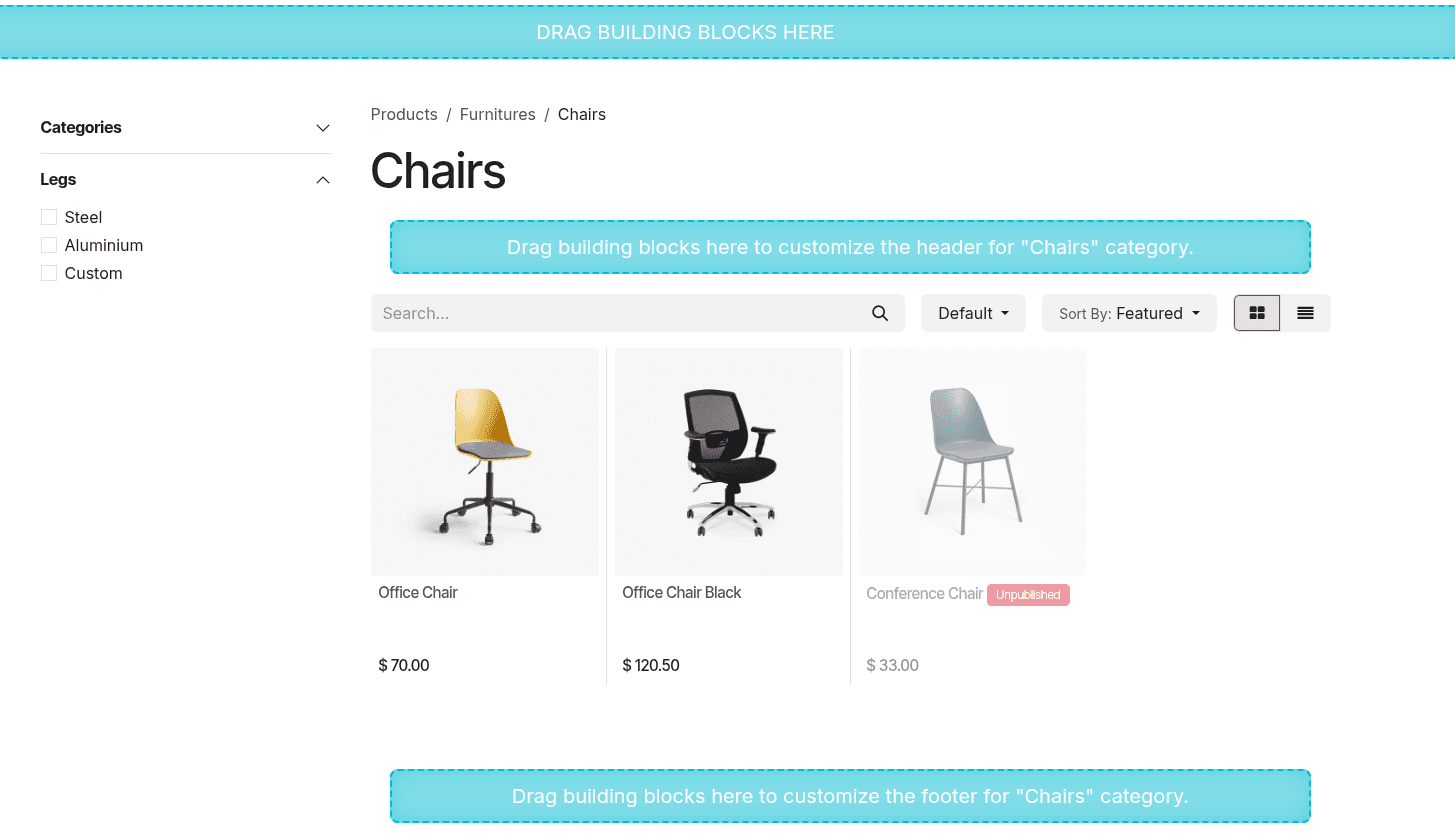
Website Builder
Design and launch professional websites with Odoo’s drag-and-drop builder, allowing you to easily customize pages, add content, and create a polished online presence without coding.
Reporting and Analytics
Generate customizable reports on sales, inventory, and project status. Dashboards provide real-time insights for better decision-making.
Ease of Use
Odoo offers a modern, intuitive interface, but its depth and modularity can make onboarding complex for new users. Many reviewers note that configuring workflows and customizing modules often requires technical knowledge or IT support. While everyday navigation is straightforward and relatively user-friendly once set up, a steep learning curve is definitely a barrier of entry compared to simpler tools. Odoo is best suited for teams willing to invest time in setup to unlock its full flexibility and feature set.
Integrations
Odoo integrates with Google Drive, Gmail, QuickBooks, Microsoft Azure, Microsoft Outlook, and Unsplash, among others. Though it should be noted that some of these integrations and connectors are paid through their Odoo Apps store.
Odoo also offers a robust API and connects with third-party integration tools for custom workflows.
Odoo Specs
- 360 Degree Feedback: Yes
- API: Yes
- Attendance Tracking: Yes
- Batch Permissions & Access: Yes
- Budgeting: Yes
- Calendar Management: Yes
- Dashboard: Yes
- Data Export: Yes
- Data Import: Yes
- Data Visualization: Yes
- Employee Database: Yes
- Employee Engagement: Yes
- Employee Incentive Management: Yes
- Employee Onboarding: Yes
- Expense Tracking: Yes
- External Integrations: Yes
- Feedback Management: Yes
- Forecasting: Yes
- Multi-Currency: Yes
- Multi-User: Yes
- Notifications: Yes
- Scheduling: Yes
- Timesheets: Yes
- Travel Management: Yes
- Vacation & Absence Calendar: Yes