
Tech CPO says product leaders are asking the wrong questions — and missing the biggest opportunities
Emrecan Dogan
CPO at Glean
Discover why AI is pushing product leaders to redesign workflows, prioritize trust, and focus on context and judgment instead of simply adding AI features.
Key Takeaways
AI as Opportunity: AI should be seen as a fundamental shift in product design rather than just another feature.
Contextual Systems: Building AI solutions requires understanding user context to effectively aid decision-making across various roles.
Workflow Redesign: AI transforms product scope; focus should shift to full workflows instead of isolated features.
Building Trust: Early design must incorporate trust and evaluation processes to avoid user skepticism and product failure.
Interdisciplinary Collaboration: AI-driven products necessitate closer collaboration among teams, breaking down traditional role boundaries.
Emrecan Dogan is CPO at Glean. He also held product leadership roles at Stripe and LinkedIn.
We caught up with him to get a sense of how PM perspectives need to shift with AI. He said most teams are still treating AI like a feature — and that's a mistake.
AI is an opportunity to build context-aware systems
I’m Emrecan Dogan, Chief Product Officer at Glean. I oversee product, data science, product operations, and technical programs, and I focus on helping teams truly rely on AI for their daily work.
My path has always sat at the intersection of systems, product judgment, and scale. Before Glean, I worked in product leadership roles at Stripe and LinkedIn. I also spent time with startups and investing, which gave me a front-row seat to how platform shifts happen and how quickly product assumptions can break when new technology becomes viable.
AI pulled me in so deeply because it’s not just another feature wave. It changes the shape of the product itself. For years, software mostly helped users navigate systems of record. But AI gives us the chance to build systems that understand context, reason across tools, and help people move from intent to execution. As a product leader, I am most interested in that transformation.

Emrecan Shares
For years, software mostly helped users navigate systems of record. But AI gives us the chance to build systems that understand context, reason across tools, and help people move from intent to execution. As a product leader, I am most interested in that transformation.
More Articles
The challenge of building tools that are both broad and precise
My organization builds AI for secure, enterprise-scale work: enterprise search, proactive assistants, agents, and the context layer that helps those experiences understand a company’s people, knowledge, tools, and permissions.
The product is fundamentally horizontal. We build for any department and team across the enterprise — from product and engineering, to sales and support, to IT, HR, finance, legal, and more. All of them share the same common need: helping people make decisions and get work done across a fragmented landscape of apps, documents, conversations, and systems.
We deliver this as an enterprise SaaS platform, designed to operate across a broad and complex set of systems while remaining deeply permission-aware, reliable, and embedded in users’ daily workflows. The challenge — and the opportunity — is building something that can be broadly useful across the entire company, while still feeling precise and relevant in each team’s specific context.
How AI changes products from features to workflows
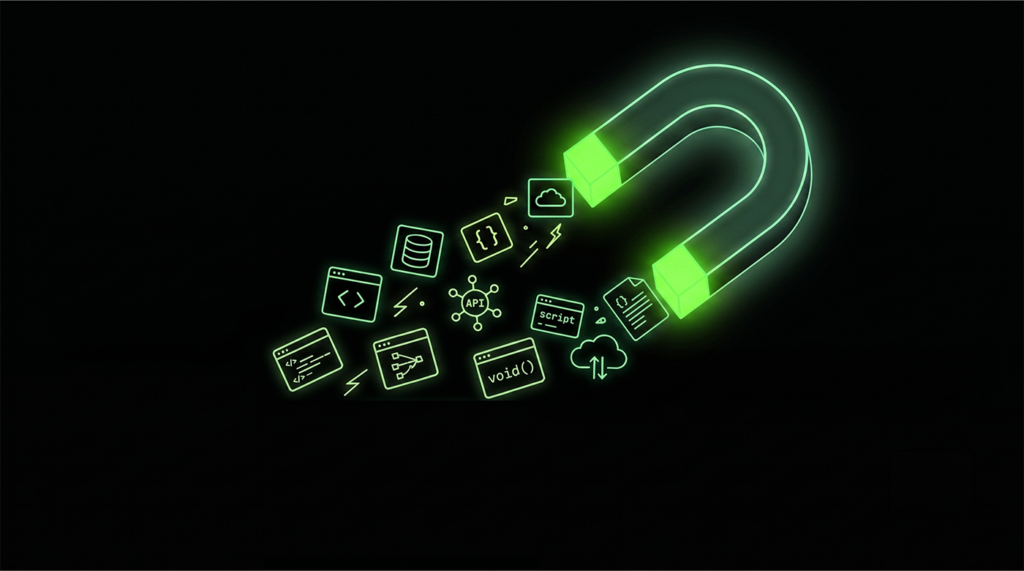
We no longer define the product primarily as isolated features. We define it as an end-to-end product workflow.
A year ago, many teams, including ours, still thought in terms of “Where does this feature live?” or “What page should own this use case?” AI pushed us to ask a different question: “How does the user get the job done from intent to outcome?”
That sounds subtle, but it changes everything. It changes scope, metrics, evaluation, UX, and even how teams are organized.
My non-consensus take: Most teams still underestimate how deep this change is. They are using AI to add a feature to the existing product. But the bigger opportunity is to redesign the entire loop of work.
In many cases, the right question is no longer "Where do we put this capability?" It is, "Which existing UI should disappear because the system can now do the work more directly?"
How AI informs product decisions while humans ensure trust
I use AI heavily for synthesis, exploration, and accelerating my work. Tasks include:
- Summarizing customer feedback across many inputs
- Pulling patterns from usage and workflow data
- Drafting PRD structure or framing options
- Exploring multiple UX directions quickly
- Pressure-testing assumptions
- Creating first-pass artifacts for planning, reviews, and communication
What remains explicitly human is judgment. Many people draw the human-machine boundary in the wrong place. The line is not that AI does low-value work and humans do high-value work. The line is that AI should do the broad search, compression, and option generation, while humans remain accountable for taste, trust, and irreversible tradeoffs.
I would never outsource product taste. Generating options is cheap now. Coherent judgment is not.

I would never outsource product taste. I would never outsource permissioning or trust decisions. And I would never let a model make the final call on what should be built simply because it can argue for multiple options.
Generating options is cheap now. Coherent judgment is not.
How AI enhances product planning workflows
Let's take our product planning workflow as an example.
I might start with a broad question like: “Help me think through whether this problem is worth solving now.”
From there, the system pulls together customer feedback, prior internal docs, usage signals, related roadmap work, and competitive context. And I use AI to synthesize the main patterns, identify open questions, and draft a first-pass product framing.
Next, I use it to turn that framing into more concrete artifacts: a draft spec, a set of options, dependencies, launch considerations, and action items for the team.
And in the strongest version of this workflow, the assistant doesn’t stop at drafting. It helps create or update the underlying objects in the systems where work happens, with a human in the loop before anything is committed.
The workflow moves from research to synthesis to execution in one continuous loop. That is where AI becomes much more valuable than a chatbot.
Why AI accelerates product development, but challenges trust

A positive result of all this is that the ceiling is dramatically higher.
AI can compress workflows that previously required extensive tab-switching, manual synthesis, and repetitive coordination. It can make product teams faster at getting from question to context, from context to decision, and from decision to action. It also elevates user expectations. Once people experience an assistant that can understand their tools, history, and permissions, they stop wanting point solutions that only answer narrow questions.
So, AI expands possibility fast, but durable product value still comes from rigor.
How designing for trust prevents AI product pitfalls
A negative result is that AI also makes it easier to ship something impressive that is not yet trustworthy. Early on, many teams over-index on demo value and under-index on evaluation, permissions, reliability, and UX clarity regarding the system's function. You can create excitement quickly, but if outputs are inconsistent or the workflow breaks in the last mile, users lose trust just as quickly.
Trust should not be a layer you add later. It is part of the product from day one.
Users are asking deeper questions almost immediately: Where did this come from? Why did it do that? Can I rely on it? Will it respect permissions? What happens if it’s wrong? If you do not design for those questions early, you end up rebuilding core parts of the product later.
If I had known that more viscerally early in my product leadership, I would have pushed even earlier on clear citations, better evals, stronger progress visibility, and tighter human-in-the-loop controls.
Why the system surrounding AI matters most
AI has not yet consistently delivered on fully autonomous, long-horizon workflows as many people hoped.
It excels at bounded tasks. It improves at multi-step execution. But when facing ambiguous, cross-functional work requiring sustained judgment, changing goals, and a nuanced understanding of stakeholders, the gap between a strong demo and dependable production value is still real.
AI also under-delivers whenever teams assume the model alone is the product. In practice, the real value comes from context, permissions, orchestration, evaluation, and thoughtful workflow design. Without that surrounding system, the model is often the least differentiated part.
Emrecan Shares
It (AI) excels at bounded tasks. It improves at multi-step execution. But when facing ambiguous, cross-functional work requiring sustained judgment, changing goals, and a nuanced understanding of stakeholders, the gap between a strong demo and dependable production value is still real.
How AI makes product teams interdisciplinary
AI has made the best teams more interdisciplinary. The boundaries between PM, design, engineering, data science, and product operations are less rigid because the product itself is less rigid.
Building strong AI-native products requires closer collaboration on workflow design, evaluation, trust, and iteration. It also raises the importance of people who can zoom between user experience and system behavior.
How product leaders should adapt to AI-driven change

Here's my advice:
- Redesign your workflows.
- Treat context as a core product primitive. In AI products, the difference between something magical and something mediocre is often not the model. It is whether the system has the right context at the right moment and can act on it safely.
- Invest in evals and trust infrastructure earlier than feels natural. Product leaders are used to instrumenting clicks and funnels. In AI, you also need to instrument quality, grounding, safety, permissions, and task success. That is not optional. The industry still underinvests here because demos reward novelty and users reward reliability. Invert the usual order of operations: If your team has not built evals, permissioning, citations, and clear handoffs, you are not ready to scale the experience, no matter how good the model looks in a demo.
- Finally, don’t wait for certainty. This is a moment to learn by shipping, but with discipline.
Here’s my advice: Redesign your workflows. Treat context as a core product primitive. Invest in evals and trust infrastructure earlier than feels natural. Finally, don’t wait for certainty.
Follow along
You can follow Emrecan Dogan's work on LinkedIn.
More expert interviews to come on The CPO Club!