
Reseña de monday dev: ventajas, desventajas, funciones y precios explicados
En mi carrera, he utilizado muchas herramientas de gestión de productos, incluyendo monday dev. En esta reseña exhaustiva, evaluaré los precios de la herramienta, alternativas, ventajas y desventajas, público objetivo y más.

Revisamos las herramientas de forma independiente y las comisiones ayudan a financiar nuestras pruebas. Consulta nuestra política de transparencia, nuestra metodología, o sugiere una herramienta.
monday dev is a product management tool built for software product and engineering teams that need to connect roadmaps, sprints, and backlogs in one place. If your team wants dev-specific workflows—bug tracking, sprint planning, release management—without the configuration overhead that comes with Jira, monday dev is worth a close look. It gives you a visual, flexible workspace that's easier to tailor to your process without needing a dedicated admin to maintain it.
monday dev Evaluation Summary
4.6/5
- From $9/month (billed annually)
- Free trial available
Por qué confiar en nuestras recomendaciones de software
6,700+
Reviews
20
Industry experts
16+
Evaluation factors
14
Years
Nuestro equipo lleva probando y evaluando software desde 2012. Como gestores de producto, sabemos lo difícil —y lo importante— que es elegir el software adecuado.
Para esta guía, evaluamos las herramientas mediante pruebas prácticas e investigación independiente, puntuando las herramientas según nuestros criterios de selección.
Nuestras reseñas reflejan nuestro criterio editorial humano, no un discurso de ventas.
Revisores expertos:
 Hannah ClarkSenior TPM
- Cristiano ValimSenior UI/UX Lead

monday dev Overview
monday dev offers a highly visual, customizable interface and strong integration options, making it a top pick for teams prioritizing flexibility and ease of onboarding. Its automation features and template library simplify setup, while responsive support helps users get started quickly.
Pricing is competitive for mid-sized teams, though advanced reporting and granular permissions may lag behind some alternatives. If you’re judging options for cross-functional collaboration or need to adapt workflows without heavy admin overhead, monday dev is a strong contender—especially for SaaS, product, and engineering teams seeking a balance of usability and depth.
Pros
- You can create forms that live within your project as a view.
- Its integrated proofing feature allows you to add comments to any attached file.
- Automations are easy to create and require no coding.
Cons
- The Gantt view is not useful to build a project.
- Subtask columns do not replicate task structure, needing more customization.
- Training videos have the old UI, making it confusing when learning the tool.
Is monday dev Right For Your Needs?
Who Would be a Good Fit for monday dev?
monday dev is perfect for agile tech teams in startups and IT departments looking for customizable workflows. Its easy-to-use automations and integrated proofing help your team streamline tasks without needing coding skills. Marketing teams also benefit from its form creation feature, which allows you to gather data directly within projects. If your team thrives on visual project management and needs flexibility, monday dev’s adaptable interface and seamless communication tools make it a strong choice.
- Tech StartupsYou’ll benefit from monday dev’s flexible project views and integrations that cater to fast-paced environments.
- IT DepartmentsUse monday dev’s automation features to reduce repetitive tasks and keep your projects moving efficiently.
- Marketing TeamsYou’ll find value in its form creation and proofing tools, which streamline campaign management.
- Creative Agenciesmonday dev’s visual layout and task comment features enhance collaboration on creative projects.
- Small BusinessesIts user-friendly interface and quick onboarding are ideal for teams needing a scalable solution.
- Project ManagersYou’ll appreciate the customizable dashboards that provide real-time insights into your project’s progress.
Who Would be a Bad Fit for monday dev?
Large enterprises with complex project hierarchies might find monday dev lacking in advanced Gantt chart capabilities. If your team relies heavily on detailed task dependencies and extensive subtask structures, you could encounter limitations. Teams needing a highly detailed, structured approach to project management may struggle with monday dev’s focus on flexibility and visual management rather than depth in hierarchical task planning.
- Large EnterprisesYou might find its Gantt view insufficient for managing complex project hierarchies.
- Construction Companiesmonday dev’s lack of detailed task dependencies can hinder projects with intricate timelines.
- Legal TeamsIts visual and flexible setup may not align with your need for linear, document-heavy workflows.
- Finance DepartmentsYou could find its task tracking less suited to the precise data management your work demands.
- Manufacturing FirmsThe absence of detailed task replication could limit efficiency in your structured processes.
- Engineering TeamsYou’ll miss advanced dependency tracking necessary for technical project planning.
Cómo Probamos y Puntamos Herramientas
Llevamos años construyendo, refinando y mejorando nuestro sistema de pruebas y puntuación de software. La rúbrica está diseñada para captar los matices de la selección de software y lo que hace que una herramienta sea eficaz, centrándose en aspectos críticos del proceso de decisión. A continuación, puedes ver exactamente cómo funcionan nuestras pruebas y puntuaciones a través de siete criterios. Esto nos permite proporcionar una evaluación imparcial del software según funcionalidad principal, características destacadas, facilidad de uso, implementación, soporte al cliente, integraciones, reseñas de clientes y relación calidad-precio.
Funcionalidad Principal (25% de la puntuación final)
El punto de partida de nuestra evaluación siempre es la funcionalidad principal de la herramienta. ¿Cuenta con las funciones básicas que un usuario espera ver? ¿Alguna de esas funciones centrales está limitada a planes de precios superiores? Esperamos que una herramienta esté a la altura de las capacidades básicas de sus competidores.
Características Destacadas (25% de la puntuación final)
Luego evaluamos características especiales poco comunes que van más allá de la funcionalidad principal que normalmente se encuentra en herramientas similares. Una alta puntuación refleja características especializadas o únicas que hacen que el producto sea más rápido, eficiente u ofrezca valor añadido al usuario. También evaluamos lo fácil que es integrar con otras herramientas habituales en el entorno tecnológico para ampliar la funcionalidad y utilidad del software. Las herramientas que ofrecen integraciones nativas abundantes, conexiones de terceros y acceso por API para crear integraciones personalizadas obtienen la mejor puntuación.
Facilidad de Uso (10% de la puntuación final)
Consideramos lo rápido y sencillo que es llevar a cabo las tareas definidas en la funcionalidad principal usando la herramienta. El software con alta puntuación está bien diseñado, es intuitivo, ofrece apps móviles, tiene plantillas y hace que tareas relativamente complejas parezcan simples.
Implementación (10% de la puntuación final)
Sabemos lo importante que es la adopción rápida del equipo para una nueva plataforma, así que evaluamos la facilidad de aprendizaje y uso de una herramienta con entrenamiento mínimo. Evaluamos cuán rápidamente un miembro del equipo puede configurar y empezar a usar la herramienta sin experiencia previa. Las soluciones con alta puntuación indican que se requiere poco o ningún soporte.
Soporte al Cliente (10% de la puntuación final)
Revisamos lo rápido y sencillo que es desatascarse y encontrar ayuda por teléfono, chat en vivo o base de conocimientos. Los productos y empresas que ofrecen soporte en tiempo real obtienen mejor puntuación, mientras que los chats automáticos obtienen la peor.
Reseñas de Clientes (10% de la puntuación final)
Más allá de nuestras propias pruebas y evaluaciones, consideramos el net promoter score de clientes actuales y pasados. Revisamos su probabilidad, dadas las opciones, de elegir la herramienta de nuevo por su funcionalidad principal. Un software con alta puntuación refleja un alto net promoter score de clientes actuales o anteriores.
Relación Calidad-Precio (10% de la puntuación final)
Por último, teniendo en cuenta todos los demás criterios, revisamos el precio promedio de los planes de nivel de entrada frente a las funcionalidades principales y consideramos el valor de los demás criterios de evaluación. El software que ofrece más por menos, obtendrá una puntuación mayor.
Core Features
Visual Boards
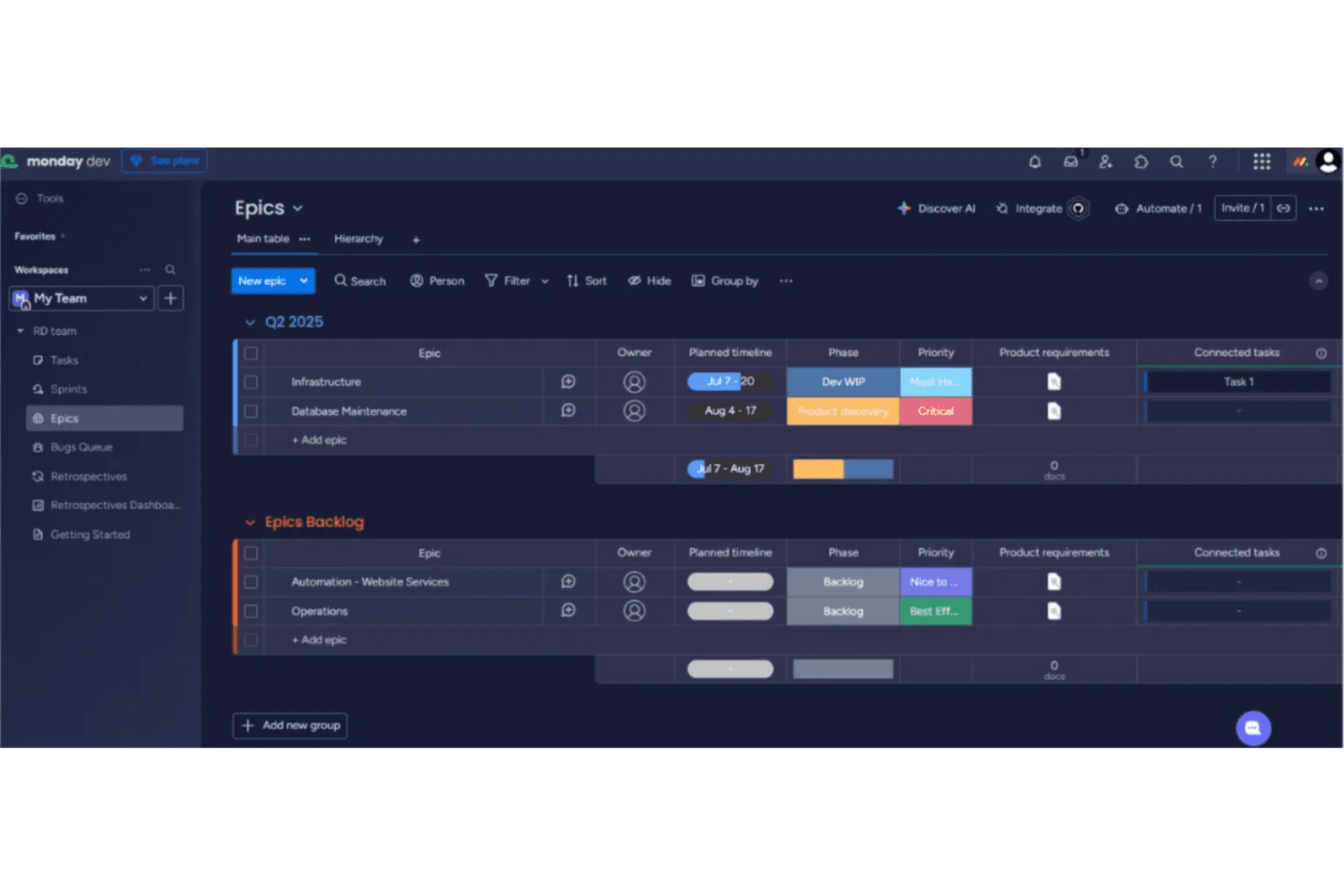
Organize tasks, sprints, and backlogs using drag-and-drop boards. Color-coded statuses and customizable columns make tracking progress easy.
Automations
Set up rules to trigger notifications, status changes, or task assignments. Automations reduce manual updates and keep workflows moving.
AI-Powered Summaries
Generate meeting notes, standup recaps, and task summaries with built-in AI tools. This helps teams quickly share updates and decisions.
Sprint Management
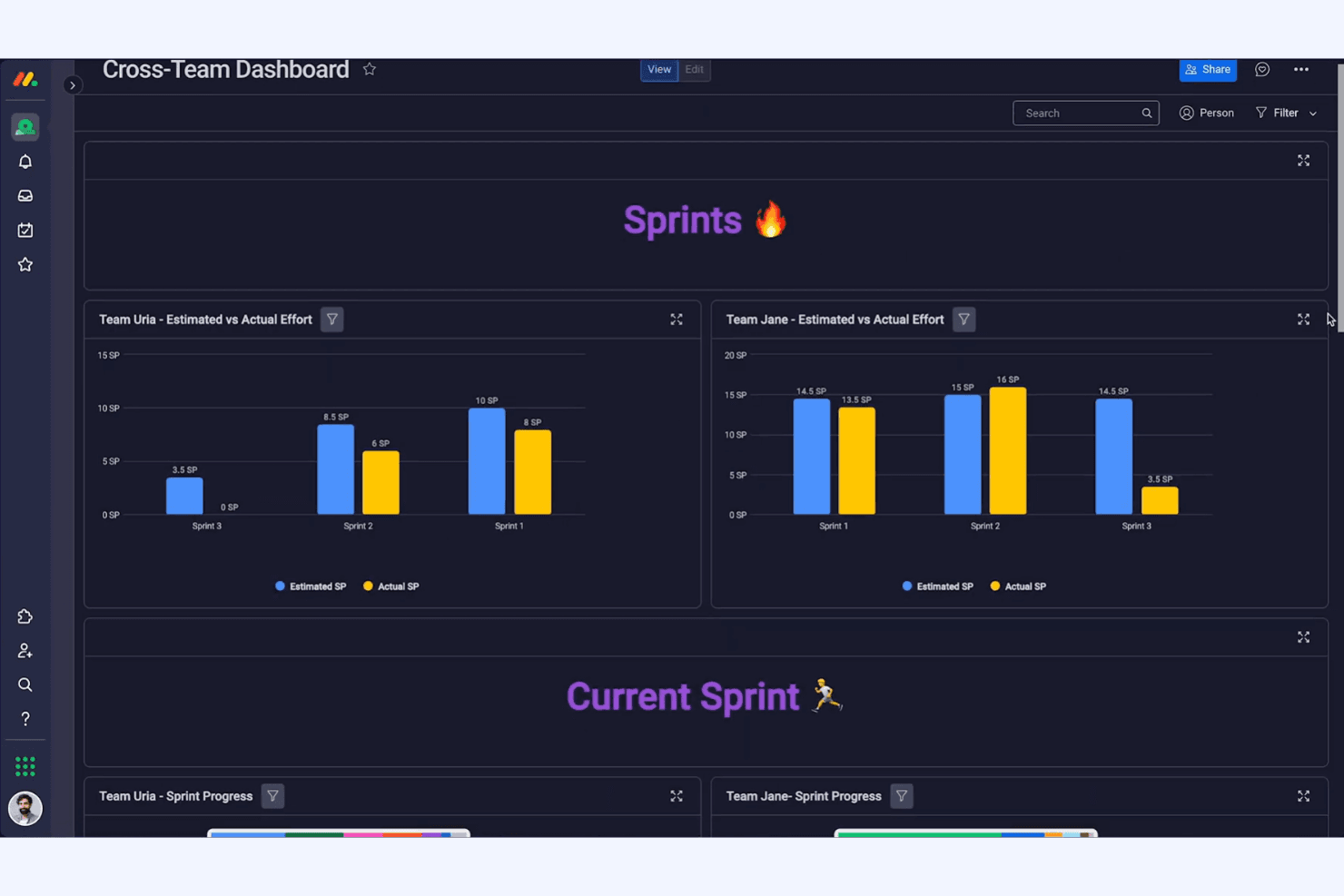
Plan, execute, and review sprints with dedicated templates and tracking tools. Burndown charts and velocity tracking support agile teams.
Custom Dashboards
Build dashboards to visualize project health, team workload, and key metrics. Widgets let you tailor views for different stakeholders.
Backlog Prioritization
Rank and categorize product ideas, bugs, and feature requests in a centralized backlog. Prioritization tools help teams focus on high-impact work.

Ease of Use
monday dev is widely recognized for its intuitive, visually-driven interface that helps new users get started quickly. Drag-and-drop boards, clear status indicators, and guided onboarding make it accessible for both technical and non-technical teams. Users often highlight the ease of customizing workflows and dashboards without coding. While some advanced features require setup, most teams can adapt monday dev to their processes with minimal training, making it a practical choice for fast-moving organizations.
Integrations
monday dev integrates with Slack, Jira, GitHub, Google Drive, Microsoft Teams, Zoom, Dropbox, Salesforce, Zendesk, and Outlook, among others.
It also offers a public API and connects with third-party integration tools like Zapier and Make for expanded automation and connectivity.

monday dev Specs
- A/B Testing: No
- Access Management: Yes
- API: Yes
- Bug Tracking: Yes
- Cloud Deployment: Yes
- Code Transformation: No
- Collaboration Support: Yes
- Data Export: Yes
- Data Import: Yes
- Data Visualization: Yes
- Document Management: No
- External Integrations: Yes
- Form Builder: Yes
- History/Version Control: Yes
- Migration to Cloud: No
- Multi-User: Yes
- Notifications: Yes
- Process Modeling: No
- Re-Platforming: No
- Software Integration: Yes
- Status Notifications: Yes
- Template Designer: Yes
- Third-Party Plugins/Add-Ons: Yes
- Workflow Management: Yes


