

AI market research tools are software platforms that use artificial intelligence to collect, analyze, and interpret market data faster and more accurately than traditional methods. If you’re searching for better ways to uncover trends, understand your audience, or outsmart your competitors, these solutions let your team harness data-driven insights without manual busywork.
This list will help you compare how different platforms leverage generative AI alongside standard research features in 2026, so you can choose the right platform to power smarter decisions, elevate your business strategy, and stay ahead in a rapidly changing market.
Why Trust Our Software Recommendations
6,700+
Reviews
20
Industry experts
16+
Evaluation factors
14
Years
Our team has been testing and reviewing software since 2012. As product managers ourselves, we know how difficult—and important—it is to choose the right software.
For this guide, we evaluated tools using hands-on testing and independent research, scoring tools using our selection criteria.
Our reviews reflect our human editorial judgment, not a sales pitch.
- Andrew LumbySenior TPM
- Cristiano ValimSenior UI/UX Lead
AI Market Research Tools Comparison Table
This comparison table summarizes pricing details for my top AI market research tool software selections:
| Tool | Best For | Trial Info | Price | ||
|---|---|---|---|---|---|
| 1 | Best for integrating social media insights | Free demo available | Pricing upon request | Website | |
| 2 | Best for real-time digital consumer intelligence | Free demo available | Pricing upon request | Website | |
| 3 | Best for collaborative qualitative data synthesis | Free plan + free demo available | Pricing upon request | Website | |
| 4 | Best for AI-powered financial market analysis | Free demo available | Pricing upon request | Website | |
| 5 | Best for sales enablement via competitive insights | Free demo available | Pricing upon request | Website | |
| 6 | Best for identifying real-time consumer trends | Free trial + free demo available | Pricing upon request | Website | |
| 7 | Best for centralizing multi-channel feedback | Free demo available | Pricing upon request | Website | |
| 8 | Best for access to global opinion data | Free demo available | Pricing upon request | Website | |
| 9 | Best for automating advanced consumer insights | Free demo available | Pricing upon request | Website | |
| 10 | Best for end-to-end AI voice research at scale | Free demo available | From $150/month | Website |


Best AI Market Research Tools Reviews
Below are my detailed summaries of the best AI market research tools that made it onto my shortlist. My reviews offer a detailed look at the features, capabilities, and use cases of each platform to help you find the best one for you.
 Best for integrating social media insights
- Free demo available
- Pricing upon request
Visit WebsiteRating:3.9/5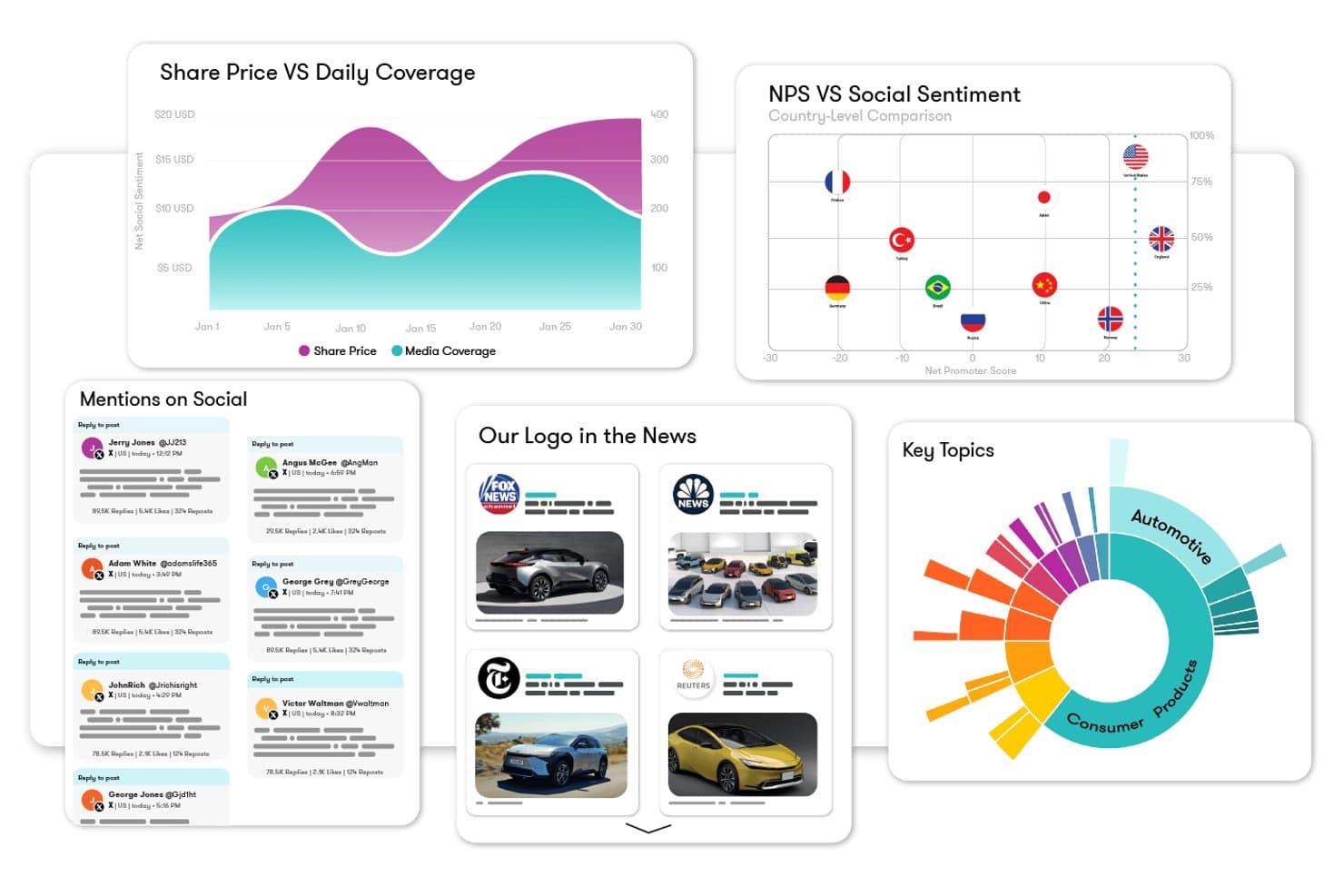
Meltwater centralizes media, social, and sentiment data in one research dashboard. Meltwater is a media intelligence and social listening platform that monitors news, social media, forums, podcasts, and LLM outputs, with AI-powered tools for sentiment analysis, competitive benchmarking, and trend detection.
Who Is Meltwater Best For?
Meltwater is a strong fit for product marketing managers and brand strategists who need to track competitive narratives, monitor social conversations, and understand how their brand appears across both media and AI platforms.
Why I Picked Meltwater
Meltwater earns its spot on my shortlist because no other tool I've tested pulls social signals, news, forums, and Reddit's full firehose into a single AI layer the way it does. I particularly like GenAI Lens, which tracks how your brand and competitors are discussed across ChatGPT, Gemini, and Perplexity—something purpose-built research platforms simply don't offer. Mira's Share of Voice dashboards and sentiment benchmarking make it easy to see exactly where your narrative stands relative to competitors across channels.
Meltwater Key Features
- BYOC (bring your own content): Upload internal research artifacts like interview transcripts and survey data to analyze alongside external media signals in one place.
- Predictive spike forecasting: A 48-hour forecasting model predicts whether an emerging conversation trend will grow or fade before it peaks.
- Meltwater MCP server: Connects AI assistants like Claude or ChatGPT directly to Meltwater's live data for natural-language queries with source attribution.
- AI-powered boolean search builder: Automatically constructs complex search queries from plain-language prompts, reducing manual query setup time.
Meltwater Integrations
Meltwater integrates with Slack, Microsoft Teams, Microsoft 365, Claude, ChatGPT via its MCP server, Power BI, Tableau, and Salesforce. Pro and Enterprise plans include API access for custom connections to business intelligence platforms, data warehouses, and internal dashboards.
Pros and Cons
Pros:
- Predicts trends with AI-powered spike forecasting
- Monitors brand mentions across major AI platforms
- Synthesizes external and internal data sources
Cons:
- Lacks native video or interview analysis
- No survey panels or respondent recruitment
Learn more about Meltwater: Best for real-time digital consumer intelligence
- Free demo available
- Pricing upon request
Visit WebsiteRating:0.0/5
Brandwatch offers an AI-assisted ad creation interface for social media ads with writing suggestion tools. Brandwatch is an AI-driven consumer intelligence platform for market research teams, offering real-time analytics, social listening, audience insights, and digital trend tracking across web and social media channels.
Who Is Brandwatch Best For?
Brandwatch is a strong choice for digital marketing and consumer insights teams at enterprise brands that need detailed, real-time analysis of online conversations.
Why I Picked Brandwatch
I picked Brandwatch because it lets my team monitor millions of digital conversations and trends as they happen. I use its AI-powered analytics and customizable dashboards to surface actionable consumer intelligence in real time.
Brandwatch Key Features
- Influencer identification: Surfaces influential voices and profiles driving online trends, giving you a boost in competitive intelligence.
- Custom audience segments: Lets you build dynamic groups using demographic, keyword, or behavioral filters.
- Image analysis: Detects brand logos and objects in social and web images for deeper visual tracking.
- Automated reporting: Generates scheduled custom reports that deliver targeted metrics to stakeholders.
Brandwatch Integrations
Brandwatch offers native integrations with Bitly, ServiceNow, Shopify, Tipalti, Box, Bynder, Zendesk, Dropbox, HubSpot, Salesforce Service Cloud, and more, and provides an API for custom integrations.
Pros and Cons
Pros:
- Granular sentiment and demographic audience insights
- Custom AI-powered trend detection and alerts
- Real-time monitoring across millions of online sources
Cons:
- Large data exports require additional steps
- Dashboard setups can be time-consuming
Learn more about Brandwatch: Best for collaborative qualitative data synthesis
- Free plan + free demo available
- Pricing upon request
Visit WebsiteRating:0.0/5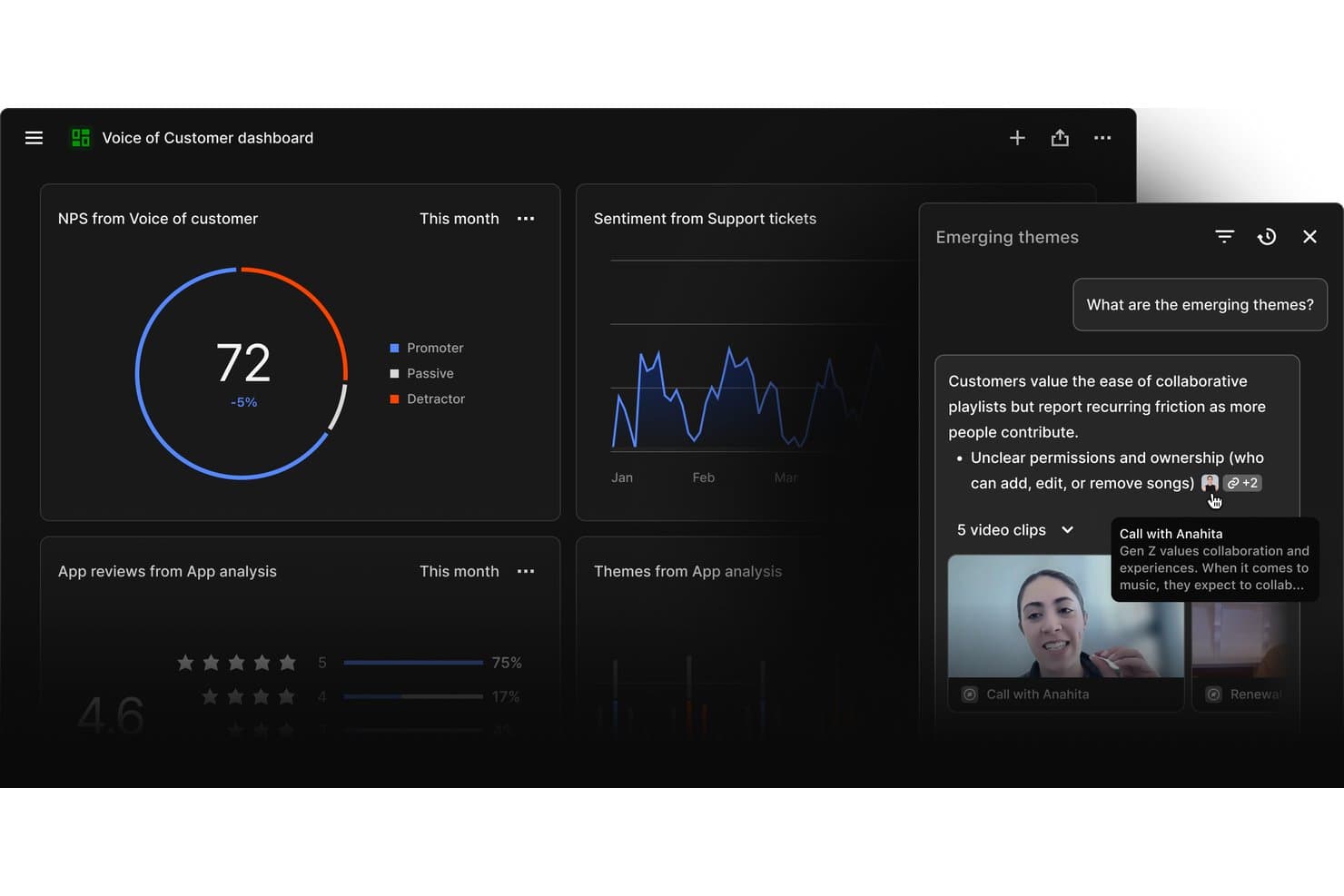
Dovetail surfaces emerging customer themes with AI-linked video evidence. Dovetail is a customer intelligence platform that synthesizes qualitative research data—interviews, call recordings, support tickets, and app reviews—into structured themes, insight reports, and trend dashboards using AI.
Who Is Dovetail Best For?
Dovetail is a strong fit for research-led product teams that need to synthesize large volumes of qualitative customer data—interviews, call recordings, and support tickets—into structured, shareable insights.
Why I Picked Dovetail
Dovetail earns its spot on my shortlist because no other tool I've tested matches its ability to turn raw qualitative data into structured, shareable insight at scale. I particularly like Magic Cluster, which automatically groups interview highlights by theme, and AI Docs, which generates full VoC reports with cited quotes from a single prompt. Digital Twins let my team pressure-test messaging and pricing against evidence-based customer segment models before running a single live study.
Dovetail Key Features
- AI Channels: Automatically classifies incoming support tickets, app reviews, and sales call transcripts into revenue-weighted product opportunities ranked by ARR impact and customer demand.
- AI Research Agents: No-code autonomous agents that monitor customer data on a schedule, generate recurring syntheses, and push findings to Slack, Teams, or email without researcher involvement.
- Insight repository: A centralized, semantically searchable hub that stores all past studies, transcripts, tags, and documents so teams can query historical findings alongside new research.
- Automatic PII redaction: Strips personally identifiable information from text, audio, and video before data enters the workspace, supporting GDPR and HIPAA compliance requirements.
Dovetail Integrations
Dovetail offers 38+ native integrations, including Jira, Linear, Productboard, Salesforce, HubSpot, Gong, Zendesk, Sprig, Pendo, PostHog, Slack, and Microsoft Teams. It also supports Google Calendar, Outlook 365, API, MCP, and CLI connectivity for custom data pipelines.
Pros and Cons
Pros:
- Supports AI-driven segment simulation for concept testing
- Links all AI answers to source data
- Synthesizes interviews and calls into structured insights
Cons:
- Advanced features restricted to Enterprise plans
- No external competitor or market signal tracking
Learn more about Dovetail: Best for AI-powered financial market analysis
- Free demo available
- Pricing upon request
Visit WebsiteRating:0.0/5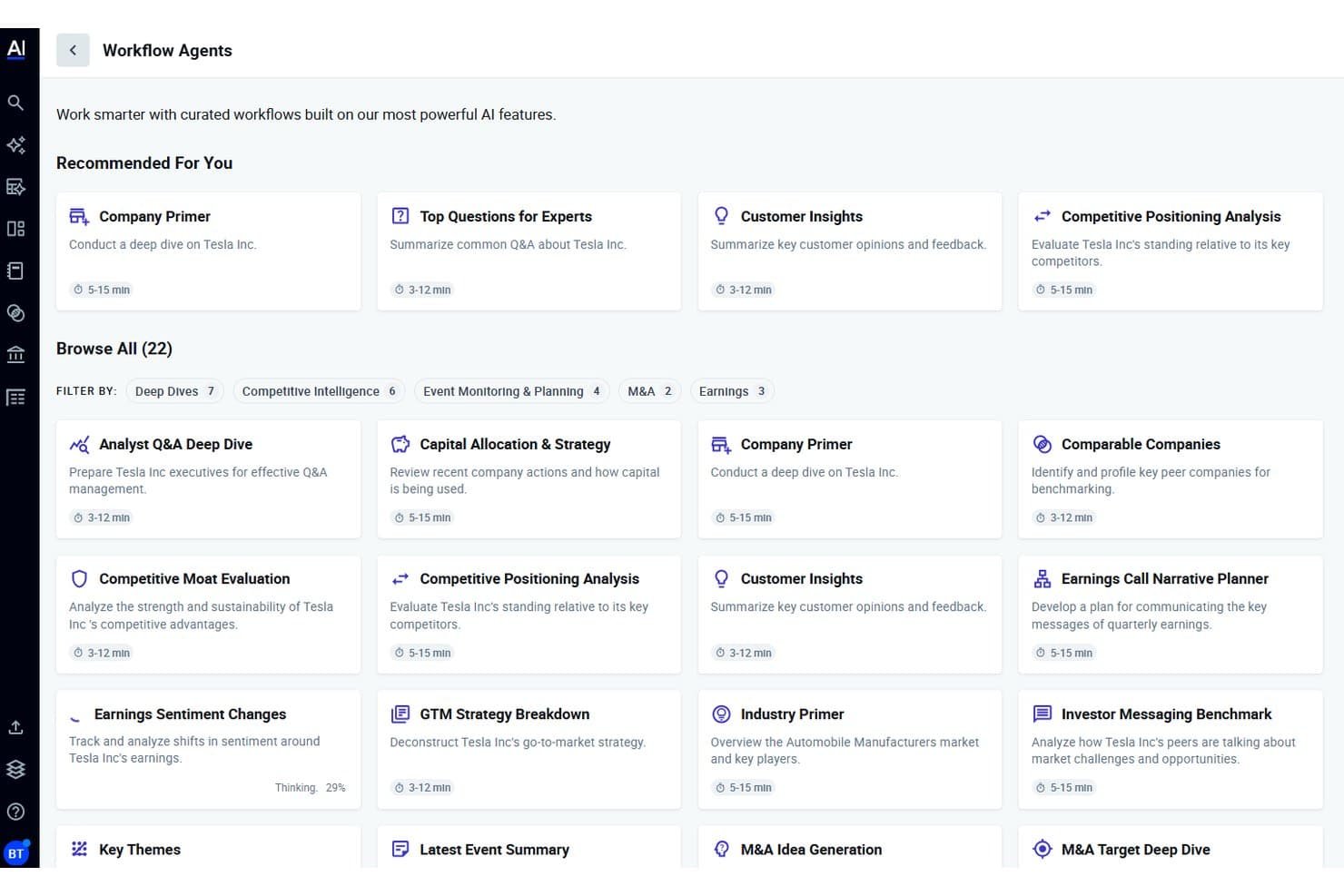
AlphaSense lets users run AI-powered research workflows on companies. AlphaSense is an AI-powered market and competitive intelligence platform that aggregates financial filings, broker research, expert call transcripts, and premium news into a unified search and synthesis environment.
Who Is AlphaSense Best For?
AlphaSense is a strong fit for product strategy directors and product marketing managers at enterprise companies who need deep competitive and market intelligence grounded in financial data.
Why I Picked AlphaSense
AlphaSense earns its spot on my shortlist because no other tool I've tested matches its depth of AI-powered financial market analysis. Its Deep Research agent autonomously scans thousands of earnings transcripts, broker reports, and regulatory filings to produce cited, decision-ready reports in minutes. I also rely on Smart Summaries to instantly extract SWOT analyses and competitive landscape snapshots from earnings calls, which is invaluable when tracking category shifts for roadmap and positioning work.
AlphaSense Key Features
- Generative Grid: Runs multiple AI prompts across many documents simultaneously, outputting organized, table-formatted answers for peer comparisons and transcript analysis.
- Snippet Explorer: Tracks specific topics and themes across the full content library over time, letting you spot trend shifts in how a subject is discussed.
- Automated monitoring and alerts: Continuously watches competitors, market moves, and industry topics across millions of documents, delivering configurable alerts in real time or on a schedule.
- Sentiment analysis: Color-codes emotion and tone across financial text, letting you filter search results by positive or negative sentiment to catch inflection points in earnings calls and filings.
AlphaSense Integrations
AlphaSense supports 20+ documented internal-content connectors, including Box, Dropbox, Google Drive, Microsoft SharePoint, Slack, Salesforce, Notion, Zoom, and Gong. Its ingestion API supports custom sources, but native integrations with product research tools and survey platforms aren’t documented.
Pros and Cons
Pros:
- Real-time alerts track competitors and market shifts
- Autonomous agent produces cited research in minutes
- Deepest available library for financial research
Cons:
- Isn’t designed for product or UX research
- Lacks survey or user feedback analysis tools
Learn more about AlphaSense: 5Best for sales enablement via competitive insights
Klue
- Free demo available
- Pricing upon request
Visit WebsiteRating:0.0/5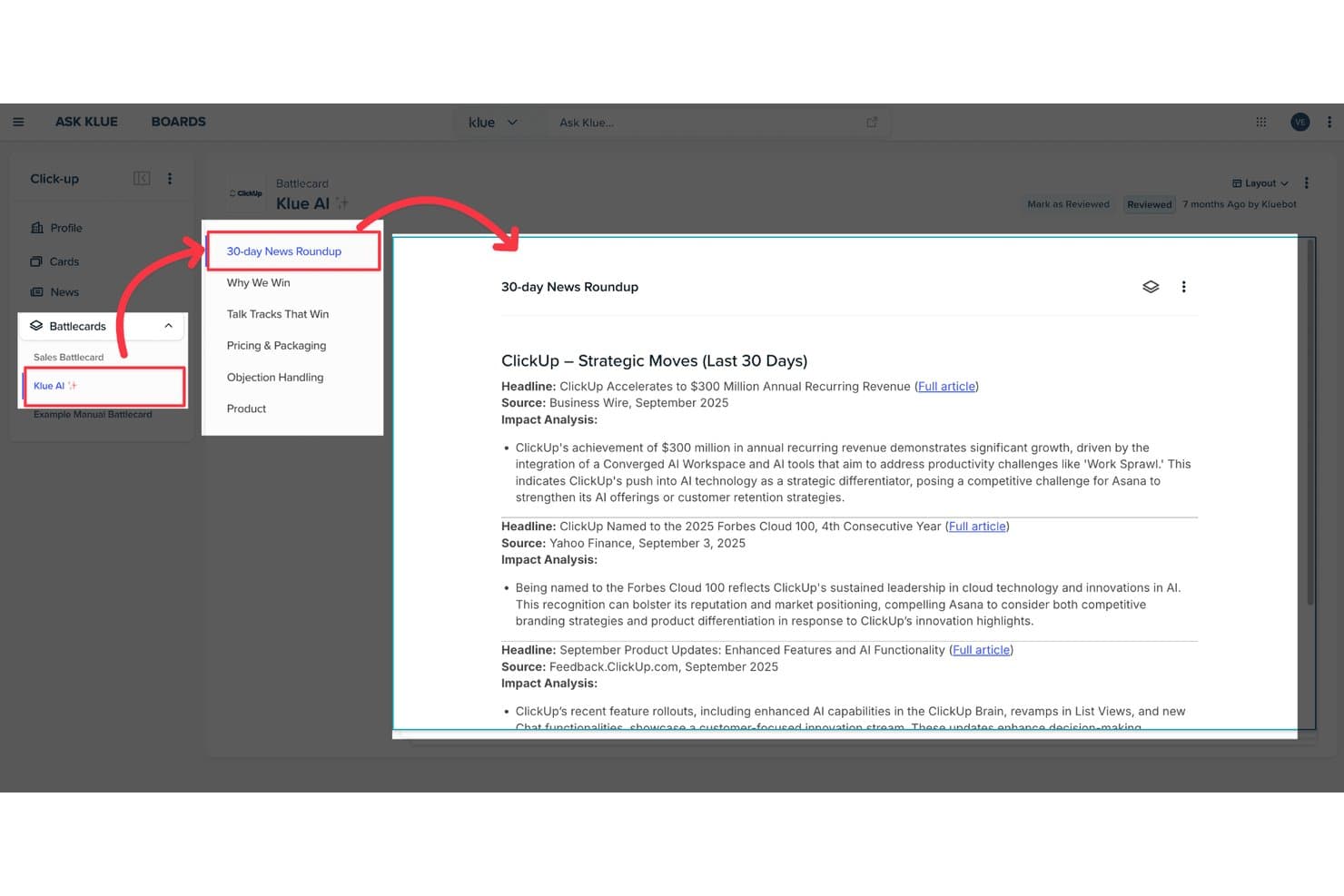
Klue delivers AI-generated competitor news roundups inside battlecards. Klue is a competitive intelligence and win-loss analysis platform that monitors competitor activity, analyzes buyer feedback, and delivers deal-specific insights to sales and product marketing teams.
Who Is Klue Best For?
Klue is a strong fit for product marketing managers and competitive intelligence teams at B2B companies that need to arm sales reps with deal-ready competitive insights.
Why I Picked Klue
Klue earns its spot on my shortlist because it's the only tool I've found that closes the loop between competitive intelligence and live deal support. I love how the Compete Agent's Deal Assistant automatically detects when a competitor is mentioned on a sales call and pushes deal-specific tips to the rep within minutes, no manual searching required. Pair that with Blindspot Interviews, which surface feedback from buyers who chose a competitor you never even knew you were up against, and you're getting competitive insight most teams simply don't have access to.
Klue Key Features
- Ask Klue: A natural-language AI chat interface that lets you query competitive and win-loss data directly inside Slack, Salesforce, or Microsoft Teams, with cited, sourced answers.
- AI-generated strengths and weaknesses: Automatically pulls competitor reviews from 12+ platforms and organizes findings into structured strength and weakness themes in about 30 seconds.
- Win & Loss Story Agent: Mines closed CRM data and call recordings immediately after a deal closes to generate structured deal recaps with extracted buyer requirements and competitive dynamics.
- MCP connector: Embeds Klue's competitive and win-loss data into third-party AI tools like Claude, enabling real-time battlecard generation and summaries from within external workflows.
Klue Integrations
Klue integrates with Salesforce, Slack, Microsoft Teams, Gong, HubSpot, Microsoft Dynamics 365, Chorus, Seismic, Showpad, and Highspot. Its MCP connector also connects competitive intelligence and win-loss data with Claude and Microsoft Copilot.
Pros and Cons
Pros:
- AI-generated strengths and weaknesses from reviews
- Win-loss insights pipeline supports sales teams
- Specialized in competitor profiling and benchmarking
Cons:
- Lacks panel or target audience recruitment tools
- No concept testing or survey creation features
Learn more about Klue: Best for identifying real-time consumer trends
- Free trial + free demo available
- Pricing upon request
Visit WebsiteRating:5.0/5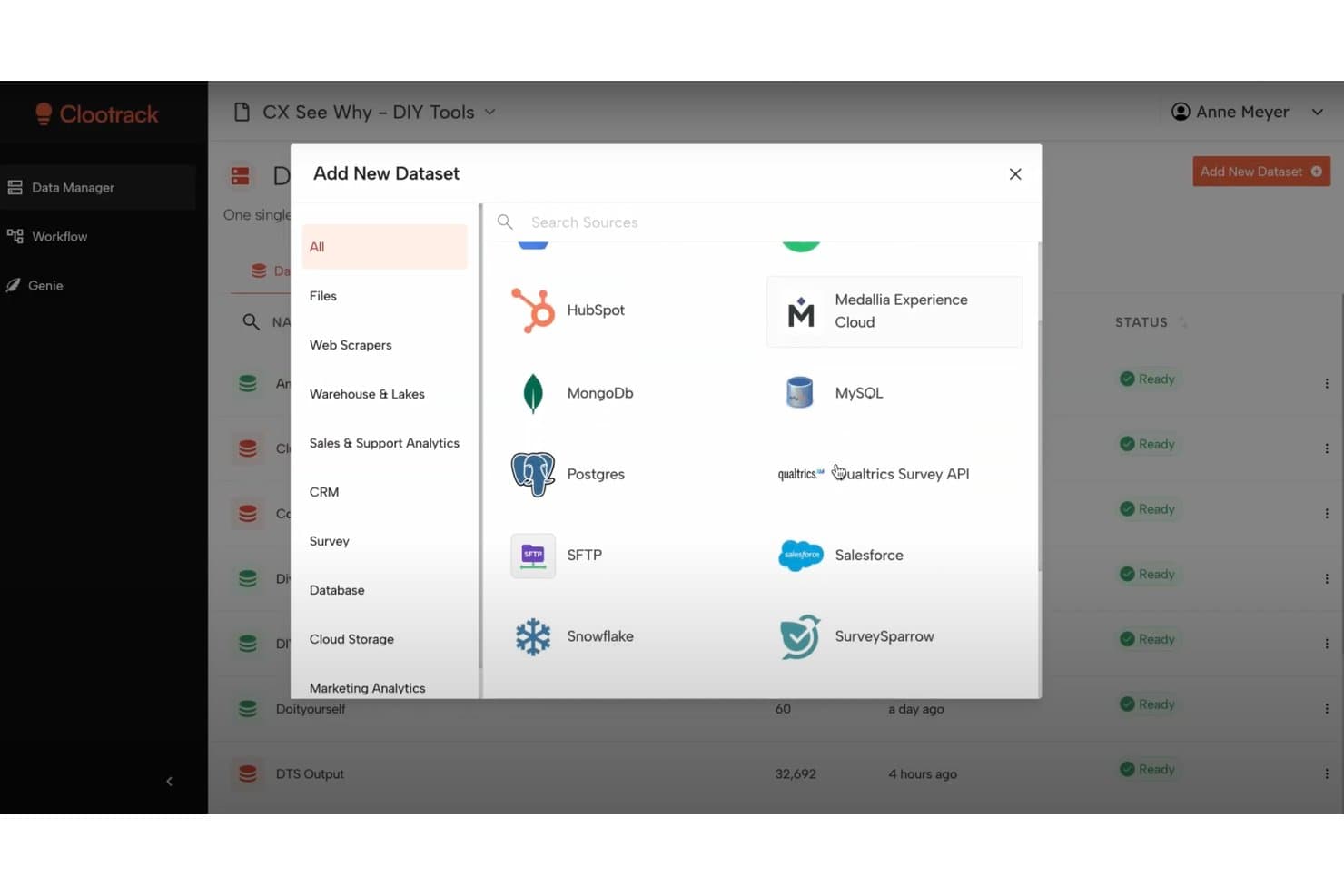
Clootrack is a customer intelligence platform that uses patented unsupervised AI to analyze feedback across 1,000+ data sources—including reviews, call transcripts, and social data—surfacing themes, sentiment shifts, and competitive benchmarks without predefined taxonomies.
Who Is Clootrack Best For?
Clootrack is a strong fit for enterprise product marketing and strategy teams that need always-on visibility into how consumer sentiment is shifting across markets and competitors.
Why I Picked Clootrack
I picked Clootrack as one of the best because its patented unsupervised AI discovers consumer sentiment shifts before you know to look for them. Rather than confirming what you already suspect, it surfaces unknown themes across 1,000+ data sources in real time. I especially like the Growth Research Agent, which compresses research timelines by up to 14x, and the always-on competitor review crawler that tracks thematic sentiment changes across rival brands continuously.
Clootrack Key Features
- Multi-language NLP: Analyzes customer feedback across 95+ languages, making it viable for global teams tracking sentiment across diverse markets.
- AI Decision Digests: Generates structured insight summaries that explain what's happening, why it's happening, and what action to take next.
- Clootrack Genie: A conversational GenAI copilot that lets you query customer intelligence datasets in natural language, with full SQL traceability behind every answer.
- Custom VoC agent builder: Lets teams configure specialized AI agents around specific business goals—like NPS improvement or returns reduction—by chatting directly with the platform.
Clootrack Integrations
Clootrack supports integrations with Salesforce, HubSpot, Zendesk, Freshdesk, Tableau, Power BI, and Snowflake, plus 1,000+ data connectors. It also offers an API, SFTP, CSV uploads, and MCP connectivity with Claude, ChatGPT, Microsoft Copilot, Google Gemini, and Glean.
Pros and Cons
Pros:
- Always-on competitor sentiment monitoring
- Multi-language analysis spans 95+ languages
- Patented AI finds hidden trends automatically
Cons:
- Dashboard design feedback highlights info overload
- No built-in audience recruitment tools
Learn more about Clootrack: Best for centralizing multi-channel feedback
- Free demo available
- Pricing upon request
Visit WebsiteRating:4.3/5
Qualtrics offers collecting, analyzing, and managing customer and employee feedback. Qualtrics is an enterprise feedback management platform designed for collecting, analyzing, and managing customer or employee feedback across multiple channels using survey and data analytics tools.
Who Is Qualtrics Best For?
Qualtrics is well-suited to CX leaders who want to run proprietary AI models to analyze feedback from multiple customer touchpoints.
Why I Picked Qualtrics
I picked Qualtrics because I can manage survey data and feedback from web, SMS, social, and call center channels all in one place. My team uses tools like text analytics and dashboard customization to track feedback in real time and quickly identify trends.
Qualtrics Key Features
- Survey logic customization: Build complex survey flows using branching, skip logic, and embedded data.
- Automated response triggers: Set rules to send alerts or follow-ups automatically based on survey answers.
- Role-based permissions: Assign different access rights and roles to users across your organization.
- Data export options: Export survey data in formats like CSV or Excel to process with your own statistical algorithms.
Qualtrics Integrations
Qualtrics offers native integrations with SAP, Tango Card, Respondent, and Awardco. An API is available for custom integrations.
Pros and Cons
Pros:
- Automated response routing for high-volume feedback
- Real-time feedback analysis with built-in AI
- Customizable survey flows for advanced research methods
Cons:
- Data exports require additional configuration steps
- Survey distribution can require manual setup
Learn more about Qualtrics: Best for access to global opinion data
- Free demo available
- Pricing upon request
Visit WebsiteRating:0.0/5
YouGov uses surveys for audience insights and consumer data analysis. YouGov is an audience intelligence and market research platform offering survey creation, opinion polling, audience profiling, and extensive access to global first-party data for research teams.
Who Is YouGov Best For?
YouGov suits market researchers and agencies that need real-time access to global opinion data for brand, political, or audience analysis across multiple countries.
Why I Picked YouGov
I picked YouGov as one of the best because I get access to global polling data and can quickly analyze public sentiment in dozens of markets. My team uses its audience profiling and survey tools to explore opinions and trends based on first-party responses.
YouGov Key Features
- Data segmentation tools: Filter and analyze datasets by demographics and geography.
- Brand tracking dashboard: Monitor brand metrics and audience perception in real time.
- Audience comparison reports: Compare responses between user-defined audiences or market segments.
- Custom research services: Commission bespoke surveys and expert analysis from YouGov’s research team.
YouGov Integrations
Native integrations are not publicly listed.
Pros and Cons
Pros:
- Ongoing survey data with frequent updates
- Extensive psychographic and attitudinal segmentation
- Global panel access for diverse opinion data
Cons:
- Survey customization capabilities can be restrictive
- Industry benchmarking options are limited
Learn more about YouGov: Best for automating advanced consumer insights
- Free demo available
- Pricing upon request
Visit WebsiteRating:0.0/5
quantilope automates surveys, analysis, and reporting with AI. quantilope is an AI-powered market research platform built for automating survey creation, data collection, analysis, and dashboard reporting using advanced methodologies.
Who Is quantilope Best For?
quantilope is well-suited to insights teams and market researchers at midsize to large businesses who need fast, advanced analytics on shifting market trends.
Why I Picked quantilope
I picked quantilope as one of the best because it enables corporate marketing teams to automate advanced methodologies like conjoint and TURF analysis. The platform lets me build and launch surveys, then instantly generate dynamic dashboards with actionable data.
quantilope Key Features
- Automated data cleaning and processing: The tool handles complex data structuring and error detection automatically.
- Integrated survey panel access: You can reach diverse, global respondents directly through the platform.
- Custom question libraries: Create, save, and reuse customizable question templates in your projects.
- Real-time data visualization: View live results and interactive charts as responses come in for immediate strategy optimization.
quantilope Integrations
quantilope offers an API for custom integrations. Native integrations are not publicly listed.
Pros and Cons
Pros:
- Real-time dashboards update with respondent data
- Advanced analytics for conjoint and TURF studies
- Fully automates complex survey methodologies
Cons:
- Steeper setup process for complex projects
- Limited native integrations with external platforms
Learn more about quantilope: 10Best for end-to-end AI voice research at scale
Suzy
- Free demo available
- From $150/month
Visit WebsiteRating:0.0/5
Suzy helps users unlock deep consumer insights with AI-driven research. Suzy is an enterprise AI market research platform that integrates quantitative surveys, AI-moderated voice interviews, competitive signal monitoring, a generative AI-queryable insight repository, and automated stakeholder deliverable generation into a single connected system.
Who Is Suzy Best For?
Suzy is built for enterprise insight teams—PMMs, user research leads, and strategy directors—who need to run qualitative and quantitative research under one roof without stitching together separate tools.
Why I Picked Suzy
Suzy earns its spot on my shortlist because no other platform I've evaluated runs AI-moderated voice interviews at the scale it does. Suzy Speaks deploys an AI moderator across thousands of simultaneous consumer conversations, capturing tone, cadence, and emotional response that standard surveys miss entirely. Paired with Suzy Intelligence, which scores signals from 10,000+ sources including patents and SEC filings, I get both the deep qual and the always-on market monitoring in one place.
Suzy Key Features
- Suzy Impact report generation: Automatically produces audience-specific deliverables—executive summaries, consumer narratives, and full pitch decks—with on-brand formatting and built-in confidence flags.
- BIOTIC bot detection: A multi-layer fraud prevention system using device fingerprinting, AI-powered challenge questions, VPN blocking, and a honeypot mode to verify panel respondents before data reaches your dashboard.
- Natural language repository querying: Ask plain-language questions across your entire research archive—past studies, uploaded briefs, third-party reports, and behavioral data—and get AI-generated, evidence-backed answers instantly.
- Suzy Live video interviews: Facilitates live 1-on-1 video interviews and focus groups with built-in scheduling, respondent incentives, and optional human moderator support.
Suzy Integrations
Native integrations with product, CRM, analytics, or collaboration tools aren’t clearly documented. Suzy connects to 70+ external panel providers and client CRM lists, and accepts PDF, Word, and CSV uploads into Suzy Insight.
Pros and Cons
Pros:
- Centralized insight repository with natural language querying
- Automated insight synthesis across all research types
- AI voice moderation for large-scale qualitative research
Cons:
- Limited depth for highly specialized qualitative interviews
- Requires annual enterprise commitment to onboard
Learn more about Suzy:
Other AI Market Research Tools
Here are some additional AI market research tools options that didn’t make it onto my shortlist, but are still worth checking out:
- 11Listen LabsBest for AI-driven qualitative analysis at scale
- 12EnterpretBest for always-on customer feedback intelligence
- 13RemeshBest for audience dialogue facilitation
- 14CrayonBest for competitor-driven market intelligence
- 15MarvinBest for qualitative insight synthesis and sharing
- 16Outset.aiBest for instant conversational insights
- 17ConveoBest for actionable live discussion summaries
- 18VoxpopmeBest for automated video feedback analytics
- 19DiscussBest for live video research with global users
AI Market Research Tools Selection Criteria
When selecting the best AI market research tools to include in this list, I considered common buyer needs and pain points like data analysis automation and global multi-language research capabilities. I also used the following framework to keep my evaluation structured and fair:
How I Evaluate AI Market Research Tools
Every tool on this list needs to do more than slap an AI label on basic survey features—it has to deliver real value, like turning hours of interview transcripts into actionable themes in minutes. I split my evaluation into two layers: the core functionality a tool must have to qualify, and the differentiating factors that separate good options from great ones.
Core Functionality (Table Stakes For This List)
When I'm selecting tools for my list, I rank each one on a scale from 0 (does not offer the functionality) to 5 (excels in this area) for each core functionality listed below. Then, I calculate the tool's total score into a percentage. Each tool needs to achieve a minimum total score of 65% to be considered for inclusion.
- AI-Powered Data Synthesis: I evaluate how well the AI turns raw inputs—like open-ended survey responses or interview transcripts—into structured themes and summaries.
- Market & Consumer Insights: The tool should surface trends and competitive signals, like shifts in buyer preferences or new entrants gaining traction in a category.
- Survey or Interview Capabilities: I look for AI-assisted data collection, such as chatbot-style interviews that adapt follow-up questions based on responses.
- Sentiment & Theme Analysis: NLP that clusters feedback into meaningful themes matters more to me than basic positive/negative sentiment scores alone.
- Audience Targeting & Segmentation: I check whether the tool offers panel access or smart filters to reach specific cohorts, like mid-market SaaS buyers or Gen Z consumers.
- Insight Reporting & Sharing: Product teams need to share findings fast, so I look for AI-generated reports or dashboards that stakeholders can explore without help.
Once I have a list of tools that meet this criteria, I consider what sets each platform apart.
Differentiating Factors (What Sets Vendors Apart)
Here's how I compare and contrast different vendors:
Standout Features
A continuous insight repository adds real value when your team runs dozens of studies a year—past findings stay searchable and connected, so you're not starting from scratch every sprint. I also evaluate whether a tool offers synthetic respondents, which let you pressure-test early concepts against AI-generated personas before spending budget on live panels. Concept and prototype testing is another differentiator, especially tools that quantify preference scores across messaging or design variants to speed up go-to-market decisions.
Beyond Features
Panel access and audience quality matter a lot—I check whether a platform offers vetted global respondents and screens for bot or fraudulent responses, since bad data ruins any study. Integrations with the product stack also weigh heavily in my evaluation. A tool that pushes findings directly into Jira or Productboard keeps insights from dying in a slide deck. I also consider data privacy, especially AI governance policies around whether respondent inputs are used to train the vendor's models—a growing concern for enterprise product teams.
How to Choose AI Market Research Tools
It’s easy to get bogged down in long feature lists and complex pricing structures. To help you stay focused as you work through your unique software selection process, here’s a checklist of factors to keep in mind:
| Factor | What to Consider |
| Scalability | Can the tool support your current and future research volume, including growth in projects, users, or global markets? |
| Integrations | Does it directly connect with your core analytics, CRM, or data visualization systems, or will you need workarounds to access critical data? |
| Customizability | Are you able to tailor analyses, reporting outputs, or workflows to fit your organization’s existing research processes and terminologies? |
| Ease of use | Will non-technical staff be able to consistently design, launch, and analyze studies without extensive training or IT support? |
| Implementation and onboarding | What resources or timeline do you need to set up the tool, migrate historical projects, and get your team up to speed? |
| Cost | Do pricing tiers align with your usage patterns and required features, and have you factored in costs for add-ons or user seats? |
| Security safeguards | Does the vendor provide data encryption, privacy compliance (GDPR, CCPA), and clear controls over where sensitive research data is stored and shared? |
| International capabilities | Is the tool equipped to handle multiple languages, recruit global respondents, and accommodate local compliance needs where needed? |
What Are AI Market Research Tools?
AI market research tools are software platforms that automate and enhance data collection, analysis, and insights for market studies using artificial intelligence. These tools help teams analyze qualitative and quantitative responses, identify trends, accelerate decision-making, and synthesize findings from surveys, interviews, or social channels, often supporting global and multi-language research needs.
Features of AI Market Research Tools
When selecting AI market research tools, keep an eye out for the following key features:
- Automated data analysis: Employs machine learning to quickly process large volumes of qualitative and quantitative responses, highlighting patterns and actionable insights without manual effort.
- Survey and questionnaire creation: Lets you design, distribute, and manage custom surveys to targeted audiences directly within the platform.
- Sentiment analysis: Analyzes open-ended responses to detect and classify emotional tone, helping you understand how respondents feel about specific topics.
- Transcription and language support: Transcribes audio and video interviews automatically and supports multiple languages for global research.
- Data visualization tools: Convert raw data into charts, graphs, and dashboards that make trends and findings easy to interpret and share.
- Integrations with other platforms: Connects with other tools such as CRM systems, data visualization platforms, or cloud storage for seamless data transfer and workflow continuity.
- Real-time reporting: Delivers up-to-date results and analytics as responses are collected, enabling teams to react quickly during live or ongoing studies.
- Panel management: Helps organize, track, and communicate with study participants, making it easier to engage the right respondents for your research.
- Customizable workflows: Allows you to adapt modules, reporting formats, and review processes to fit your team's research methodologies.
- Secure data storage: Ensures all research data is stored safely with encryption and compliance options to protect sensitive information and support privacy standards.
Benefits of AI Market Research Tools
Implementing AI market research tools provides several benefits for your team and your business. Here are a few you can look forward to:
- Faster insights: Automated data analysis and real-time reporting reduce turnaround times for market studies.
- Deeper understanding of sentiment: AI-powered sentiment analysis uncovers emotional drivers behind customer responses and feedback.
- Global research capabilities: Multi-language and transcription features make it easy to conduct studies across different regions and languages.
- Centralized collaboration: Integrated dashboards and customizable workflows let your team and stakeholders work efficiently in one place.
- Improved data accuracy: AI-driven error reduction and advanced validation result in cleaner, more reliable datasets.
- Streamlined participant management: Panel management tools simplify organizing, tracking, and communicating with research respondents.
- Enhanced data security: Secure data storage and compliance features help maintain privacy and meet regulations.
Costs and Pricing of AI Market Research Tools
Selecting AI market research tools requires an understanding of the various pricing models and plans available. Costs vary based on features, team size, add-ons, and more. The table below summarizes common plans, their average prices, and typical features included in AI market research tools solutions:
Plan Comparison Table for AI Market Research Tools
| Plan Type | Average Price | Common Features |
| Free Plan | $0 | Access to basic surveys, limited responses, core analytics, and entry-level reporting. |
| Personal Plan | $20-$50/user/month | Advanced survey design, limited automation features, basic sentiment analysis, and email support. |
| Business Plan | $60-$150/user/month | Team collaboration tools, AI-driven insights, custom dashboards, integration options, and live chat support. |
| Enterprise Plan | $200-$500+/user/month | Dedicated account management, advanced security, API access, unlimited projects, and compliance features. |
AI Market Research Tools FAQs
Here are some answers to common questions about AI market research tools:
How do AI market research tools handle data privacy and compliance?
Most AI market research tools offer security features like data encryption, role-based access, and compliance with standards such as GDPR and CCPA. It’s important to review each tool’s privacy policy and verify it meets your organization’s data protection requirements before adoption.
Can AI market research tools analyze data in multiple languages?
Yes, many AI market research tools support multilingual data analysis. They offer built-in translation and transcription, letting teams collect, process, and interpret responses from global audiences without significant manual effort or language barriers.
How customizable are these tools for unique research workflows?
Most solutions provide customizable dashboards, reporting templates, and workflow settings. This flexibility allows you to adapt the tool to your specific research methodologies, branding, and team collaboration preferences.
What types of integrations should I look for in AI market research tools?
You’ll want tools that connect with your data visualization systems, CRMs, and productivity platforms. Common integrations include Slack, Salesforce, Tableau, and cloud storage providers to streamline workflows and consolidate data sources.
Is technical expertise required to use AI market research tools?
No, most modern AI market research tools are designed with user-friendly interfaces, so non-technical users can build surveys, analyze data, and generate reports—often supported by tutorials and guided onboarding features.