

As ferramentas de IA para pesquisa de mercado são plataformas de software que utilizam inteligência artificial para recolher, analisar e interpretar dados de mercado de forma mais rápida e precisa do que os métodos tradicionais. Se procura melhores formas de descobrir tendências, compreender o seu público ou superar os seus concorrentes, estas soluções permitem à sua equipa aproveitar informações baseadas em dados sem trabalho manual repetitivo.
Esta lista ajudá-lo-á a comparar a forma como diferentes plataformas utilizam IA generativa juntamente com funcionalidades de pesquisa padrão em 2026, para que possa escolher a plataforma certa para apoiar decisões mais inteligentes, elevar a sua estratégia empresarial e manter-se na vanguarda num mercado em rápida mudança.
Why Trust Our Software Recommendations
6,700+
Reviews
20
Industry experts
16+
Evaluation factors
14
Years
Our team has been testing and reviewing software since 2012. As product managers ourselves, we know how difficult—and important—it is to choose the right software.
For this guide, we evaluated tools using hands-on testing and independent research, scoring tools using our selection criteria.
Our reviews reflect our human editorial judgment, not a sales pitch.
Expert reviewers:
- Andrew LumbySenior TPM
- Cristiano ValimSenior UI/UX Lead


Tabela de comparação: ferramentas de IA para pesquisa de mercado
Esta tabela de comparação resume os detalhes de preços das minhas principais seleções de software de ferramentas de IA para pesquisa de mercado.
| Tool | Best For | Trial Info | Price | ||
|---|---|---|---|---|---|
| 1 | Best for integrating social media insights | Free demo available | From $10,000/year (billed annually) | Website | |
| 2 | Best for real-time digital consumer intelligence | Free demo available | Pricing upon request | Website | |
| 3 | Best for collaborative qualitative data synthesis | Free plan + free demo available | Pricing upon request | Website | |
| 4 | Best for AI-powered financial market analysis | Free demo available | Pricing upon request | Website | |
| 5 | Best for sales enablement via competitive insights | Free demo available | Pricing upon request | Website | |
| 6 | Best for identifying real-time consumer trends | Free trial + free demo available | Pricing upon request | Website | |
| 7 | Best for centralizing multi-channel feedback | Free demo available | Pricing upon request | Website | |
| 8 | Best for access to global opinion data | Free demo available | Pricing upon request | Website | |
| 9 | Best for automating advanced consumer insights | Free demo available | Pricing upon request | Website | |
| 10 | Best for end-to-end AI voice research at scale | Free demo available | From $150/month | Website |


Avaliações das melhores ferramentas de IA para pesquisa de mercado
Abaixo encontram-se os meus resumos detalhados das melhores ferramentas de IA para pesquisa de mercado que entraram na minha lista restrita. As minhas avaliações apresentam uma análise detalhada das funcionalidades, capacidades e casos de utilização de cada plataforma, para o ajudar a encontrar a melhor opção para si.
 Best for integrating social media insights
- Free demo available
- From $10,000/year (billed annually)
Visit WebsiteCustomer Rating:4.1/5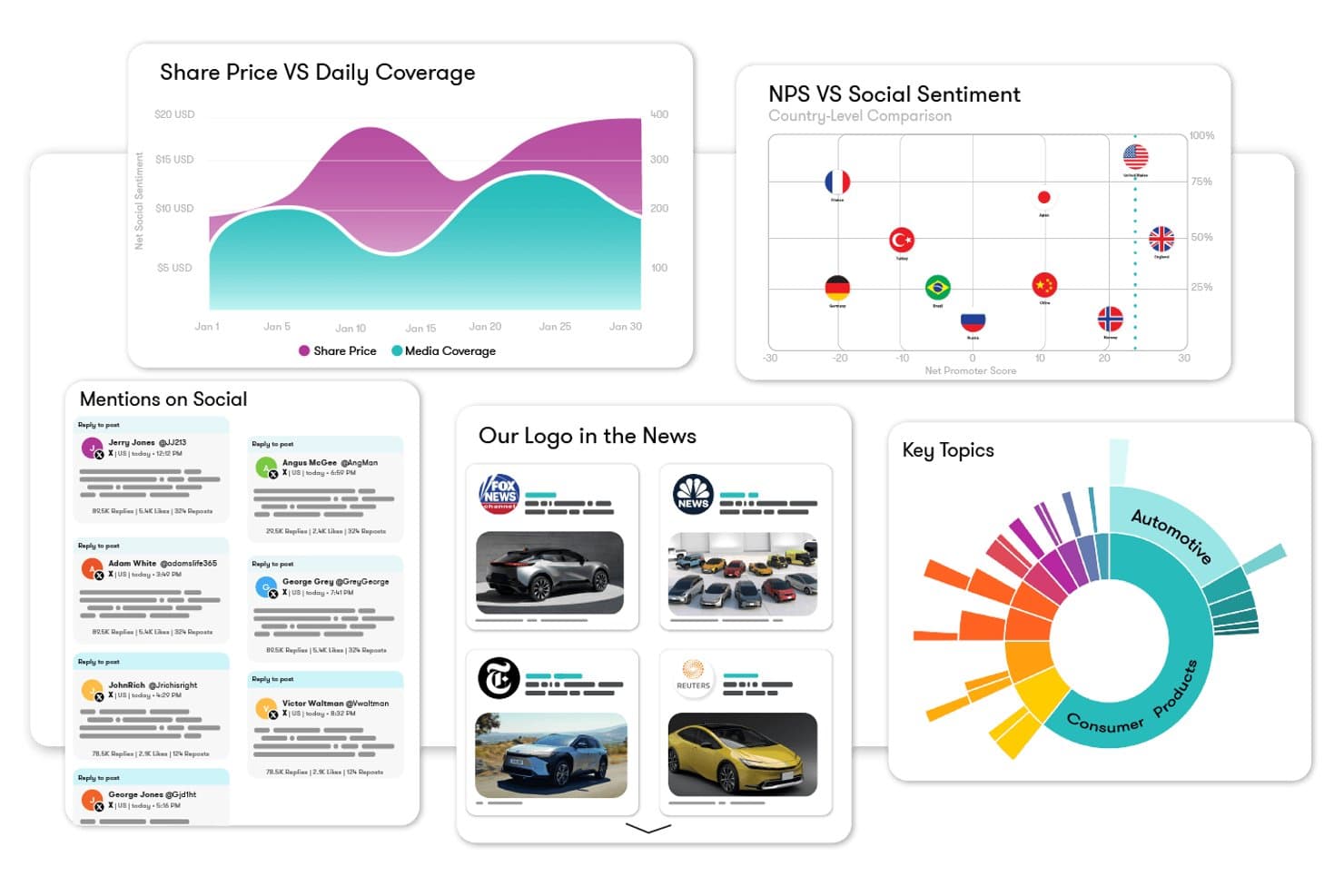
Meltwater centralizes media, social, and sentiment data in one research dashboard. Meltwater is a media intelligence and social listening platform that monitors news, social media, forums, podcasts, and LLM outputs, with AI-powered tools for sentiment analysis, competitive benchmarking, and trend detection.
Who Is Meltwater Best For?
Meltwater is a strong fit for product marketing managers and brand strategists who need to track competitive narratives, monitor social conversations, and understand how their brand appears across both media and AI platforms.
Why I Picked Meltwater
Meltwater earns its spot on my shortlist because no other tool I've tested pulls social signals, news, forums, and Reddit's full firehose into a single AI layer the way it does. I particularly like GenAI Lens, which tracks how your brand and competitors are discussed across ChatGPT, Gemini, and Perplexity—something purpose-built research platforms simply don't offer. Mira's Share of Voice dashboards and sentiment benchmarking make it easy to see exactly where your narrative stands relative to competitors across channels.
Meltwater Key Features
- BYOC (bring your own content): Upload internal research artifacts like interview transcripts and survey data to analyze alongside external media signals in one place.
- Predictive spike forecasting: A 48-hour forecasting model predicts whether an emerging conversation trend will grow or fade before it peaks.
- Meltwater MCP server: Connects AI assistants like Claude or ChatGPT directly to Meltwater's live data for natural-language queries with source attribution.
- AI-powered boolean search builder: Automatically constructs complex search queries from plain-language prompts, reducing manual query setup time.
Meltwater Integrations
Meltwater integrates with Slack, Microsoft Teams, Microsoft 365, Claude, ChatGPT via its MCP server, Power BI, Tableau, and Salesforce. Pro and Enterprise plans include API access for custom connections to business intelligence platforms, data warehouses, and internal dashboards.
Pros and Cons
Pros:
- Predicts trends with AI-powered spike forecasting
- Monitors brand mentions across major AI platforms
- Synthesizes external and internal data sources
Cons:
- Lacks native video or interview analysis
- No survey panels or respondent recruitment
Learn more about Meltwater: Best for real-time digital consumer intelligence
- Free demo available
- Pricing upon request

Brandwatch offers an AI-assisted ad creation interface for social media ads with writing suggestion tools. Brandwatch is an AI-driven consumer intelligence platform for market research teams, offering real-time analytics, social listening, audience insights, and digital trend tracking across web and social media channels.
Who Is Brandwatch Best For?
Brandwatch is a strong choice for digital marketing and consumer insights teams at enterprise brands that need detailed, real-time analysis of online conversations.
Why I Picked Brandwatch
I picked Brandwatch because it lets my team monitor millions of digital conversations and trends as they happen. I use its AI-powered analytics and customizable dashboards to surface actionable consumer intelligence in real time.
Brandwatch Key Features
- Influencer identification: Surfaces influential voices and profiles driving online trends, giving you a boost in competitive intelligence.
- Custom audience segments: Lets you build dynamic groups using demographic, keyword, or behavioral filters.
- Image analysis: Detects brand logos and objects in social and web images for deeper visual tracking.
- Automated reporting: Generates scheduled custom reports that deliver targeted metrics to stakeholders.
Brandwatch Integrations
Brandwatch offers native integrations with Bitly, ServiceNow, Shopify, Tipalti, Box, Bynder, Zendesk, Dropbox, HubSpot, Salesforce Service Cloud, and more, and provides an API for custom integrations.
Pros and Cons
Pros:
- Granular sentiment and demographic audience insights
- Custom AI-powered trend detection and alerts
- Real-time monitoring across millions of online sources
Cons:
- Large data exports require additional steps
- Dashboard setups can be time-consuming
Learn more about Brandwatch: Best for collaborative qualitative data synthesis
- Free plan + free demo available
- Pricing upon request
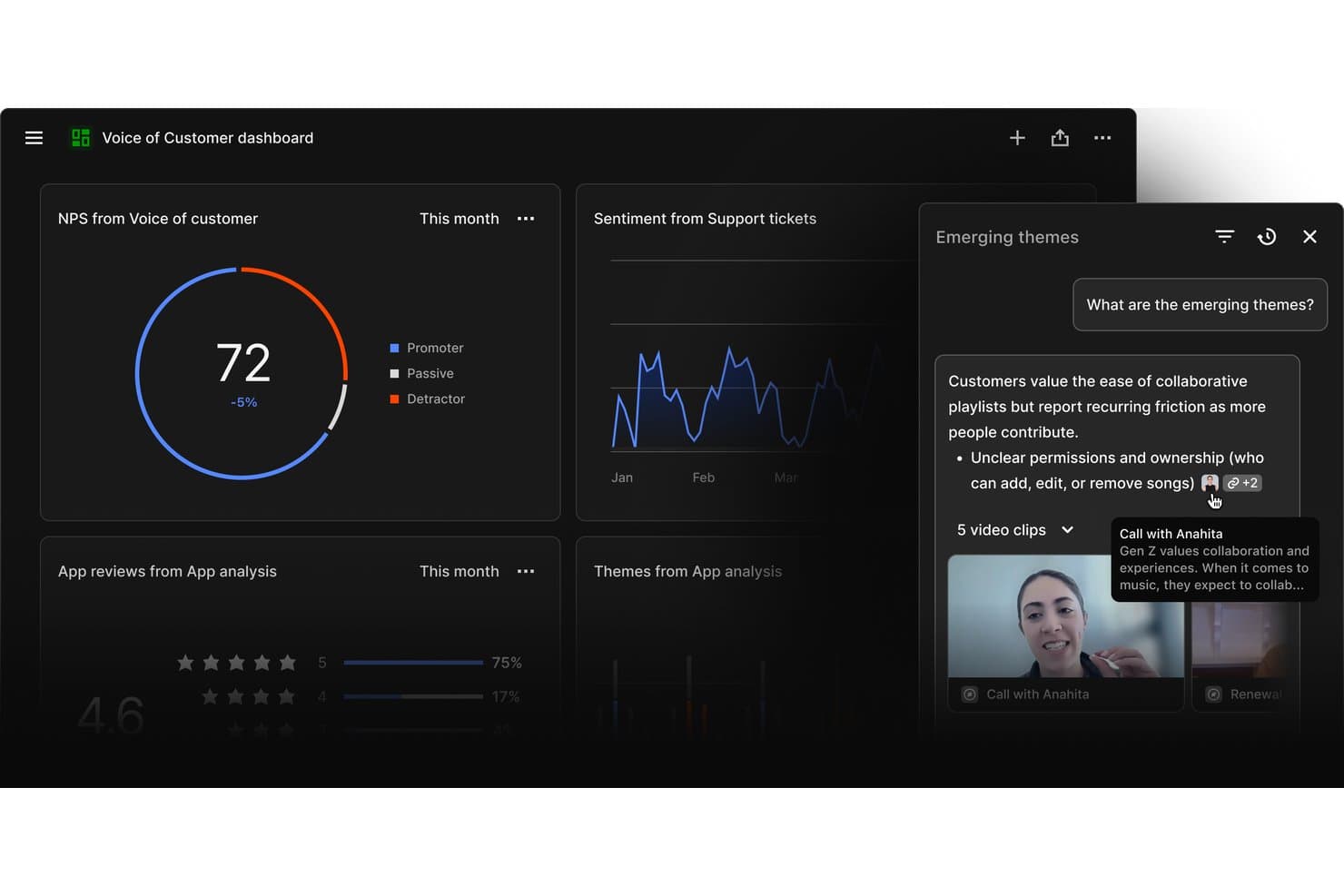
Dovetail surfaces emerging customer themes with AI-linked video evidence. Dovetail is a customer intelligence platform that synthesizes qualitative research data—interviews, call recordings, support tickets, and app reviews—into structured themes, insight reports, and trend dashboards using AI.
Who Is Dovetail Best For?
Dovetail is a strong fit for research-led product teams that need to synthesize large volumes of qualitative customer data—interviews, call recordings, and support tickets—into structured, shareable insights.
Why I Picked Dovetail
Dovetail earns its spot on my shortlist because no other tool I've tested matches its ability to turn raw qualitative data into structured, shareable insight at scale. I particularly like Magic Cluster, which automatically groups interview highlights by theme, and AI Docs, which generates full VoC reports with cited quotes from a single prompt. Digital Twins let my team pressure-test messaging and pricing against evidence-based customer segment models before running a single live study.
Dovetail Key Features
- AI Channels: Automatically classifies incoming support tickets, app reviews, and sales call transcripts into revenue-weighted product opportunities ranked by ARR impact and customer demand.
- AI Research Agents: No-code autonomous agents that monitor customer data on a schedule, generate recurring syntheses, and push findings to Slack, Teams, or email without researcher involvement.
- Insight repository: A centralized, semantically searchable hub that stores all past studies, transcripts, tags, and documents so teams can query historical findings alongside new research.
- Automatic PII redaction: Strips personally identifiable information from text, audio, and video before data enters the workspace, supporting GDPR and HIPAA compliance requirements.
Dovetail Integrations
Dovetail offers 38+ native integrations, including Jira, Linear, Productboard, Salesforce, HubSpot, Gong, Zendesk, Sprig, Pendo, PostHog, Slack, and Microsoft Teams. It also supports Google Calendar, Outlook 365, API, MCP, and CLI connectivity for custom data pipelines.
Pros and Cons
Pros:
- Supports AI-driven segment simulation for concept testing
- Links all AI answers to source data
- Synthesizes interviews and calls into structured insights
Cons:
- Advanced features restricted to Enterprise plans
- No external competitor or market signal tracking
Learn more about Dovetail: Best for AI-powered financial market analysis
- Free demo available
- Pricing upon request
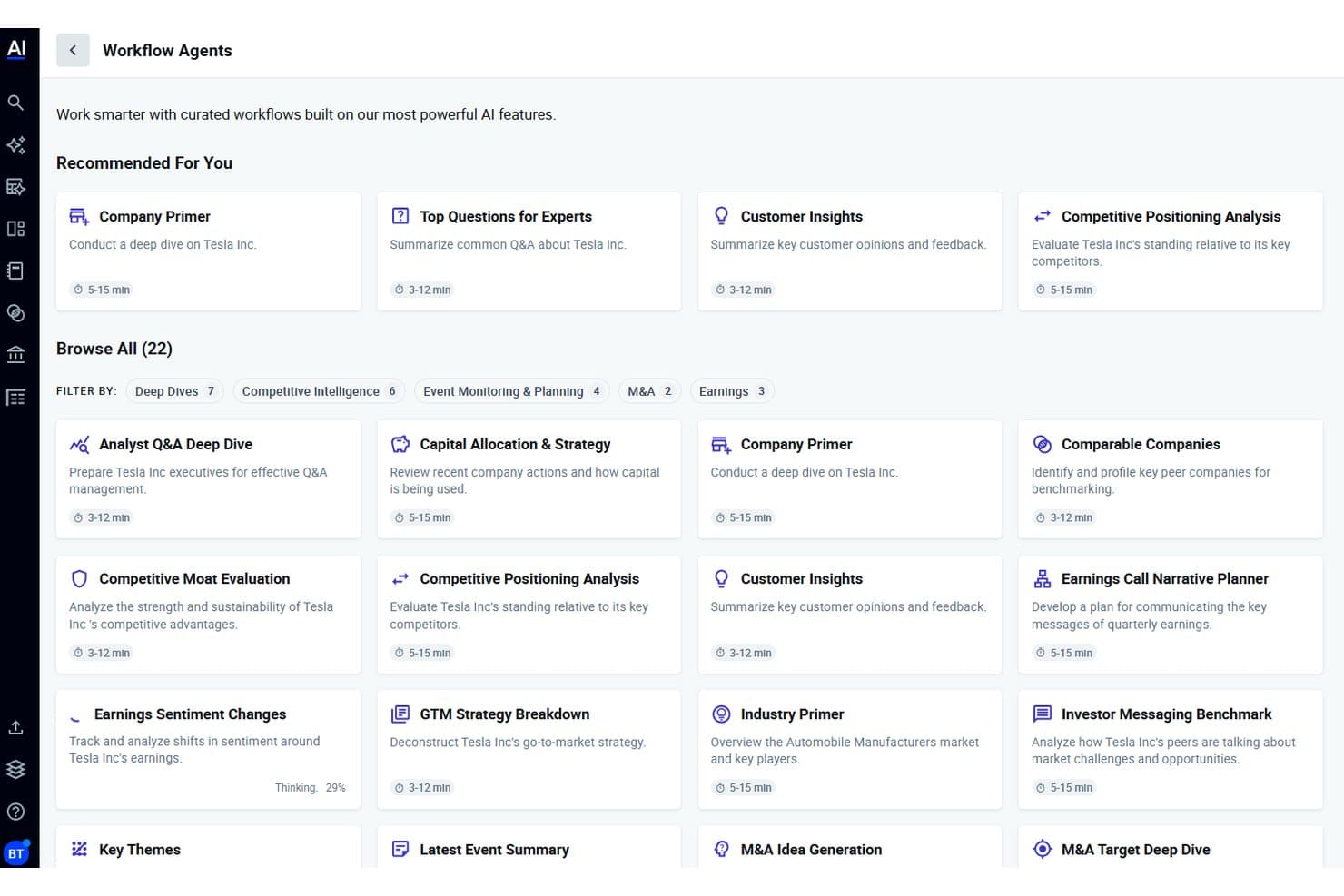
AlphaSense lets users run AI-powered research workflows on companies. AlphaSense is an AI-powered market and competitive intelligence platform that aggregates financial filings, broker research, expert call transcripts, and premium news into a unified search and synthesis environment.
Who Is AlphaSense Best For?
AlphaSense is a strong fit for product strategy directors and product marketing managers at enterprise companies who need deep competitive and market intelligence grounded in financial data.
Why I Picked AlphaSense
AlphaSense earns its spot on my shortlist because no other tool I've tested matches its depth of AI-powered financial market analysis. Its Deep Research agent autonomously scans thousands of earnings transcripts, broker reports, and regulatory filings to produce cited, decision-ready reports in minutes. I also rely on Smart Summaries to instantly extract SWOT analyses and competitive landscape snapshots from earnings calls, which is invaluable when tracking category shifts for roadmap and positioning work.
AlphaSense Key Features
- Generative Grid: Runs multiple AI prompts across many documents simultaneously, outputting organized, table-formatted answers for peer comparisons and transcript analysis.
- Snippet Explorer: Tracks specific topics and themes across the full content library over time, letting you spot trend shifts in how a subject is discussed.
- Automated monitoring and alerts: Continuously watches competitors, market moves, and industry topics across millions of documents, delivering configurable alerts in real time or on a schedule.
- Sentiment analysis: Color-codes emotion and tone across financial text, letting you filter search results by positive or negative sentiment to catch inflection points in earnings calls and filings.
AlphaSense Integrations
AlphaSense supports 20+ documented internal-content connectors, including Box, Dropbox, Google Drive, Microsoft SharePoint, Slack, Salesforce, Notion, Zoom, and Gong. Its ingestion API supports custom sources, but native integrations with product research tools and survey platforms aren’t documented.
Pros and Cons
Pros:
- Real-time alerts track competitors and market shifts
- Autonomous agent produces cited research in minutes
- Deepest available library for financial research
Cons:
- Isn’t designed for product or UX research
- Lacks survey or user feedback analysis tools
Learn more about AlphaSense:
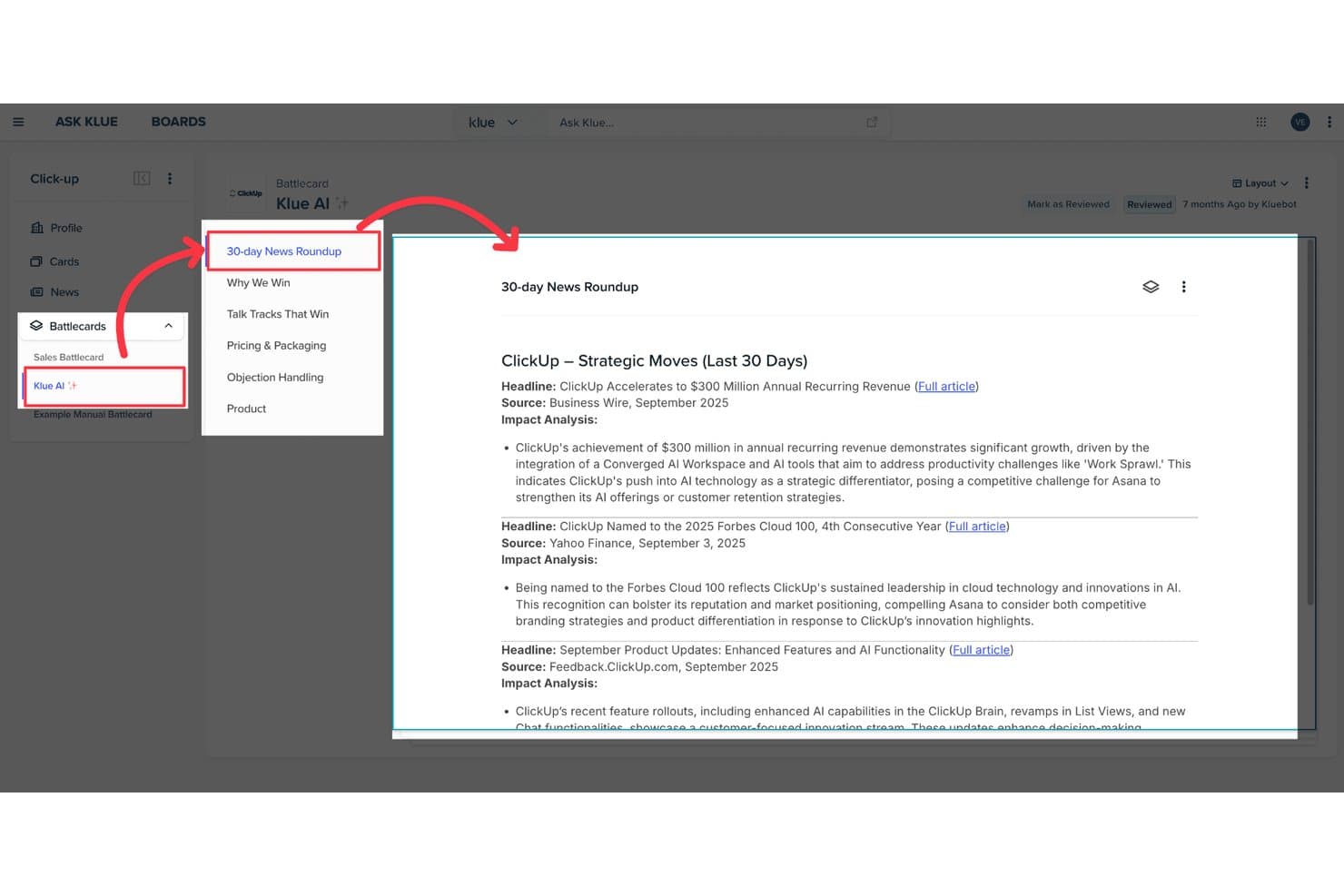
Klue delivers AI-generated competitor news roundups inside battlecards. Klue is a competitive intelligence and win-loss analysis platform that monitors competitor activity, analyzes buyer feedback, and delivers deal-specific insights to sales and product marketing teams.
Who Is Klue Best For?
Klue is a strong fit for product marketing managers and competitive intelligence teams at B2B companies that need to arm sales reps with deal-ready competitive insights.
Why I Picked Klue
Klue earns its spot on my shortlist because it's the only tool I've found that closes the loop between competitive intelligence and live deal support. I love how the Compete Agent's Deal Assistant automatically detects when a competitor is mentioned on a sales call and pushes deal-specific tips to the rep within minutes, no manual searching required. Pair that with Blindspot Interviews, which surface feedback from buyers who chose a competitor you never even knew you were up against, and you're getting competitive insight most teams simply don't have access to.
Klue Key Features
- Ask Klue: A natural-language AI chat interface that lets you query competitive and win-loss data directly inside Slack, Salesforce, or Microsoft Teams, with cited, sourced answers.
- AI-generated strengths and weaknesses: Automatically pulls competitor reviews from 12+ platforms and organizes findings into structured strength and weakness themes in about 30 seconds.
- Win & Loss Story Agent: Mines closed CRM data and call recordings immediately after a deal closes to generate structured deal recaps with extracted buyer requirements and competitive dynamics.
- MCP connector: Embeds Klue's competitive and win-loss data into third-party AI tools like Claude, enabling real-time battlecard generation and summaries from within external workflows.
Klue Integrations
Klue integrates with Salesforce, Slack, Microsoft Teams, Gong, HubSpot, Microsoft Dynamics 365, Chorus, Seismic, Showpad, and Highspot. Its MCP connector also connects competitive intelligence and win-loss data with Claude and Microsoft Copilot.
Pros and Cons
Pros:
- AI-generated strengths and weaknesses from reviews
- Win-loss insights pipeline supports sales teams
- Specialized in competitor profiling and benchmarking
Cons:
- Lacks panel or target audience recruitment tools
- No concept testing or survey creation features
Learn more about Klue: Best for identifying real-time consumer trends
- Free trial + free demo available
- Pricing upon request
Visit WebsiteCustomer Rating:5/5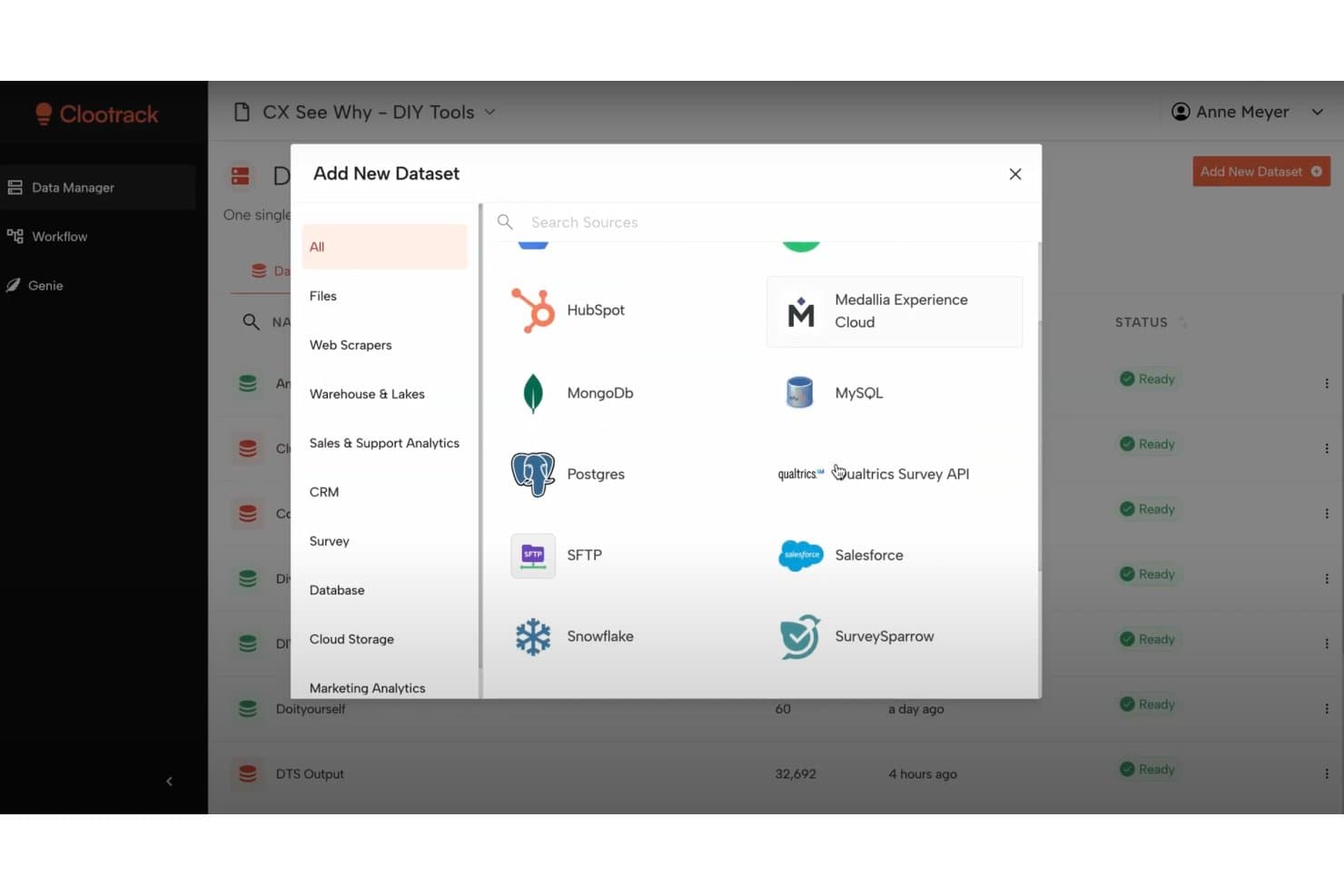
Clootrack is a customer intelligence platform that uses patented unsupervised AI to analyze feedback across 1,000+ data sources—including reviews, call transcripts, and social data—surfacing themes, sentiment shifts, and competitive benchmarks without predefined taxonomies.
Who Is Clootrack Best For?
Clootrack is a strong fit for enterprise product marketing and strategy teams that need always-on visibility into how consumer sentiment is shifting across markets and competitors.
Why I Picked Clootrack
I picked Clootrack as one of the best because its patented unsupervised AI discovers consumer sentiment shifts before you know to look for them. Rather than confirming what you already suspect, it surfaces unknown themes across 1,000+ data sources in real time. I especially like the Growth Research Agent, which compresses research timelines by up to 14x, and the always-on competitor review crawler that tracks thematic sentiment changes across rival brands continuously.
Clootrack Key Features
- Multi-language NLP: Analyzes customer feedback across 95+ languages, making it viable for global teams tracking sentiment across diverse markets.
- AI Decision Digests: Generates structured insight summaries that explain what's happening, why it's happening, and what action to take next.
- Clootrack Genie: A conversational GenAI copilot that lets you query customer intelligence datasets in natural language, with full SQL traceability behind every answer.
- Custom VoC agent builder: Lets teams configure specialized AI agents around specific business goals—like NPS improvement or returns reduction—by chatting directly with the platform.
Clootrack Integrations
Clootrack supports integrations with Salesforce, HubSpot, Zendesk, Freshdesk, Tableau, Power BI, and Snowflake, plus 1,000+ data connectors. It also offers an API, SFTP, CSV uploads, and MCP connectivity with Claude, ChatGPT, Microsoft Copilot, Google Gemini, and Glean.
Pros and Cons
Pros:
- Always-on competitor sentiment monitoring
- Multi-language analysis spans 95+ languages
- Patented AI finds hidden trends automatically
Cons:
- Dashboard design feedback highlights info overload
- No built-in audience recruitment tools
Learn more about Clootrack: Best for centralizing multi-channel feedback
- Free demo available
- Pricing upon request
Visit WebsiteCustomer Rating:3.9/5
Qualtrics offers collecting, analyzing, and managing customer and employee feedback. Qualtrics is an enterprise feedback management platform designed for collecting, analyzing, and managing customer or employee feedback across multiple channels using survey and data analytics tools.
Who Is Qualtrics Best For?
Qualtrics is well-suited to CX leaders who want to run proprietary AI models to analyze feedback from multiple customer touchpoints.
Why I Picked Qualtrics
I picked Qualtrics because I can manage survey data and feedback from web, SMS, social, and call center channels all in one place. My team uses tools like text analytics and dashboard customization to track feedback in real time and quickly identify trends.
Qualtrics Key Features
- Survey logic customization: Build complex survey flows using branching, skip logic, and embedded data.
- Automated response triggers: Set rules to send alerts or follow-ups automatically based on survey answers.
- Role-based permissions: Assign different access rights and roles to users across your organization.
- Data export options: Export survey data in formats like CSV or Excel to process with your own statistical algorithms.
Qualtrics Integrations
Qualtrics offers native integrations with SAP, Tango Card, Respondent, and Awardco. An API is available for custom integrations.
Pros and Cons
Pros:
- Automated response routing for high-volume feedback
- Real-time feedback analysis with built-in AI
- Customizable survey flows for advanced research methods
Cons:
- Data exports require additional configuration steps
- Survey distribution can require manual setup
Learn more about Qualtrics:

YouGov uses surveys for audience insights and consumer data analysis. YouGov is an audience intelligence and market research platform offering survey creation, opinion polling, audience profiling, and extensive access to global first-party data for research teams.
Who Is YouGov Best For?
YouGov suits market researchers and agencies that need real-time access to global opinion data for brand, political, or audience analysis across multiple countries.
Why I Picked YouGov
I picked YouGov as one of the best because I get access to global polling data and can quickly analyze public sentiment in dozens of markets. My team uses its audience profiling and survey tools to explore opinions and trends based on first-party responses.
YouGov Key Features
- Data segmentation tools: Filter and analyze datasets by demographics and geography.
- Brand tracking dashboard: Monitor brand metrics and audience perception in real time.
- Audience comparison reports: Compare responses between user-defined audiences or market segments.
- Custom research services: Commission bespoke surveys and expert analysis from YouGov’s research team.
YouGov Integrations
Native integrations are not publicly listed.
Pros and Cons
Pros:
- Ongoing survey data with frequent updates
- Extensive psychographic and attitudinal segmentation
- Global panel access for diverse opinion data
Cons:
- Survey customization capabilities can be restrictive
- Industry benchmarking options are limited
Learn more about YouGov: Best for automating advanced consumer insights
- Free demo available
- Pricing upon request

quantilope automates surveys, analysis, and reporting with AI. quantilope is an AI-powered market research platform built for automating survey creation, data collection, analysis, and dashboard reporting using advanced methodologies.
Who Is quantilope Best For?
quantilope is well-suited to insights teams and market researchers at midsize to large businesses who need fast, advanced analytics on shifting market trends.
Why I Picked quantilope
I picked quantilope as one of the best because it enables corporate marketing teams to automate advanced methodologies like conjoint and TURF analysis. The platform lets me build and launch surveys, then instantly generate dynamic dashboards with actionable data.
quantilope Key Features
- Automated data cleaning and processing: The tool handles complex data structuring and error detection automatically.
- Integrated survey panel access: You can reach diverse, global respondents directly through the platform.
- Custom question libraries: Create, save, and reuse customizable question templates in your projects.
- Real-time data visualization: View live results and interactive charts as responses come in for immediate strategy optimization.
quantilope Integrations
quantilope offers an API for custom integrations. Native integrations are not publicly listed.
Pros and Cons
Pros:
- Real-time dashboards update with respondent data
- Advanced analytics for conjoint and TURF studies
- Fully automates complex survey methodologies
Cons:
- Steeper setup process for complex projects
- Limited native integrations with external platforms
Learn more about quantilope:
Suzy helps users unlock deep consumer insights with AI-driven research. Suzy is an enterprise AI market research platform that integrates quantitative surveys, AI-moderated voice interviews, competitive signal monitoring, a generative AI-queryable insight repository, and automated stakeholder deliverable generation into a single connected system.
Who Is Suzy Best For?
Suzy is built for enterprise insight teams—PMMs, user research leads, and strategy directors—who need to run qualitative and quantitative research under one roof without stitching together separate tools.
Why I Picked Suzy
Suzy earns its spot on my shortlist because no other platform I've evaluated runs AI-moderated voice interviews at the scale it does. Suzy Speaks deploys an AI moderator across thousands of simultaneous consumer conversations, capturing tone, cadence, and emotional response that standard surveys miss entirely. Paired with Suzy Intelligence, which scores signals from 10,000+ sources including patents and SEC filings, I get both the deep qual and the always-on market monitoring in one place.
Suzy Key Features
- Suzy Impact report generation: Automatically produces audience-specific deliverables—executive summaries, consumer narratives, and full pitch decks—with on-brand formatting and built-in confidence flags.
- BIOTIC bot detection: A multi-layer fraud prevention system using device fingerprinting, AI-powered challenge questions, VPN blocking, and a honeypot mode to verify panel respondents before data reaches your dashboard.
- Natural language repository querying: Ask plain-language questions across your entire research archive—past studies, uploaded briefs, third-party reports, and behavioral data—and get AI-generated, evidence-backed answers instantly.
- Suzy Live video interviews: Facilitates live 1-on-1 video interviews and focus groups with built-in scheduling, respondent incentives, and optional human moderator support.
Suzy Integrations
Native integrations with product, CRM, analytics, or collaboration tools aren’t clearly documented. Suzy connects to 70+ external panel providers and client CRM lists, and accepts PDF, Word, and CSV uploads into Suzy Insight.
Pros and Cons
Pros:
- Centralized insight repository with natural language querying
- Automated insight synthesis across all research types
- AI voice moderation for large-scale qualitative research
Cons:
- Limited depth for highly specialized qualitative interviews
- Requires annual enterprise commitment to onboard
Learn more about Suzy:
Outras ferramentas de IA para pesquisa de mercado
Eis algumas opções adicionais de ferramentas de IA para pesquisa de mercado que não entraram na minha lista restrita, mas que vale a pena consultar:
- 11Listen LabsBest for AI-driven qualitative analysis at scale
- 12EnterpretBest for always-on customer feedback intelligence
- 13RemeshBest for audience dialogue facilitation
- 14CrayonBest for competitor-driven market intelligence
- 15MarvinBest for qualitative insight synthesis and sharing
- 16Outset.aiBest for instant conversational insights
- 17ConveoBest for actionable live discussion summaries
- 18VoxpopmeBest for automated video feedback analytics
- 19DiscussBest for live video research with global users
Critérios de seleção das ferramentas de IA para pesquisa de mercado
Ao selecionar as melhores ferramentas de IA para pesquisa de mercado a incluir nesta lista, considerei necessidades e dificuldades comuns dos compradores, como a automatização da análise de dados e as capacidades de pesquisa global multilingue. Também utilizei o seguinte quadro para manter a minha avaliação estruturada e justa:
How I Evaluate AI Market Research Tools
To make this list, a tool's AI needs to handle real product research work, like analyzing interview themes or answering research questions. From there, I evaluate three things. Core functionality carries the most weight, like collecting data and segmenting audiences. Then I look at video and voice analysis and trustworthy AI outputs.
Core Functionality (Table Stakes For This List)
When I'm selecting tools for my list, I score each one on a scale from 0 (does not offer the functionality) to 5 (excels in this area) for each core functionality listed below. I then convert the total into a percentage to help assess each tool's overall fit, with extra weight on any functionalities I’ve deemed essential.
- AI Insight Synthesis (Essential): I look for themes spanning interviews, surveys, reviews, and social data, with findings tied to roadmap or positioning decisions.
- Automated Data Collection (Essential): I assess how tools gather surveys, reviews, interviews, social posts, and web signals without repeated manual imports.
- Sentiment And Theme Analysis: I check whether NLP detects sentiment, intent, emotions, and recurring issues in open-text customer feedback.
- Generative AI Querying: I evaluate natural-language questions, cited answers, follow-up prompts, and reports built from research data.
- Audience Targeting And Segmentation: I look for relevant respondent recruitment, screening, demographic filters, and segments for concept or pricing research.
- Competitive And Market Intelligence: I assess competitor monitoring, category trends, positioning comparisons, and signals that inform opportunity discovery.
Once I have a list of tools that meet the criteria, I consider what sets each platform apart.
Differentiating Factors (What Sets Vendors Apart)
Here's how I compare and contrast different vendors:
Standout Features
I evaluate whether a tool offers AI research agents that can design studies, conduct interviews, and probe with follow-ups autonomously. That capability changes the math on how many studies a small product team can run per sprint. I also check for an insight repository—a searchable hub where past findings surface when new questions arise, so teams stop repeating research they've already done. Real-time trend detection matters too. I look for tools that continuously scan reviews and social channels and flag emerging complaints or shifts before they hit your backlog as surprises.
Beyond Features
I check whether a tool connects to your existing product stack—Jira, Slack, Amplitude, Figma—because insights trapped in a silo don't reach sprint planning. Data quality matters just as much: I evaluate bot screening, respondent verification, and whether AI summaries link back to source evidence so you can audit a claim before acting on it. I also look at pricing scalability, since a credit model that works for three studies a quarter can collapse when research ops ramps up.
Como escolher ferramentas de IA para pesquisa de mercado
É fácil ficar preso a listas extensas de funcionalidades e estruturas de preços complexas. Para o ajudar a manter-se concentrado enquanto analisa o seu processo específico de seleção de software, eis uma lista de verificação dos fatores a ter em conta:
| Fator | O que deve considerar |
| Escalabilidade | A ferramenta consegue suportar o seu volume de pesquisa atual e futuro, incluindo o crescimento do número de projetos, utilizadores ou mercados globais? |
| Integrações | Estabelece ligação direta aos seus sistemas principais de análise, CRM ou visualização de dados, ou precisará de soluções alternativas para aceder a dados críticos? |
| Personalização | Consegue adaptar as análises, os resultados dos relatórios ou os fluxos de trabalho aos processos e à terminologia de pesquisa existentes na sua organização? |
| Facilidade de utilização | Os colaboradores sem conhecimentos técnicos conseguirão conceber, lançar e analisar estudos de forma consistente sem formação extensa ou apoio de TI? |
| Implementação e integração inicial | De que recursos ou prazo precisa para configurar a ferramenta, migrar projetos históricos e preparar a sua equipa? |
| Custo | Os níveis de preços estão alinhados com os seus padrões de utilização e funcionalidades necessárias, e teve em conta os custos de suplementos ou licenças de utilizador? |
| Medidas de segurança | O fornecedor disponibiliza encriptação de dados, conformidade com a privacidade (RGPD, CCPA) e controlos claros sobre onde os dados de pesquisa sensíveis são armazenados e partilhados? |
| Capacidades internacionais | A ferramenta está preparada para lidar com vários idiomas, recrutar participantes a nível global e cumprir os requisitos locais de conformidade quando necessário? |
O que são ferramentas de IA para pesquisa de mercado?
As ferramentas de estudos de mercado com IA são plataformas de software que automatizam e melhoram a recolha, a análise e as conclusões de dados para estudos de mercado, utilizando inteligência artificial. Estas ferramentas ajudam as equipas a analisar respostas qualitativas e quantitativas, identificar tendências, acelerar a tomada de decisões e sintetizar conclusões de inquéritos, entrevistas ou canais sociais, apoiando frequentemente necessidades de estudos globais e multilingues.
Funcionalidades das ferramentas de estudos de mercado com IA
Ao selecionar ferramentas de estudos de mercado com IA, tenha em atenção as seguintes funcionalidades essenciais:
- Análise de dados automatizada: Utiliza aprendizagem automática para processar rapidamente grandes volumes de respostas qualitativas e quantitativas, destacando padrões e conclusões úteis sem esforço manual.
- Criação de inquéritos e questionários: Permite criar, distribuir e gerir inquéritos personalizados para públicos-alvo diretamente na plataforma.
- Análise de sentimentos: Analisa respostas abertas para detetar e classificar o tom emocional, ajudando a compreender como os inquiridos se sentem relativamente a temas específicos.
- Transcrição e suporte linguístico: Transcreve automaticamente entrevistas em áudio e vídeo e suporta vários idiomas para estudos globais.
- Ferramentas de visualização de dados: Convertem dados brutos em gráficos, diagramas e painéis que facilitam a interpretação e a partilha de tendências e conclusões.
- Integrações com outras plataformas: Ligam-se a outras ferramentas, como sistemas de CRM, plataformas de visualização de dados ou armazenamento na nuvem, para uma transferência de dados contínua e a continuidade dos fluxos de trabalho.
- Relatórios em tempo real: Fornecem resultados e análises atualizados à medida que as respostas são recolhidas, permitindo às equipas reagir rapidamente durante estudos em direto ou em curso.
- Gestão de painéis: Ajuda a organizar, acompanhar e comunicar com os participantes nos estudos, facilitando o envolvimento dos inquiridos adequados para a investigação.
- Fluxos de trabalho personalizáveis: Permitem adaptar módulos, formatos de relatórios e processos de revisão às metodologias de investigação da sua equipa.
- Armazenamento seguro de dados: Garante que todos os dados de investigação são armazenados de forma segura, com encriptação e opções de conformidade para proteger informações sensíveis e apoiar as normas de privacidade.
Benefícios das ferramentas de estudos de mercado com IA
A implementação de ferramentas de estudos de mercado com IA proporciona vários benefícios à sua equipa e à sua empresa. Eis alguns dos benefícios que pode esperar:
- Conclusões mais rápidas: A análise de dados automatizada e os relatórios em tempo real reduzem os tempos de resposta dos estudos de mercado.
- Compreensão mais aprofundada dos sentimentos: A análise de sentimentos baseada em IA revela os fatores emocionais subjacentes às respostas e aos comentários dos clientes.
- Capacidades de investigação global: As funcionalidades multilingues e de transcrição facilitam a realização de estudos em diferentes regiões e idiomas.
- Colaboração centralizada: Os painéis integrados e os fluxos de trabalho personalizáveis permitem que a sua equipa e as partes interessadas trabalhem de forma eficiente num único local.
- Maior precisão dos dados: A redução de erros orientada por IA e a validação avançada resultam em conjuntos de dados mais limpos e fiáveis.
- Gestão simplificada dos participantes: As ferramentas de gestão de painéis simplificam a organização, o acompanhamento e a comunicação com os inquiridos da investigação.
- Segurança de dados reforçada: O armazenamento seguro de dados e as funcionalidades de conformidade ajudam a manter a privacidade e a cumprir os regulamentos.
Custos e preços das ferramentas de estudos de mercado com IA
A seleção de ferramentas de estudos de mercado com IA requer uma compreensão dos vários modelos de preços e planos disponíveis. Os custos variam consoante as funcionalidades, a dimensão da equipa, os complementos e outros fatores. A tabela abaixo resume os planos comuns, os respetivos preços médios e as funcionalidades normalmente incluídas nas soluções de ferramentas de estudos de mercado com IA:
Tabela de comparação de planos para ferramentas de estudos de mercado com IA
| Tipo de plano | Preço médio | Funcionalidades comuns |
| Plano gratuito | $0 | Acesso a inquéritos básicos, respostas limitadas, análises essenciais e relatórios de nível inicial. |
| Plano pessoal | $20-$50/utilizador/mês | Conceção avançada de inquéritos, funcionalidades de automatização limitadas, análise de sentimentos básica e suporte por e-mail. |
| Plano empresarial | $60-$150/utilizador/mês | Ferramentas de colaboração em equipa, informações obtidas com IA, painéis personalizados, opções de integração e suporte por conversação em direto. |
| Plano empresarial avançado | $200-$500+/utilizador/mês | Gestão de conta dedicada, segurança avançada, acesso à API, projetos ilimitados e funcionalidades de conformidade. |
Perguntas frequentes sobre ferramentas de estudos de mercado com IA
Eis algumas respostas a perguntas comuns sobre ferramentas de estudos de mercado com IA:
Como lidam as ferramentas de estudos de mercado com IA com a privacidade e a conformidade dos dados?
A maioria das ferramentas de estudos de mercado com IA oferece funcionalidades de segurança, como encriptação de dados, acesso baseado em funções e conformidade com normas como o RGPD e a CCPA. É importante analisar a política de privacidade de cada ferramenta e verificar se cumpre os requisitos de proteção de dados da sua organização antes da adoção.
As ferramentas de estudos de mercado com IA podem analisar dados em vários idiomas?
Sim, muitas ferramentas de estudos de mercado com IA suportam a análise de dados multilingue. Oferecem tradução e transcrição integradas, permitindo às equipas recolher, processar e interpretar respostas de públicos globais sem um esforço manual significativo ou barreiras linguísticas.
Até que ponto são personalizáveis estas ferramentas para fluxos de trabalho de investigação específicos?
A maioria das soluções disponibiliza painéis, modelos de relatórios e definições dos fluxos de trabalho personalizáveis. Esta flexibilidade permite adaptar a ferramenta às suas metodologias de investigação específicas, à identidade da marca e às preferências de colaboração da equipa.
Que tipos de integrações devo procurar nas ferramentas de estudos de mercado com IA?
Deve procurar ferramentas que se liguem aos seus sistemas de visualização de dados, CRM e plataformas de produtividade. As integrações comuns incluem o Slack, o Salesforce, o Tableau e fornecedores de armazenamento na nuvem, para simplificar os fluxos de trabalho e consolidar as fontes de dados.
É necessário ter conhecimentos técnicos para utilizar ferramentas de estudos de mercado com IA?
Não, a maioria das ferramentas modernas de estudos de mercado com IA foi concebida com interfaces fáceis de utilizar, para que utilizadores sem conhecimentos técnicos possam criar inquéritos, analisar dados e gerar relatórios — frequentemente com o apoio de tutoriais e funcionalidades de integração orientada.