
Founder and ex-Apple PM says PRD processes must be overhauled — here’s the blueprint
Sonia Vora
Head of Product/Director of Product Management
Discover how Sonia Vora uses AI to overhaul PRDs, speed up prototyping, and help product teams experiment faster while keeping human judgment in control.
Key Takeaways
AI Integration: Sonia Vora discusses using AI to enhance product management workflows and improve healthcare solutions.
PRD Evolution: Product leaders must revise traditional PRD processes to include faster prototyping and early engineering involvement.
AI Experimentation: Experimentation is AI's key strength, enabling quick concept testing and iterative product development.
Evaluation Workflow: AI-driven workflows allow for simulation and evaluation of product updates, though inconsistencies remain a challenge.
Adapting to AI: Begin integrating AI tools now to keep pace with evolving technologies and remain competitive in product management.
Sonia Vora has served as Head of Product and Director of Product Management at various healthcare companies. She also led product for a couple of Apple's healthcare products. And now, she's the founder of an AI healthcare company.
We sat down with Sonia to learn how she's using agents in PM workflows. Here's what she told us.
Diving into AI healthcare products
Hi, I'm Sonia. I started my career in strategy consulting at McKinsey and GoogleX. Then, I became Director of Product Management at ACKO Insurance, a Series D direct-to-consumer insurance company in India. And later, I became Head of Product at Narayana One Health, an integrated care unit within a hospital system in India. I also led product for two health products at Apple — the Attain app (built in partnership with Aetna Insurance) and Lumihealth (built in partnership with the Singaporean government). And I earned recognition in Forbes 30 Under 30.
In 2017, before transformers and LLMs, I researched AI’s impact at McKinsey and Google and explored ML-based opportunities to improve patient care at Apple and ACKO. But I hadn’t worked directly with AI since then. Then, about 1.5 years ago, I realized AI would transform not only my industry (healthcare) but also product management. I immediately began several initiatives:
- Self-educating on AI fundamentals.
- Integrating ChatGPT/Gemini into the day-to-day PM work of my product team. This included building prompts for more refined PRDs, brainstorming PRDs, conducting research with Deep Research, and using ChatGPT and Gemini to provide design feedback and catch UX issues.
- Experimenting with tools like Lovable to quickly prototype and gather UX feedback from users and buyers.
Now, I'm the founder of Alongside Health, an AI x healthcare company. I've leveraged a mix of LLM natural language capabilities and deterministic protocols to automate clinical care. To build our initial pilots, I use Claude Code daily to design deterministic systems and ship agents for our pilot customers to test. I also build prototypes and our website directly with Claude Code.

Sonia Shares
Product leaders must completely reimagine the system where product managers write a PRD, hand it off to design, and then to engineering.
More Articles
How AI changes the PRD process

Product leaders must completely reimagine the system where product managers write a PRD, hand it off to design, and then to engineering. The goal is to speed up this entire cycle, prevent PMs and designers from being bottlenecked by engineering, and involve engineering earlier where their expertise is most needed.
People approach this in different ways, but I see two high-impact, low-hanging fruits:
- Speed up initial ‘PRD grooming’ and ideation by providing prototypes built with Claude, initially by PMs and then refined by designers. This gives engineers a concrete foundation for building design docs for new features, rather than starting from lengthy written requirements.
- For an existing feature, I've found it helpful to give PMs and designers full access to make certain changes and push PRs — as long as these changes do not fundamentally impact the architecture. If you have a strong code review process, you will prevent a lot of messy new code when PMs and designers push changes.
Personally, I no longer write long PRDs up front that try to handle every edge case. Instead, I immediately work with Claude to flesh out my initial requirements document through question-and-answer discussions.
I then use that document as a starting point for Claude Code and use the actual prototype to find edge cases and integrate those requirements back into the PRD document with Claude before launching.
As a result, I produce much higher-quality work in the same amount of time. I have a thought partner and sparring buddy who helps me to be thorough, explore options faster, and research helpful online resources.
Why experimentation is AI's superpower
I'll break down my AI usage in product management:
- Problem discovery: AI is least helpful here because it doesn't know users' real-world problems. AI can form hypotheses, but these aren't firsthand and won't reveal non-consensus truths. Nothing compares to sitting with a user and understanding their thoughts.
- Prioritization: Similarly, AI can offer a "common sense" first pass at prioritization, but it lacks real user feedback or product sense, so you must carefully monitor AI in this area.
- Design taste and UX decisions: AI offers a great first pass, but it doesn't understand your users or their goals; it merely mimics existing flows. You must carefully consider the "human" element that helps users achieve their tasks. I've iterated extensively on UX to ensure consistency, consider components, and achieve information architecture that truly matches user expectations and goals. It's like an engineer with amazing front-end libraries designing every screen — sometimes it looks great, but it doesn't help users easily understand how to complete their tasks.
- Planning: This is an area where AI excels at creating a first pass. Given enough context, it can effectively develop initial timelines and assist with planning tactics. I'm especially loving Linear.
- Identifying tradeoffs and the impact of design decisions: Coding agents often won't do this unless explicitly asked. However, when prompted, they effectively present multiple pros, cons, and internal debates, helping you think through implications more deeply. I still often find gaps in RCA and brainstorming with coding agents, but sometimes they also raise points I hadn't immediately considered.
- Experimentation: This is AI's true superpower. Because you can build concepts so quickly, you can try many different things, experience the product, and then iterate based on your findings.
Problem discovery: AI is least helpful here because it doesn’t know users’ real-world problems.

How AI can support eval workflows
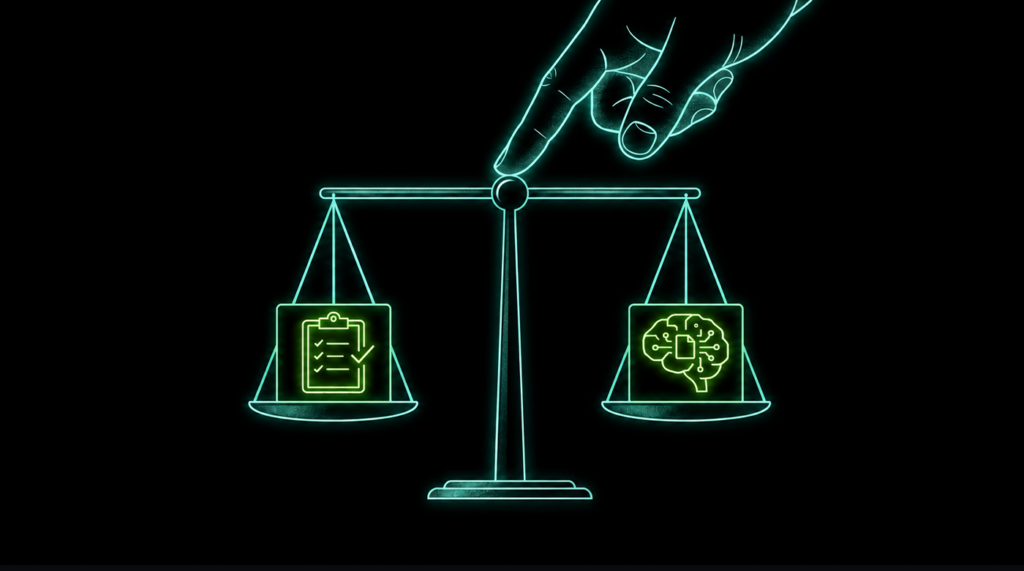
Here's an example of an AI workflow I'm using in my product management.
I used Claude to script a process where, for each new product version, I ask OpenAI or Gemini (via API calls) to impersonate a patient persona and respond to my agent in a simulated chat.
I generate patient personas from a script that creates all protocol branches and tests each one. The script also incorporates personality types from our research-based generator. After each persona converses with the new agent version, we ask Gemini or OpenAI to evaluate the conversation against our 10 evaluation criteria and provide pass/fail scores.
I then review the evaluation results, list suggested changes to fix Claude's issues, ship a new agent version, and rerun the entire pipeline.
I used Claude Code to build the front end, where I can view the evaluation results, the simulated conversations, and the simulated patient personas.
It has been hugely helpful, but with a caveat: AI is still extremely stochastic. I have struggled in areas requiring reliability. For example, with LLM-as-judge evaluations like this, the AI often gives a pass in one run and a fail in another, which is a major issue.
You can design to reduce inconsistency, but you must also always design to catch potential AI misses.
How PMs can stop feeling intimidated by Claude Code
Initially, I felt intimidated by the idea of using Claude Code effectively as a non-engineer, especially since most people used it within the terminal.
But I started building. I treated Claude/Cursor like a junior employee requiring significant brainstorming and handholding, and that helped me to learn the potential issues with Claude-style coding. And I now preempt them in my workflow.
For example, Claude can seem "forgetful" because it compacts information to fit its context window. To work around this, I now ask it to always write down a plan and refer to it before building something, just as you would with a real human — we are forgetful too!
Claude is now especially easy to use because the models have significantly improved. Even with incomplete context, if you prompt it to ask questions, it can converse with you to generate a comprehensive plan first. It can then execute more reliably, reducing your need to worry about scaffolding.
Why coding agents aren't silver bullets
Everyone can be an engineer now, with coding agents. So, we should keep the experts focused on the things that only they do well, and let everyone else do the simple things. The mindset that "everyone is an engineer" is super important.
But it's worth noting that coding agents cannot magically fix bugs without intervention. Often, coding agents lack common sense or design context, leading them to incorrectly root cause or solve issues.
With a bit of prompting, they perform much better, but contextual limitations can subtly lead to lazy execution or thinking.
It has still cut development time immensely, but shipping a good product still requires significant thought.
How to keep up with the AI curve
Start working with these tools in your real work now! The later you adopt, the more you'll lag behind peers who have already optimized workflows with these agents.
While you're at it, keep an open mind about AI's strengths and weaknesses — and recognize that this changes almost every month.
Experiment. Use Claude Code or other tools for your day-to-day work to understand the models' strengths and weaknesses. If you spend even 30 minutes daily on a task, it's likely worth investing one or two hours to automate it — that time will compound.
Try multiple LLM chat tools when seeking answers to see how different providers and models respond. And change your LinkedIn "diet" to stay updated with people applying AI to become the best possible PMs.
Everyone is feeling overwhelmed right now, and that’s okay. I talk to full-time AI professionals who feel overwhelmed — be kind to yourself and celebrate small wins as you keep up with AI developments.
Follow along
You can connect with Sonia Vora on LinkedIn.
More expert interviews to come on The CPO Club!