

Verktøy for KI-markedsundersøkelser er programvareplattformer som bruker kunstig intelligens til å samle inn, analysere og tolke markedsdata raskere og mer nøyaktig enn tradisjonelle metoder. Hvis du ser etter bedre måter å avdekke trender, forstå målgruppen din eller utmanøvrere konkurrentene på, lar disse løsningene teamet ditt utnytte datadrevet innsikt uten tidkrevende manuelt arbeid.
Denne listen hjelper deg med å sammenligne hvordan ulike plattformer bruker generativ KI sammen med standardfunksjoner for undersøkelser i 2026, slik at du kan velge den rette plattformen for å ta smartere beslutninger, styrke forretningsstrategien og holde deg foran i et marked i rask endring.
Hvorfor du kan stole på våre programvareanbefalinger
6,700+
Reviews
20
Industry experts
16+
Evaluation factors
14
Years
Teamet vårt har testet og anmeldt programvare siden 2012. Vi er selv produktledere, så vi vet hvor vanskelig og hvor viktig det er å velge riktig programvare.
I denne guiden har vi vurdert verktøyene gjennom praktisk testing og uavhengig research og gitt dem poeng ut fra våre utvelgelseskriterier.
Anmeldelsene våre bygger på vår egen redaksjonelle vurdering. De er ikke et salgsargument.
Ekspertanmeldere:
- Andrew LumbySenior TPM
- Cristiano ValimSenior UI/UX Lead


Sammenligningstabell: Verktøy for KI-markedsundersøkelser
Denne sammenligningstabellen oppsummerer prisdetaljene for mine utvalgte programvareverktøy for KI-markedsundersøkelser.
| Tool | Best For | Trial Info | Price | ||
|---|---|---|---|---|---|
| 1 | Best for integrating social media insights | Free demo available | From $10,000/year (billed annually) | Website | |
| 2 | Best for real-time digital consumer intelligence | Free demo available | Pricing upon request | Website | |
| 3 | Best for collaborative qualitative data synthesis | Free plan + free demo available | Pricing upon request | Website | |
| 4 | Best for AI-powered financial market analysis | Free demo available | Pricing upon request | Website | |
| 5 | Best for sales enablement via competitive insights | Free demo available | Pricing upon request | Website | |
| 6 | Best for identifying real-time consumer trends | Free trial + free demo available | Pricing upon request | Website | |
| 7 | Best for centralizing multi-channel feedback | Free demo available | Pricing upon request | Website | |
| 8 | Best for access to global opinion data | Free demo available | Pricing upon request | Website | |
| 9 | Best for automating advanced consumer insights | Free demo available | Pricing upon request | Website | |
| 10 | Best for end-to-end AI voice research at scale | Free demo available | From $150/month | Website |


Anmeldelser av de beste verktøyene for KI-markedsundersøkelser
Nedenfor finner du mine detaljerte sammendrag av de beste verktøyene for KI-markedsundersøkelser som kom med på kortlisten min. Anmeldelsene mine gir et detaljert innblikk i funksjonene, egenskapene og bruksområdene til hver plattform, slik at du kan finne den beste løsningen for deg.
 Best for integrating social media insights
- Free demo available
- From $10,000/year (billed annually)
Visit WebsiteCustomer Rating:4.1/5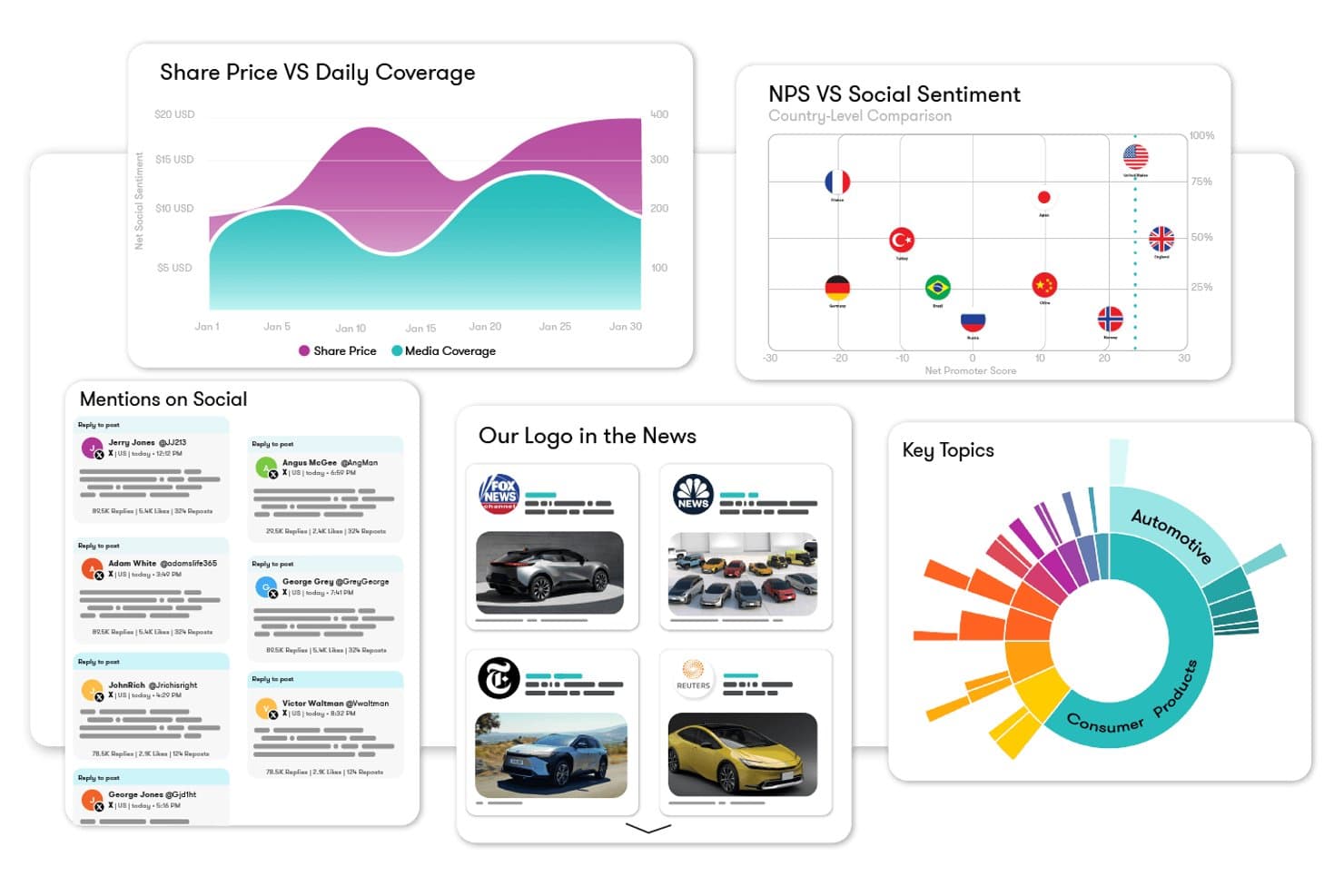
Meltwater centralizes media, social, and sentiment data in one research dashboard. Meltwater is a media intelligence and social listening platform that monitors news, social media, forums, podcasts, and LLM outputs, with AI-powered tools for sentiment analysis, competitive benchmarking, and trend detection.
Who Is Meltwater Best For?
Meltwater is a strong fit for product marketing managers and brand strategists who need to track competitive narratives, monitor social conversations, and understand how their brand appears across both media and AI platforms.
Why I Picked Meltwater
Meltwater earns its spot on my shortlist because no other tool I've tested pulls social signals, news, forums, and Reddit's full firehose into a single AI layer the way it does. I particularly like GenAI Lens, which tracks how your brand and competitors are discussed across ChatGPT, Gemini, and Perplexity—something purpose-built research platforms simply don't offer. Mira's Share of Voice dashboards and sentiment benchmarking make it easy to see exactly where your narrative stands relative to competitors across channels.
Meltwater Key Features
- BYOC (bring your own content): Upload internal research artifacts like interview transcripts and survey data to analyze alongside external media signals in one place.
- Predictive spike forecasting: A 48-hour forecasting model predicts whether an emerging conversation trend will grow or fade before it peaks.
- Meltwater MCP server: Connects AI assistants like Claude or ChatGPT directly to Meltwater's live data for natural-language queries with source attribution.
- AI-powered boolean search builder: Automatically constructs complex search queries from plain-language prompts, reducing manual query setup time.
Meltwater Integrations
Meltwater integrates with Slack, Microsoft Teams, Microsoft 365, Claude, ChatGPT via its MCP server, Power BI, Tableau, and Salesforce. Pro and Enterprise plans include API access for custom connections to business intelligence platforms, data warehouses, and internal dashboards.
Pros and Cons
Pros:
- Predicts trends with AI-powered spike forecasting
- Monitors brand mentions across major AI platforms
- Synthesizes external and internal data sources
Cons:
- Lacks native video or interview analysis
- No survey panels or respondent recruitment
Learn more about Meltwater: Best for real-time digital consumer intelligence
- Free demo available
- Pricing upon request

Brandwatch offers an AI-assisted ad creation interface for social media ads with writing suggestion tools. Brandwatch is an AI-driven consumer intelligence platform for market research teams, offering real-time analytics, social listening, audience insights, and digital trend tracking across web and social media channels.
Who Is Brandwatch Best For?
Brandwatch is a strong choice for digital marketing and consumer insights teams at enterprise brands that need detailed, real-time analysis of online conversations.
Why I Picked Brandwatch
I picked Brandwatch because it lets my team monitor millions of digital conversations and trends as they happen. I use its AI-powered analytics and customizable dashboards to surface actionable consumer intelligence in real time.
Brandwatch Key Features
- Influencer identification: Surfaces influential voices and profiles driving online trends, giving you a boost in competitive intelligence.
- Custom audience segments: Lets you build dynamic groups using demographic, keyword, or behavioral filters.
- Image analysis: Detects brand logos and objects in social and web images for deeper visual tracking.
- Automated reporting: Generates scheduled custom reports that deliver targeted metrics to stakeholders.
Brandwatch Integrations
Brandwatch offers native integrations with Bitly, ServiceNow, Shopify, Tipalti, Box, Bynder, Zendesk, Dropbox, HubSpot, Salesforce Service Cloud, and more, and provides an API for custom integrations.
Pros and Cons
Pros:
- Granular sentiment and demographic audience insights
- Custom AI-powered trend detection and alerts
- Real-time monitoring across millions of online sources
Cons:
- Large data exports require additional steps
- Dashboard setups can be time-consuming
Learn more about Brandwatch: Best for collaborative qualitative data synthesis
- Free plan + free demo available
- Pricing upon request
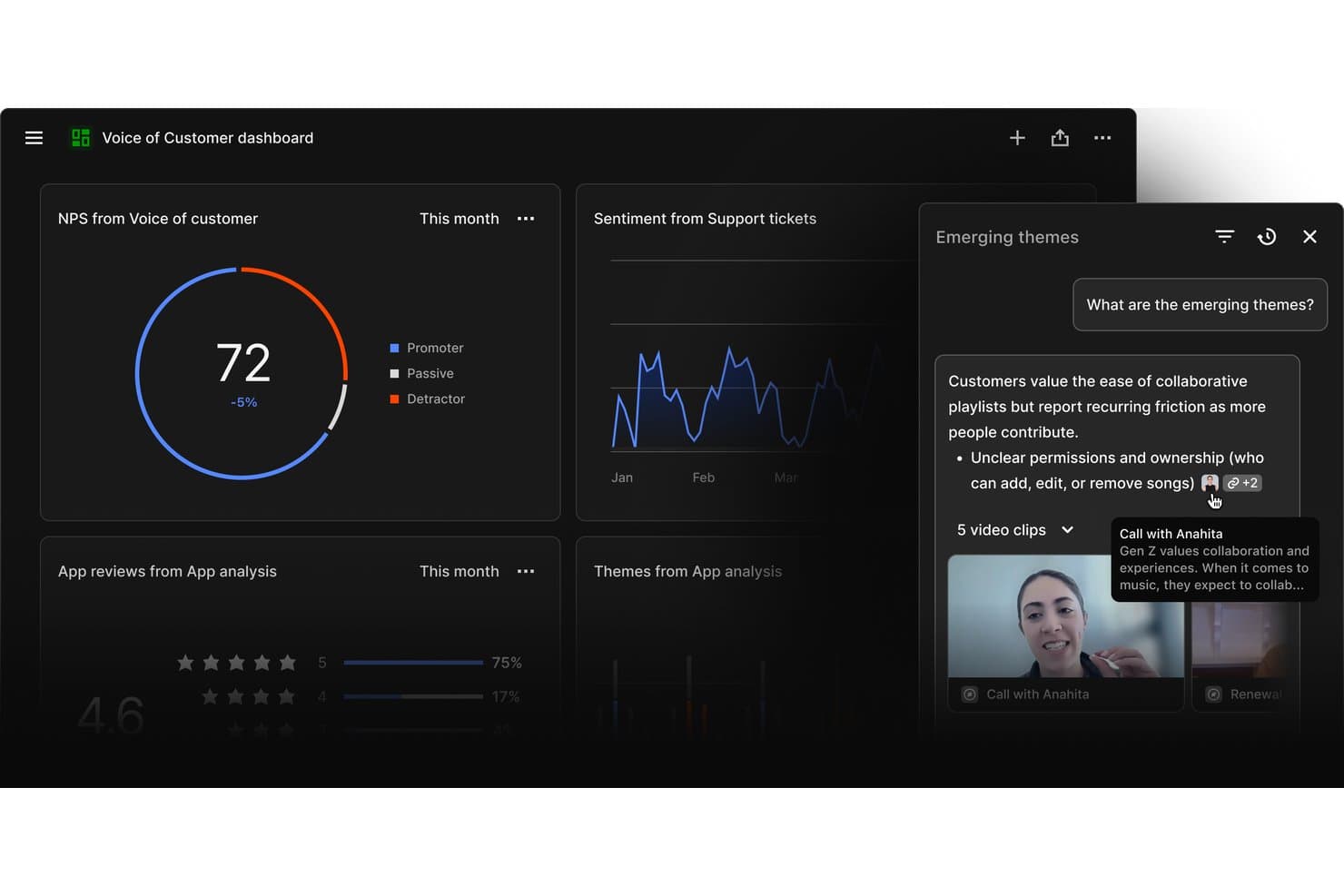
Dovetail surfaces emerging customer themes with AI-linked video evidence. Dovetail is a customer intelligence platform that synthesizes qualitative research data—interviews, call recordings, support tickets, and app reviews—into structured themes, insight reports, and trend dashboards using AI.
Who Is Dovetail Best For?
Dovetail is a strong fit for research-led product teams that need to synthesize large volumes of qualitative customer data—interviews, call recordings, and support tickets—into structured, shareable insights.
Why I Picked Dovetail
Dovetail earns its spot on my shortlist because no other tool I've tested matches its ability to turn raw qualitative data into structured, shareable insight at scale. I particularly like Magic Cluster, which automatically groups interview highlights by theme, and AI Docs, which generates full VoC reports with cited quotes from a single prompt. Digital Twins let my team pressure-test messaging and pricing against evidence-based customer segment models before running a single live study.
Dovetail Key Features
- AI Channels: Automatically classifies incoming support tickets, app reviews, and sales call transcripts into revenue-weighted product opportunities ranked by ARR impact and customer demand.
- AI Research Agents: No-code autonomous agents that monitor customer data on a schedule, generate recurring syntheses, and push findings to Slack, Teams, or email without researcher involvement.
- Insight repository: A centralized, semantically searchable hub that stores all past studies, transcripts, tags, and documents so teams can query historical findings alongside new research.
- Automatic PII redaction: Strips personally identifiable information from text, audio, and video before data enters the workspace, supporting GDPR and HIPAA compliance requirements.
Dovetail Integrations
Dovetail offers 38+ native integrations, including Jira, Linear, Productboard, Salesforce, HubSpot, Gong, Zendesk, Sprig, Pendo, PostHog, Slack, and Microsoft Teams. It also supports Google Calendar, Outlook 365, API, MCP, and CLI connectivity for custom data pipelines.
Pros and Cons
Pros:
- Supports AI-driven segment simulation for concept testing
- Links all AI answers to source data
- Synthesizes interviews and calls into structured insights
Cons:
- Advanced features restricted to Enterprise plans
- No external competitor or market signal tracking
Learn more about Dovetail: Best for AI-powered financial market analysis
- Free demo available
- Pricing upon request
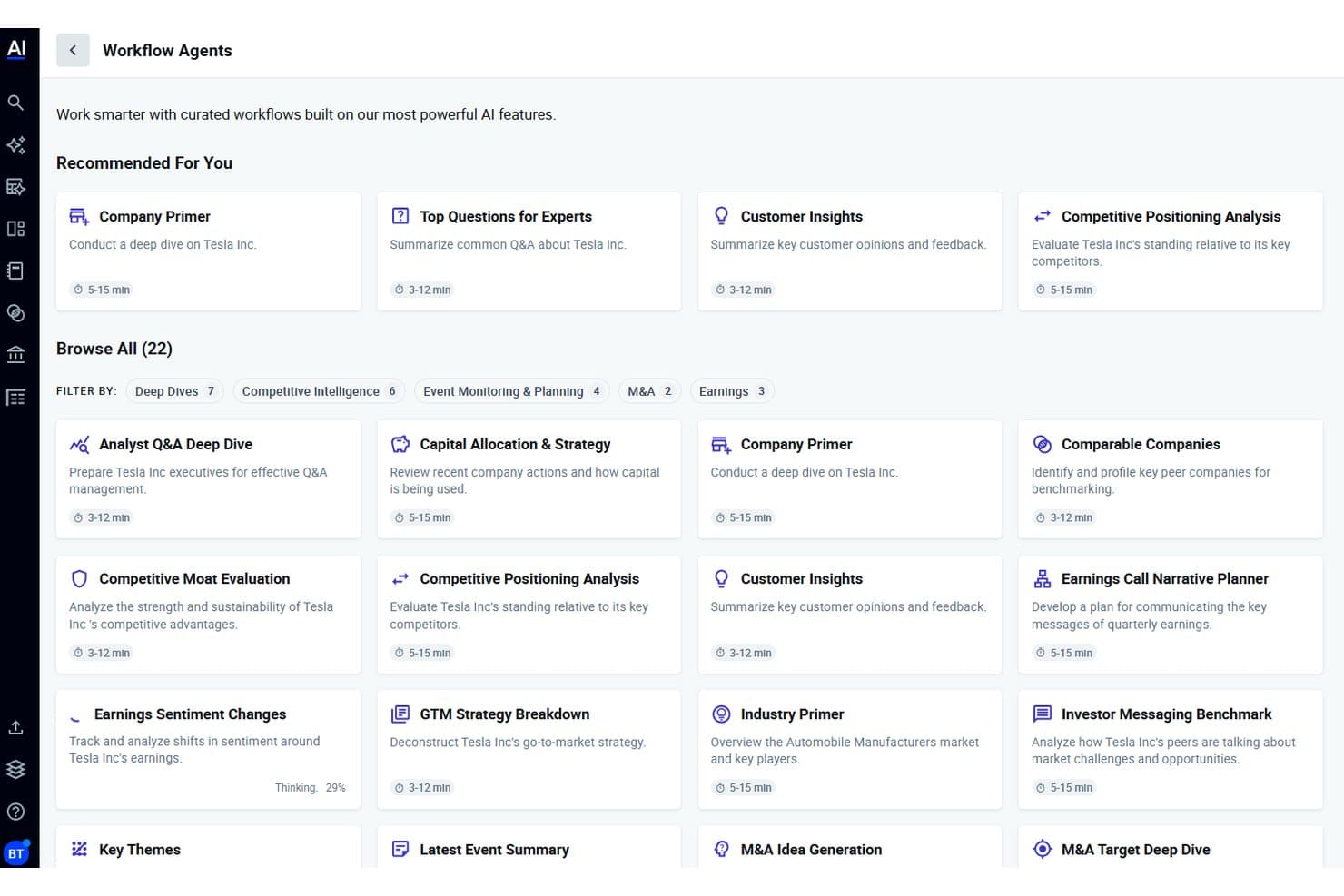
AlphaSense lets users run AI-powered research workflows on companies. AlphaSense is an AI-powered market and competitive intelligence platform that aggregates financial filings, broker research, expert call transcripts, and premium news into a unified search and synthesis environment.
Who Is AlphaSense Best For?
AlphaSense is a strong fit for product strategy directors and product marketing managers at enterprise companies who need deep competitive and market intelligence grounded in financial data.
Why I Picked AlphaSense
AlphaSense earns its spot on my shortlist because no other tool I've tested matches its depth of AI-powered financial market analysis. Its Deep Research agent autonomously scans thousands of earnings transcripts, broker reports, and regulatory filings to produce cited, decision-ready reports in minutes. I also rely on Smart Summaries to instantly extract SWOT analyses and competitive landscape snapshots from earnings calls, which is invaluable when tracking category shifts for roadmap and positioning work.
AlphaSense Key Features
- Generative Grid: Runs multiple AI prompts across many documents simultaneously, outputting organized, table-formatted answers for peer comparisons and transcript analysis.
- Snippet Explorer: Tracks specific topics and themes across the full content library over time, letting you spot trend shifts in how a subject is discussed.
- Automated monitoring and alerts: Continuously watches competitors, market moves, and industry topics across millions of documents, delivering configurable alerts in real time or on a schedule.
- Sentiment analysis: Color-codes emotion and tone across financial text, letting you filter search results by positive or negative sentiment to catch inflection points in earnings calls and filings.
AlphaSense Integrations
AlphaSense supports 20+ documented internal-content connectors, including Box, Dropbox, Google Drive, Microsoft SharePoint, Slack, Salesforce, Notion, Zoom, and Gong. Its ingestion API supports custom sources, but native integrations with product research tools and survey platforms aren’t documented.
Pros and Cons
Pros:
- Real-time alerts track competitors and market shifts
- Autonomous agent produces cited research in minutes
- Deepest available library for financial research
Cons:
- Isn’t designed for product or UX research
- Lacks survey or user feedback analysis tools
Learn more about AlphaSense:
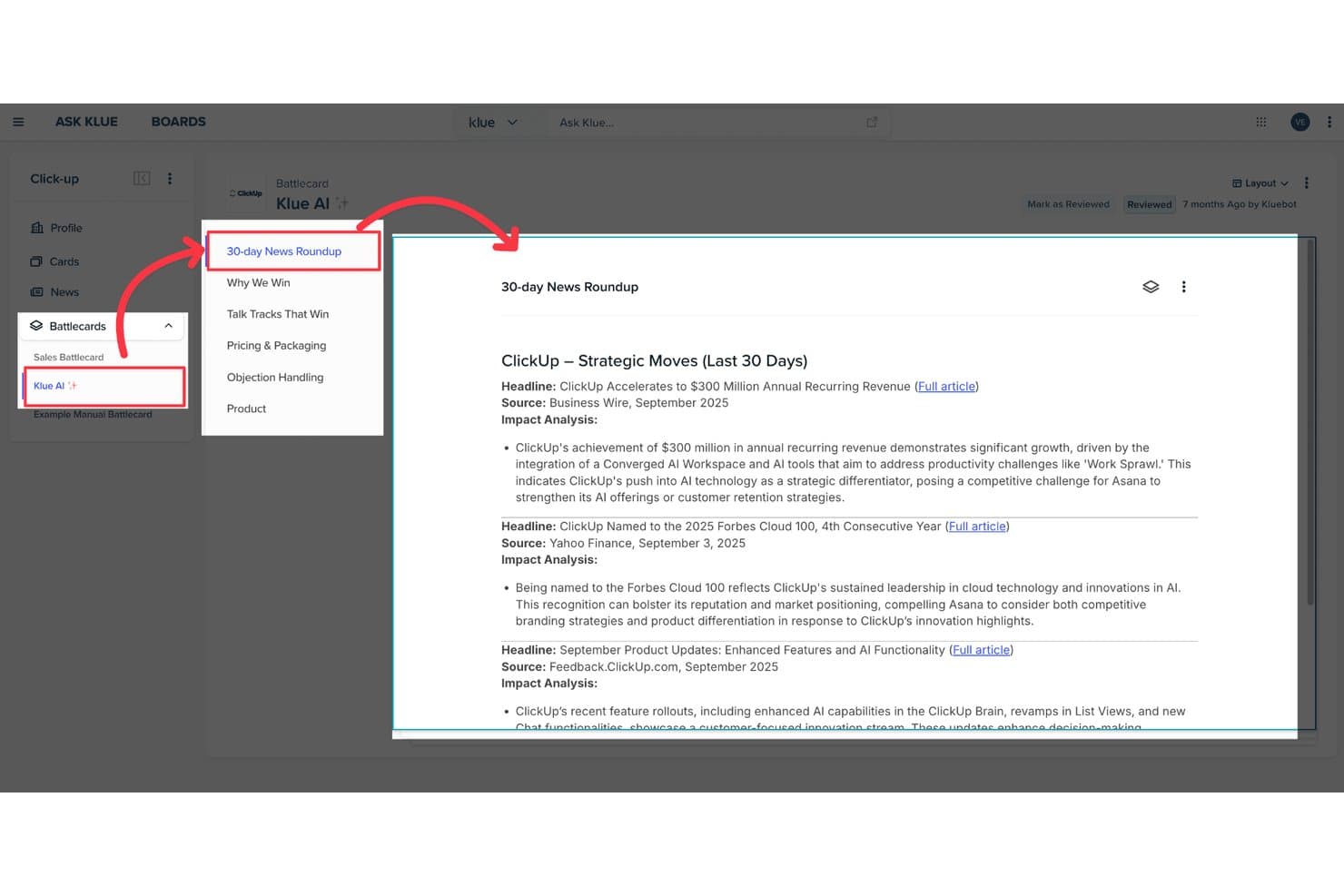
Klue delivers AI-generated competitor news roundups inside battlecards. Klue is a competitive intelligence and win-loss analysis platform that monitors competitor activity, analyzes buyer feedback, and delivers deal-specific insights to sales and product marketing teams.
Who Is Klue Best For?
Klue is a strong fit for product marketing managers and competitive intelligence teams at B2B companies that need to arm sales reps with deal-ready competitive insights.
Why I Picked Klue
Klue earns its spot on my shortlist because it's the only tool I've found that closes the loop between competitive intelligence and live deal support. I love how the Compete Agent's Deal Assistant automatically detects when a competitor is mentioned on a sales call and pushes deal-specific tips to the rep within minutes, no manual searching required. Pair that with Blindspot Interviews, which surface feedback from buyers who chose a competitor you never even knew you were up against, and you're getting competitive insight most teams simply don't have access to.
Klue Key Features
- Ask Klue: A natural-language AI chat interface that lets you query competitive and win-loss data directly inside Slack, Salesforce, or Microsoft Teams, with cited, sourced answers.
- AI-generated strengths and weaknesses: Automatically pulls competitor reviews from 12+ platforms and organizes findings into structured strength and weakness themes in about 30 seconds.
- Win & Loss Story Agent: Mines closed CRM data and call recordings immediately after a deal closes to generate structured deal recaps with extracted buyer requirements and competitive dynamics.
- MCP connector: Embeds Klue's competitive and win-loss data into third-party AI tools like Claude, enabling real-time battlecard generation and summaries from within external workflows.
Klue Integrations
Klue integrates with Salesforce, Slack, Microsoft Teams, Gong, HubSpot, Microsoft Dynamics 365, Chorus, Seismic, Showpad, and Highspot. Its MCP connector also connects competitive intelligence and win-loss data with Claude and Microsoft Copilot.
Pros and Cons
Pros:
- AI-generated strengths and weaknesses from reviews
- Win-loss insights pipeline supports sales teams
- Specialized in competitor profiling and benchmarking
Cons:
- Lacks panel or target audience recruitment tools
- No concept testing or survey creation features
Learn more about Klue: Best for identifying real-time consumer trends
- Free trial + free demo available
- Pricing upon request
Visit WebsiteCustomer Rating:5/5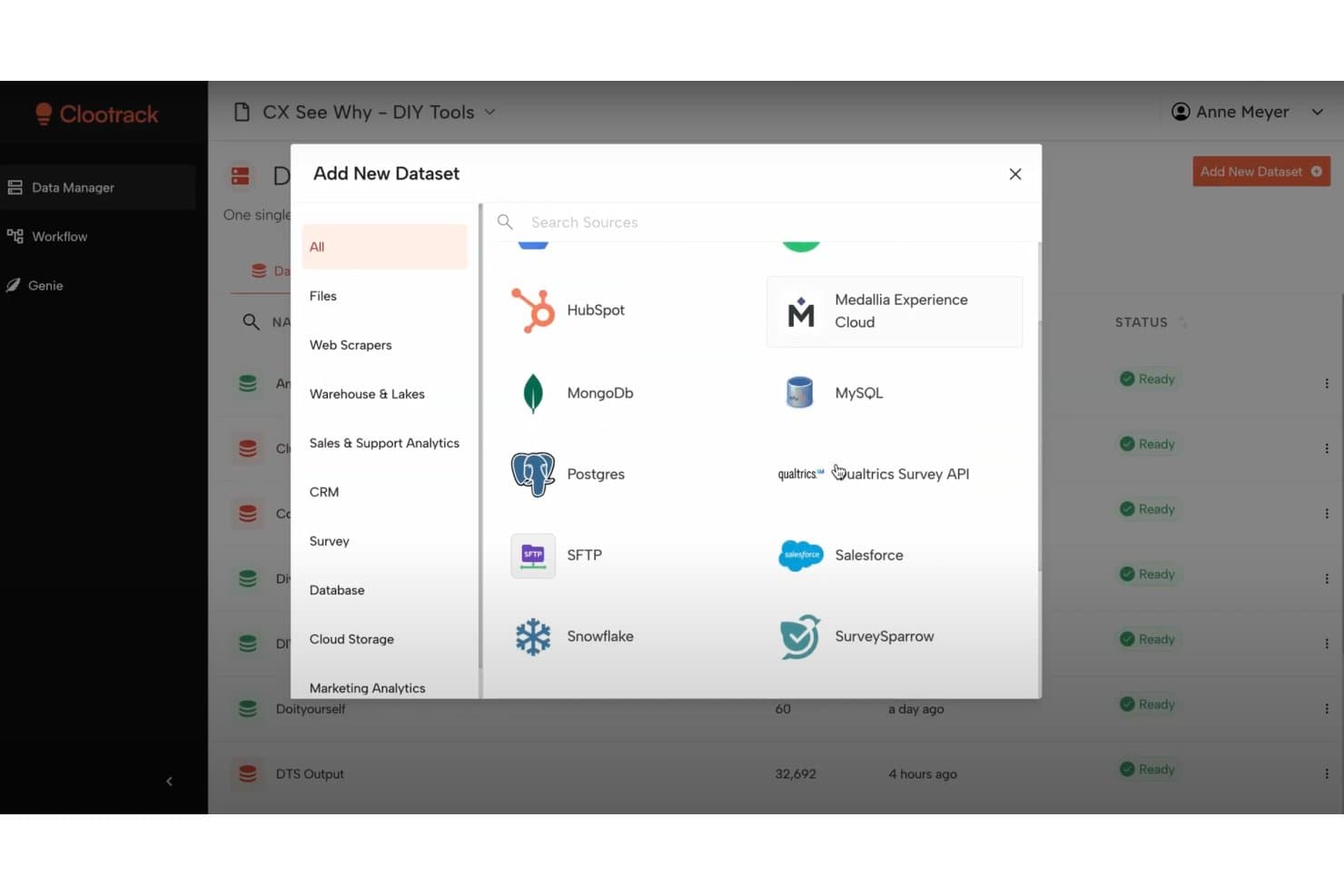
Clootrack is a customer intelligence platform that uses patented unsupervised AI to analyze feedback across 1,000+ data sources—including reviews, call transcripts, and social data—surfacing themes, sentiment shifts, and competitive benchmarks without predefined taxonomies.
Who Is Clootrack Best For?
Clootrack is a strong fit for enterprise product marketing and strategy teams that need always-on visibility into how consumer sentiment is shifting across markets and competitors.
Why I Picked Clootrack
I picked Clootrack as one of the best because its patented unsupervised AI discovers consumer sentiment shifts before you know to look for them. Rather than confirming what you already suspect, it surfaces unknown themes across 1,000+ data sources in real time. I especially like the Growth Research Agent, which compresses research timelines by up to 14x, and the always-on competitor review crawler that tracks thematic sentiment changes across rival brands continuously.
Clootrack Key Features
- Multi-language NLP: Analyzes customer feedback across 95+ languages, making it viable for global teams tracking sentiment across diverse markets.
- AI Decision Digests: Generates structured insight summaries that explain what's happening, why it's happening, and what action to take next.
- Clootrack Genie: A conversational GenAI copilot that lets you query customer intelligence datasets in natural language, with full SQL traceability behind every answer.
- Custom VoC agent builder: Lets teams configure specialized AI agents around specific business goals—like NPS improvement or returns reduction—by chatting directly with the platform.
Clootrack Integrations
Clootrack supports integrations with Salesforce, HubSpot, Zendesk, Freshdesk, Tableau, Power BI, and Snowflake, plus 1,000+ data connectors. It also offers an API, SFTP, CSV uploads, and MCP connectivity with Claude, ChatGPT, Microsoft Copilot, Google Gemini, and Glean.
Pros and Cons
Pros:
- Always-on competitor sentiment monitoring
- Multi-language analysis spans 95+ languages
- Patented AI finds hidden trends automatically
Cons:
- Dashboard design feedback highlights info overload
- No built-in audience recruitment tools
Learn more about Clootrack: Best for centralizing multi-channel feedback
- Free demo available
- Pricing upon request
Visit WebsiteCustomer Rating:4.3/5
Qualtrics offers collecting, analyzing, and managing customer and employee feedback. Qualtrics is an enterprise feedback management platform designed for collecting, analyzing, and managing customer or employee feedback across multiple channels using survey and data analytics tools.
Who Is Qualtrics Best For?
Qualtrics is well-suited to CX leaders who want to run proprietary AI models to analyze feedback from multiple customer touchpoints.
Why I Picked Qualtrics
I picked Qualtrics because I can manage survey data and feedback from web, SMS, social, and call center channels all in one place. My team uses tools like text analytics and dashboard customization to track feedback in real time and quickly identify trends.
Qualtrics Key Features
- Survey logic customization: Build complex survey flows using branching, skip logic, and embedded data.
- Automated response triggers: Set rules to send alerts or follow-ups automatically based on survey answers.
- Role-based permissions: Assign different access rights and roles to users across your organization.
- Data export options: Export survey data in formats like CSV or Excel to process with your own statistical algorithms.
Qualtrics Integrations
Qualtrics offers native integrations with SAP, Tango Card, Respondent, and Awardco. An API is available for custom integrations.
Pros and Cons
Pros:
- Automated response routing for high-volume feedback
- Real-time feedback analysis with built-in AI
- Customizable survey flows for advanced research methods
Cons:
- Data exports require additional configuration steps
- Survey distribution can require manual setup
Learn more about Qualtrics:

YouGov uses surveys for audience insights and consumer data analysis. YouGov is an audience intelligence and market research platform offering survey creation, opinion polling, audience profiling, and extensive access to global first-party data for research teams.
Who Is YouGov Best For?
YouGov suits market researchers and agencies that need real-time access to global opinion data for brand, political, or audience analysis across multiple countries.
Why I Picked YouGov
I picked YouGov as one of the best because I get access to global polling data and can quickly analyze public sentiment in dozens of markets. My team uses its audience profiling and survey tools to explore opinions and trends based on first-party responses.
YouGov Key Features
- Data segmentation tools: Filter and analyze datasets by demographics and geography.
- Brand tracking dashboard: Monitor brand metrics and audience perception in real time.
- Audience comparison reports: Compare responses between user-defined audiences or market segments.
- Custom research services: Commission bespoke surveys and expert analysis from YouGov’s research team.
YouGov Integrations
Native integrations are not publicly listed.
Pros and Cons
Pros:
- Ongoing survey data with frequent updates
- Extensive psychographic and attitudinal segmentation
- Global panel access for diverse opinion data
Cons:
- Survey customization capabilities can be restrictive
- Industry benchmarking options are limited
Learn more about YouGov: Best for automating advanced consumer insights
- Free demo available
- Pricing upon request

quantilope automates surveys, analysis, and reporting with AI. quantilope is an AI-powered market research platform built for automating survey creation, data collection, analysis, and dashboard reporting using advanced methodologies.
Who Is quantilope Best For?
quantilope is well-suited to insights teams and market researchers at midsize to large businesses who need fast, advanced analytics on shifting market trends.
Why I Picked quantilope
I picked quantilope as one of the best because it enables corporate marketing teams to automate advanced methodologies like conjoint and TURF analysis. The platform lets me build and launch surveys, then instantly generate dynamic dashboards with actionable data.
quantilope Key Features
- Automated data cleaning and processing: The tool handles complex data structuring and error detection automatically.
- Integrated survey panel access: You can reach diverse, global respondents directly through the platform.
- Custom question libraries: Create, save, and reuse customizable question templates in your projects.
- Real-time data visualization: View live results and interactive charts as responses come in for immediate strategy optimization.
quantilope Integrations
quantilope offers an API for custom integrations. Native integrations are not publicly listed.
Pros and Cons
Pros:
- Real-time dashboards update with respondent data
- Advanced analytics for conjoint and TURF studies
- Fully automates complex survey methodologies
Cons:
- Steeper setup process for complex projects
- Limited native integrations with external platforms
Learn more about quantilope:
Suzy helps users unlock deep consumer insights with AI-driven research. Suzy is an enterprise AI market research platform that integrates quantitative surveys, AI-moderated voice interviews, competitive signal monitoring, a generative AI-queryable insight repository, and automated stakeholder deliverable generation into a single connected system.
Who Is Suzy Best For?
Suzy is built for enterprise insight teams—PMMs, user research leads, and strategy directors—who need to run qualitative and quantitative research under one roof without stitching together separate tools.
Why I Picked Suzy
Suzy earns its spot on my shortlist because no other platform I've evaluated runs AI-moderated voice interviews at the scale it does. Suzy Speaks deploys an AI moderator across thousands of simultaneous consumer conversations, capturing tone, cadence, and emotional response that standard surveys miss entirely. Paired with Suzy Intelligence, which scores signals from 10,000+ sources including patents and SEC filings, I get both the deep qual and the always-on market monitoring in one place.
Suzy Key Features
- Suzy Impact report generation: Automatically produces audience-specific deliverables—executive summaries, consumer narratives, and full pitch decks—with on-brand formatting and built-in confidence flags.
- BIOTIC bot detection: A multi-layer fraud prevention system using device fingerprinting, AI-powered challenge questions, VPN blocking, and a honeypot mode to verify panel respondents before data reaches your dashboard.
- Natural language repository querying: Ask plain-language questions across your entire research archive—past studies, uploaded briefs, third-party reports, and behavioral data—and get AI-generated, evidence-backed answers instantly.
- Suzy Live video interviews: Facilitates live 1-on-1 video interviews and focus groups with built-in scheduling, respondent incentives, and optional human moderator support.
Suzy Integrations
Native integrations with product, CRM, analytics, or collaboration tools aren’t clearly documented. Suzy connects to 70+ external panel providers and client CRM lists, and accepts PDF, Word, and CSV uploads into Suzy Insight.
Pros and Cons
Pros:
- Centralized insight repository with natural language querying
- Automated insight synthesis across all research types
- AI voice moderation for large-scale qualitative research
Cons:
- Limited depth for highly specialized qualitative interviews
- Requires annual enterprise commitment to onboard
Learn more about Suzy:
Andre verktøy for KI-markedsundersøkelser
Her er noen flere alternativer for KI-markedsundersøkelser som ikke kom med på kortlisten min, men som likevel er verdt å se nærmere på:
- 11Listen LabsBest for AI-driven qualitative analysis at scale
- 12EnterpretBest for always-on customer feedback intelligence
- 13RemeshBest for audience dialogue facilitation
- 14CrayonBest for competitor-driven market intelligence
- 15MarvinBest for qualitative insight synthesis and sharing
- 16Outset.aiBest for instant conversational insights
- 17ConveoBest for actionable live discussion summaries
- 18VoxpopmeBest for automated video feedback analytics
- 19DiscussBest for live video research with global users
Kriterier for valg av verktøy for KI-markedsundersøkelser
Da jeg valgte ut de beste verktøyene for KI-markedsundersøkelser til denne listen, tok jeg hensyn til vanlige kjøperbehov og utfordringer, som automatisering av dataanalyse og muligheten til å gjennomføre globale undersøkelser på flere språk. Jeg brukte også følgende rammeverk for å holde evalueringen strukturert og rettferdig:
How I Evaluate AI Market Research Tools
To make this list, a tool's AI needs to handle real product research work, like analyzing interview themes or answering research questions. From there, I evaluate three things. Core functionality carries the most weight, like collecting data and segmenting audiences. Then I look at video and voice analysis and trustworthy AI outputs.
Core Functionality (Table Stakes For This List)
When I'm selecting tools for my list, I score each one on a scale from 0 (does not offer the functionality) to 5 (excels in this area) for each core functionality listed below. I then convert the total into a percentage to help assess each tool's overall fit, with extra weight on any functionalities I’ve deemed essential.
- AI Insight Synthesis (Essential): I look for themes spanning interviews, surveys, reviews, and social data, with findings tied to roadmap or positioning decisions.
- Automated Data Collection (Essential): I assess how tools gather surveys, reviews, interviews, social posts, and web signals without repeated manual imports.
- Sentiment And Theme Analysis: I check whether NLP detects sentiment, intent, emotions, and recurring issues in open-text customer feedback.
- Generative AI Querying: I evaluate natural-language questions, cited answers, follow-up prompts, and reports built from research data.
- Audience Targeting And Segmentation: I look for relevant respondent recruitment, screening, demographic filters, and segments for concept or pricing research.
- Competitive And Market Intelligence: I assess competitor monitoring, category trends, positioning comparisons, and signals that inform opportunity discovery.
Once I have a list of tools that meet the criteria, I consider what sets each platform apart.
Differentiating Factors (What Sets Vendors Apart)
Here's how I compare and contrast different vendors:
Standout Features
I evaluate whether a tool offers AI research agents that can design studies, conduct interviews, and probe with follow-ups autonomously. That capability changes the math on how many studies a small product team can run per sprint. I also check for an insight repository—a searchable hub where past findings surface when new questions arise, so teams stop repeating research they've already done. Real-time trend detection matters too. I look for tools that continuously scan reviews and social channels and flag emerging complaints or shifts before they hit your backlog as surprises.
Beyond Features
I check whether a tool connects to your existing product stack—Jira, Slack, Amplitude, Figma—because insights trapped in a silo don't reach sprint planning. Data quality matters just as much: I evaluate bot screening, respondent verification, and whether AI summaries link back to source evidence so you can audit a claim before acting on it. I also look at pricing scalability, since a credit model that works for three studies a quarter can collapse when research ops ramps up.
Slik velger du verktøy for KI-markedsundersøkelser
Det er lett å gå seg vill i lange funksjonslister og kompliserte prismodeller. For å hjelpe deg med å holde fokus mens du går gjennom den unike prosessen din for valg av programvare, får du her en sjekkliste over faktorer du bør ha i bakhodet:
| Faktor | Hva du bør vurdere |
| Skalerbarhet | Kan verktøyet støtte det nåværende og fremtidige omfanget av undersøkelsene dine, inkludert vekst i prosjekter, brukere eller globale markeder? |
| Integrasjoner | Kobler det seg direkte til de viktigste systemene dine for analyse, CRM eller datavisualisering, eller trenger du omveier for å få tilgang til kritiske data? |
| Tilpasningsmuligheter | Kan du tilpasse analyser, rapporteringsresultater eller arbeidsflyter slik at de passer organisasjonens eksisterende prosesser og begreper for undersøkelser? |
| Brukervennlighet | Vil ikke-teknisk personale kunne utforme, gjennomføre og analysere undersøkelser på en konsekvent måte uten omfattende opplæring eller IT-støtte? |
| Implementering og introduksjon | Hvilke ressurser eller hvor lang tid trenger du for å sette opp verktøyet, overføre historiske prosjekter og gjøre teamet ditt kjent med løsningen? |
| Kostnad | Samsvarer prisnivåene med bruksmønstrene og funksjonene du trenger, og har du tatt høyde for kostnader til tilleggstjenester eller brukerplasser? |
| Sikkerhetstiltak | Tilbyr leverandøren datakryptering, personvernregler (GDPR, CCPA) og tydelig kontroll over hvor sensitive undersøkelsesdata lagres og deles? |
| Internasjonale funksjoner | Er verktøyet utstyrt for å håndtere flere språk, rekruttere respondenter globalt og oppfylle lokale krav der det er nødvendig? |
Hva er verktøy for KI-markedsundersøkelser?
Verktøy for AI-markedsundersøkelser er programvareplattformer som automatiserer og forbedrer datainnsamling, analyse og innsikt for markedsundersøkelser ved hjelp av kunstig intelligens. Disse verktøyene hjelper team med å analysere kvalitative og kvantitative svar, identifisere trender, fremskynde beslutningstaking og sammenfatte funn fra spørreundersøkelser, intervjuer eller sosiale kanaler. De støtter ofte globale undersøkelser og undersøkelser på flere språk.
Funksjoner i verktøy for AI-markedsundersøkelser
Når du velger verktøy for AI-markedsundersøkelser, bør du se etter følgende viktige funksjoner:
- Automatisert dataanalyse: Bruker maskinlæring til raskt å behandle store mengder kvalitative og kvantitative svar, og fremhever mønstre og handlingsrettet innsikt uten manuelt arbeid.
- Oppretting av spørreundersøkelser og spørreskjemaer: Lar deg utforme, distribuere og administrere tilpassede spørreundersøkelser til målrettede målgrupper direkte i plattformen.
- Sentimentanalyse: Analyserer åpne svar for å oppdage og klassifisere følelsesmessig tone, slik at du kan forstå hva respondentene føler om bestemte temaer.
- Transkripsjon og språkstøtte: Transkriberer lyd- og videointervjuer automatisk og støtter flere språk for globale undersøkelser.
- Verktøy for datavisualisering: Konverterer rådata til diagrammer, grafer og oversikter som gjør trender og funn enkle å tolke og dele.
- Integrasjoner med andre plattformer: Kobler seg til andre verktøy, for eksempel CRM-systemer, datavisualiseringsplattformer eller skylagring, for sømløs dataoverføring og sammenhengende arbeidsflyt.
- Rapportering i sanntid: Leverer oppdaterte resultater og analyser etter hvert som svarene samles inn, slik at team kan reagere raskt under direkte eller pågående undersøkelser.
- Paneladministrasjon: Hjelper med å organisere, følge opp og kommunisere med deltakere i undersøkelser, noe som gjør det enklere å engasjere de riktige respondentene.
- Tilpassbare arbeidsflyter: Lar deg tilpasse moduler, rapportformater og gjennomgangsprosesser slik at de passer teamets metoder for markedsundersøkelser.
- Sikker datalagring: Sikrer at alle undersøkelsesdata lagres trygt, med kryptering og alternativer for regelverksetterlevelse som beskytter sensitiv informasjon og støtter personvernstandarder.
Fordeler med verktøy for AI-markedsundersøkelser
Implementering av verktøy for AI-markedsundersøkelser gir flere fordeler for teamet og virksomheten din. Her er noen av fordelene du kan se frem til:
- Raskere innsikt: Automatisert dataanalyse og rapportering i sanntid reduserer behandlingstiden for markedsundersøkelser.
- Dypere forståelse av følelser: AI-drevet sentimentanalyse avdekker de følelsesmessige drivkreftene bak kunders svar og tilbakemeldinger.
- Muligheter for globale undersøkelser: Funksjoner for flere språk og transkripsjon gjør det enkelt å gjennomføre undersøkelser på tvers av ulike regioner og språk.
- Sentralisert samarbeid: Integrerte oversikter og tilpassbare arbeidsflyter gjør at teamet og interessentene dine kan arbeide effektivt på ett sted.
- Forbedret datanøyaktighet: AI-drevet feilreduksjon og avansert validering gir renere og mer pålitelige datasett.
- Forenklet deltakeradministrasjon: Verktøy for paneladministrasjon gjør det enklere å organisere, følge opp og kommunisere med respondenter i undersøkelser.
- Forbedret datasikkerhet: Sikker datalagring og funksjoner for regelverksetterlevelse bidrar til å opprettholde personvernet og oppfylle krav.
Kostnader og priser for verktøy for AI-markedsundersøkelser
Valg av verktøy for AI-markedsundersøkelser krever en forståelse av de ulike prismodellene og abonnementene som er tilgjengelige. Kostnadene varierer basert på funksjoner, teamstørrelse, tillegg og mer. Tabellen nedenfor oppsummerer vanlige abonnementer, gjennomsnittsprisene deres og typiske funksjoner som er inkludert i løsninger for AI-markedsundersøkelser:
Sammenligningstabell for abonnementer for verktøy for AI-markedsundersøkelser
| Abonnementstype | Gjennomsnittspris | Vanlige funksjoner |
| Gratisabonnement | $0 | Tilgang til grunnleggende spørreundersøkelser, begrenset antall svar, kjerneanalyse og rapportering på begynnernivå. |
| Personlig abonnement | $20-$50/bruker/måned | Avansert utforming av spørreundersøkelser, begrensede automatiseringsfunksjoner, grunnleggende sentimentanalyse og brukerstøtte via e-post. |
| Bedriftsabonnement | $60-$150/bruker/måned | Verktøy for teamsamarbeid, AI-drevet innsikt, tilpassede oversikter, integrasjonsalternativer og brukerstøtte via nettprat. |
| Virksomhetsabonnement | $200-$500+/bruker/måned | Dedikert kontoadministrasjon, avansert sikkerhet, API-tilgang, ubegrensede prosjekter og funksjoner for regelverksetterlevelse. |
Vanlige spørsmål om AI-verktøy for markedsundersøkelser
Her er noen svar på vanlige spørsmål om AI-verktøy for markedsundersøkelser:
Hvordan håndterer AI-verktøy for markedsundersøkelser personvern og samsvar?
De fleste AI-verktøy for markedsundersøkelser tilbyr sikkerhetsfunksjoner som datakryptering, rollebasert tilgang og samsvar med standarder som GDPR og CCPA. Det er viktig å gjennomgå personvernerklæringen for hvert verktøy og kontrollere at det oppfyller organisasjonens krav til databeskyttelse før det tas i bruk.
Kan AI-verktøy for markedsundersøkelser analysere data på flere språk?
Ja, mange AI-verktøy for markedsundersøkelser støtter flerspråklig dataanalyse. De tilbyr innebygd oversettelse og transkripsjon, slik at team kan samle inn, behandle og tolke svar fra globale målgrupper uten betydelig manuelt arbeid eller språkbarrierer.
Hvor tilpasningsbare er disse verktøyene for unike arbeidsflyter for markedsundersøkelser?
De fleste løsninger tilbyr tilpassbare dashbord, rapporteringsmaler og arbeidsflytinnstillinger. Denne fleksibiliteten lar deg tilpasse verktøyet til dine spesifikke metoder for markedsundersøkelser, merkevareprofilering og preferanser for teamsamarbeid.
Hvilke typer integrasjoner bør jeg se etter i AI-verktøy for markedsundersøkelser?
Du bør se etter verktøy som kobler seg til systemene dine for datavisualisering, CRM-systemer og produktivitetsplattformer. Vanlige integrasjoner inkluderer Slack, Salesforce, Tableau og leverandører av skylagring for å effektivisere arbeidsflyter og samle datakilder.
Kreves det teknisk kompetanse for å bruke AI-verktøy for markedsundersøkelser?
Nei, de fleste moderne AI-verktøy for markedsundersøkelser er utviklet med brukervennlige grensesnitt, slik at brukere uten teknisk kompetanse kan lage spørreundersøkelser, analysere data og generere rapporter – ofte med støtte fra veiledninger og funksjoner for veiledet introduksjon.