
How can we ensure our product is actually fulfilling our vision? And in a world where well-intentioned products often have catastrophic consequences, how do we craft visions for an equitable future?
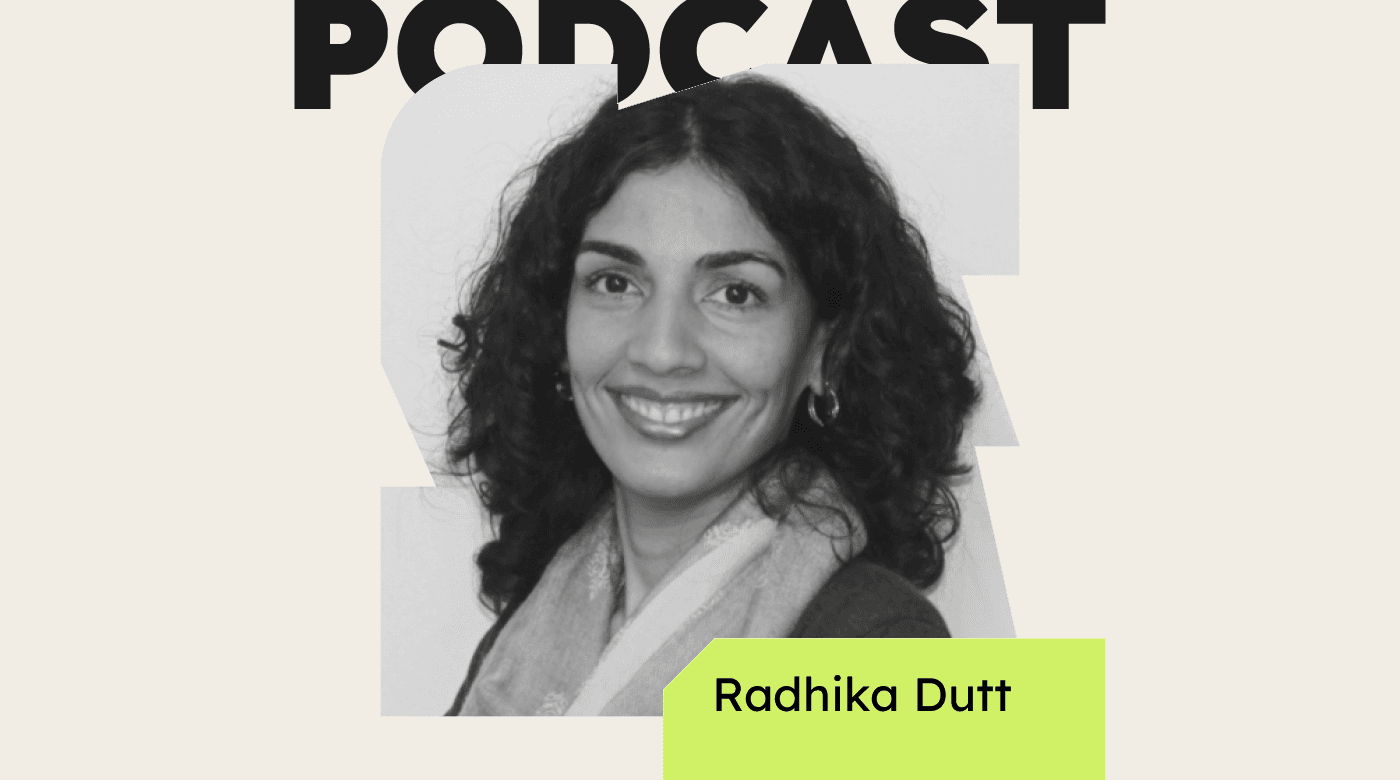
In this episode, Hannah Clark is joined by Radhika Dutt—Author of Radical Product Thinking and Chief Product Officer at Moveprice—in this second part conversation to pick up where we left off and examine visionary thinking at a higher level.
Tune in to learn how your product vision shapes reality!
Interview Highlights
- Recap: vision vs survival model [0:39]
- Rationalize why we prioritize instead of just handing down priorities
- We’re trading off the long-term versus short-term – you can do this by putting it on an x and y axis.
- The quadrants that emerge - good for vision and survival - that’s good for the business
- Vision investment - good for the long term, bad for the short term.
- Vision debt - good for the short term, bad for the long term.
The way we can share our rationale is by communicating our intuition.
Radhika Dutt
- The caveat to the vision vs survival model and creating a vision in general is whether you can successfully articulate the result you want to see in the world—and we’re seeing in real time what the failure to do this looks like in in the world of LLMs [2:11]
- We often think of the product as the end goal, rather than the vision being the end state.
- Shares an example of someone who wanted to give laptops to children to end poverty and increase education, but the vision focused so heavily on the act of giving the children laptops rather than the end state.
- LLMs are one way that we are able to create a product that will answer all of our questions.
- Ask - what outcome do you want out of this AI? That will affect how you build that AI.
- Inclusive products [6:55]
- We don’t have the intent to exclude someone when we create a product, but we don’t think about all the possible personas that will use our products and how it’ll affect people differently.
- When we don’t deliberately create inclusive products, we will end up excluding people
- You take on vision debt when you don’t work to include marginalized groups in your product
As product people, we're all affecting human lives. Our products affect people's lives. And with that power comes the responsibility that we have to realize that we need to build products that actually work for all.
Radhika Dutt
- What can we learn from the ethical failings of social media platforms as we find ourselves at the doorstep of an AI revolution? [10:36]
- We are voting for the world we want to create through the labour we put into the work.
- We used to think that consumers could vote with their dollar - but that is increasingly unrealistic. There are monopolies that are so strong that the consumer doesn’t really have a choice.
- We often look to corporate responsibility, but the corporate entity was constructed to be able to shield the people behind it from liability. So it’s naive of us to think that they’ll do the responsible thing.
- The biggest thing we can do is realize that we are voting for that world.
- What are some of the other challenges in terms of building a more equitable approach to product management? [15:47]
- The vision is the first step - what’s the end state you want to bring about?
- The second stage - when you create your strategy, ask how it will address marginalized groups. You have to bake it into your strategy. Who are the personas and what are their pain points?
- RDCL strategy
- Real Pain Points, Design, Capabilities, and Logistics
- Thinking about vision debt and how you can pay it back
- Example of a company that has baked equity into their strategy [19:04]
- Papadam company - Lijjat
- All female employees with equal ownership of the company - started with 7 women, now it’s 45,000 women.
- Buses transport the women to centres to pick up dough to roll at home, then they come back to drop off the rolled dough. They get paid for what they rolled and at the end of each month they share in the profits or losses.
- Any organization can take this approach. You don’t have to be a non-profit to have financial success and do good.
Meet Our Guest
Radhika Dutt is the author of Radical Product Thinking: The New Mindset for Innovating Smarter which has been translated into several languages including Chinese and Japanese. She is an entrepreneur and product leader who has participated in five acquisitions, two of which were companies that she founded. She advises organizations from high-tech startups to government agencies on building radical products that create a fundamental change. She is currently Advisor on Product Thinking to the Monetary Authority of Singapore, and serves on the board of the independent publisher, Berrett Koehler. Radhika has built products in a wide range of industries including broadcast, media and entertainment, telecom, advertising technology, government, consumer apps, robotics, and even wine. She graduated from MIT with an SB and M.Eng in Electrical Engineering, and speaks nine languages.

We are voting for the world that we want to create through the labor that we put into our work.
Radhika Dutt
Resources from this episode:
- Subscribe to The CPO Club newsletter
- Connect with Radhika on LinkedIn
- Check out Radical Product Thinking website
- Check out Radhika’s book - Radical Product Thinking: The New Mindset for Innovating Smarter
Related articles and podcasts:
Read The Transcript:
We’re trying out transcribing our podcasts using a software program. Please forgive any typos as the bot isn’t correct 100% of the time.
Hannah Clark: You may recall our previous conversation with Radhika Dutt—the author of Radical Product Thinking—which touched on the power of vision, the devices for managing that vision, and how product teams can use the vision versus survival model to work collaboratively and steer toward the right outcomes.
Radhika joins us again to pick up where we left off and examine visionary thinking at a higher level. How can we ensure our product is actually fulfilling our vision? And in a world where well intentioned products often have catastrophic consequences, how do we craft visions for an equitable future? Let’s jump in.
Thank you so much, Radhika, for joining us again.
Radhika Dutt: I’m excited to be back. Thank you for having me back.
Hannah Clark: I’m very excited for this part of the conversation. So just to recap what we discussed in our first part, we talked a little bit about the vision versus survival model and what that looks like, how to apply it and use it to explain your vision.
Did you want to just give a brief recap of how that works for anyone who might have missed part one?
Radhika Dutt: Yeah. A quick summary is that it’s helpful to communicate our rationale for how we prioritize instead of just handing down priorities. And the way we can share our rationale is by communicating our intuition, which is typically when we’re making these decisions and trade offs, we’re trading off the long term against the short term.
So you can make this explicit by putting this yin and yang of short term and long term on an X and Y axis of, is this good for the vision or not? And the X axis, is this helpful for survival in the short term or not? And the quadrants that emerge when you drop this X and Y axis are, something is good for both vision and survival, well, those are easy decisions.
Then, something that’s good for the vision, but it doesn’t help you in the short term, like refactoring code, means you’re investing in the vision. And the opposite quadrant to investing in the vision is, of course, the vision debt, meaning it’s good for the short term, but it’s bad for your long term vision.
And so the way you communicate your rationale is talking about where does a feature or an opportunity lie in these quadrants? And this way, it’s not a contentious discussion about I’m right or you’re right. It’s really about, is this good for the vision or not? It’s a more objective decision making process.
Hannah Clark: So with that being said, now we’ve got an effective model in place for communicating our vision and kind of steering the team towards that vision. The caveat to that is how do we define what’s a good vision and creating a vision that’s worth steering towards? And I think part of what we’ve seen is people don’t always do a great job of defining what the result is of the vision that they want to see.
Radhika Dutt: Exactly. We often think about the product as the end goal in itself as opposed to thinking about the end state. One example that really comes to mind of what you just described is an initiative called One Laptop per Child, which was all the rage in about 2005.
This came out of the Media Lab and Nicholas Negroponte, who was heading that, had really huge ambitions for this project. The idea was every child in the world would have access to a laptop and that would mean that, we could end all wars, end poverty by giving every child a laptop and therefore education.
But if you notice everything, including the name, it talks about the vision of this whole initiative as handing a laptop to a child. This is the product, the laptop. Whereas the vision should be about the end state. It’s not about handing a laptop to a child. Really, the vision should have been giving a child an education.
Hannah Clark: Yeah, I fully agree. I think that there’s a little bit of a lapse there in terms of, what are the supporting resources that you need? A laptop is a wonderful thing to give in theory, and it gives a very tangible takeaway for anyone who’s contributing to that vision. But then what? What’s the next step?
Radhika Dutt: Exactly. What is the end state and how is the laptop bringing that about? What’s the problem you’re setting out to solve? Is the laptop in fact the biggest impediment to a child getting an education? I think those are the key questions that your vision has to answer.
Hannah Clark: And I think we’re seeing some repeats of that when we talk about LLMs and just this competitive landscape that we’re entering now where there’s this race to be the most competitive product in AI. I think we’re seeing a little bit of a parallel lapse in judgment where the product doesn’t always match up with the true intent of the vision.
Radhika Dutt: Exactly. We’ve seen this time and time again, where we built something thinking, this product is going to be all the rage. Facebook did this with a vision of open and connected, but you ask, well, what does open and connected mean?
It’s not really clear. Do you want a world that’s truly open and truly connected? I don’t think we ever stopped that through. And then we built Facebook and we re-optimized it for maximizing how much time someone spends on it. And exactly as you were pointing out, if we look at AI, we’re thinking about AI in the same way. Like how do we maximize the usage of AI that it can answer all of these questions and the shortest possible way to get there where, it can pretty much seem to answer everything, right?
And Large Language Models or LLMs were one way that we’ve taken this approach to be able to create this product that’s going to be able to answer all of our questions. But let’s look at the outcomes and what is it that we want to create? If we look at how large language models work, well, they really use all sorts of text, including stuff that has, hate speech, racially derogatory speech, all kinds of stuff that’s embedded in there.
It’s you know, all of the biases and bad things about our society are absorbed as part of these large language models. So then you wonder, okay, when you create AI based on that, of course, those are things that are going to come out of the AI and what AI spits out to each user. So if you, instead of just focusing on the success of a product by itself, if you say, what is the outcome that you want out of this AI?
If you say that what you want is a set of equitable outcomes for people, then how you build that AI would look very different. And this was in fact, the point that one of the researchers made in a paper, and I can’t remember who the person was, but the point was that we would build AI very systematically to be able to create the outcomes we want to create. As opposed to build something and then take the approach of, we’ll fix it when we discover problems.
As we know from the example of Facebook, that has not worked so well. Why do we feel like this is going to work again?
Hannah Clark: I really agree with you there. I think that we’ve now discovered as a whole that sometimes going back and fixing an issue when it’s caused societal rifts and possibly interference with elections, it’s a very tall order further down the line rather than approaching those things from a proactive standpoint.
So in a previous conversation, we had discussed a little bit about equality in terms of product development and how the product development process also can be not as equitable as it should be. Can you tell me a little bit about what you’ve seen in the field and how that could be remedied in your perspective?
Radhika Dutt: When we build products, we don’t have the intent to actually exclude someone. It’s not that we purposefully exclude marginalized populations in our product. But what happens is we often don’t think about who are all the possible personas who are going to use our product and how is it going to affect people differently.
And I’ll give a very simple example. And that example is, let’s say you’re building a checking account. So your product is a checking account and so theoretically it should work for anyone. Anyone should be able to have this checking account, but then you look at features within this checking account.
Let’s say you charge a fee or the checking account, but then you’re witty of it if you have a certain balance. Now, all of a sudden you’re already creating outcomes that are not equitable. So who is going to be paying this fee? It’s the people who cannot maintain a certain bank balance. And so when we don’t design products deliberately to create equitable outcomes, we will most likely leave out people.
The thing that we need to all work towards, what we need to realize is that as product people, we’re all affecting human lives. Our products affect people’s lives. And with that power comes the responsibility that we have to realize that we need to build products that actually work for all. Whenever I say this, right, that we have to build products that work for all, the next question is of course going to be, “Yes, but we can’t possibly build products that work for all that, we have to prioritize things.”
So how do you do inclusion when you clearly have to prioritize personas? And the answer to that is, we very often take the attitude of, well, let me build something for the majority persona right now. And then we’ll think about the marginalized. Going back to the Facebook example, this is exactly what happened. So if you think about all the resources that are devoted to trying to moderate hate speech, I think 87% of that money was going to the US market and only 10% was devoted to other markets. And, this meant that hate speech in places like Ethiopia or Myanmar, that they were not moderated well enough.
So, we can always, like, it’s very easy to say, we’ll come back and fix problems for those marginalized groups, but hardly ever do we go back and fix those issues. So one of the things that we need to think about is, as we prioritize, think about vision versus survival, and then realize that if you’re not prioritizing some of those marginalized groups, that you are taking on vision debt.
The question for you then is how long are you going to keep accumulating vision debt and not ever paying it back? And this is the kind of open discussion that needs to happen in a product team because we all recognize the responsibility that comes with building our products.
Hannah Clark: That kind of gave me chills actually, because when you think about what’s happened with Facebook and with other social media platforms in terms of not prioritizing marginalized groups, that vision debt that seems to not affect the majority actually ends up affecting the majority in a very substantial way, ultimately. So that’s very impactful. I have to give that some credence.
I’m curious at this stage, if we’re looking at AI almost as if it’s a revolution, I kind of feel that we’re all treating it that way. We’re at a really critical moment where we really have the ability to decide and take action and do things differently versus when social media was at its revolution phase.
What in your perspective and your expertise do you think are some of the concrete steps that we can take as product people to guide away from the same kinds of ill fates that we’ve experienced with social media?
Radhika Dutt: One of the biggest things is to realize that we are voting for the world that we want to create through the labor that we put into our work.
This fact that we’re voting through our labor is so powerful because, a while ago, we used to think that consumers can vote with their dollar. If they don’t like the product, just don’t use it. And the reality is that is increasingly just unrealistic. You have products that are sometimes so pervasive and monopolies essentially that consumers don’t really have that much of a choice.
And so where is the power? Like who can control things? And really the answer lies in teams building products, the individuals, not even the teams. We often look to corporate responsibility, and I’m not saying that’s wrong. Yes, companies should take responsibility, but let’s go back to, even how the corporate entity was constructed.
The corporate entity was constructed to be able to shield the people behind it from responsibility and legal liability. So to then expect that it’s the companies who will take responsibility and therefore do things differently, is I think very naive of us. This is again, not to say that we shouldn’t be holding those leaders and companies responsible. By all means we should, and regulations are important, but all of that is going to take time to come into play.
Until then, the biggest thing we can do is realize that we are voting for that world and therefore having these conversations about how do we take that responsibility.
Hannah Clark: What you’re saying has me a little bit emotional because I feel very strongly about that as well. I think all of us have been in a moment where we’ve been in a corporate situation or some kind of a team situation where a decision is being made, where we have sort of some ethical cognitive dissonance.
Where we think, on one hand, we’re doing what’s right for the team, what’s right for the business, what’s right for, what we see is right for the product. But then there’s maybe some internal conflict where you are tempted to absolve yourself of responsibility when you know in your heart that it’s probably not for the best of mankind.
And when you think of a corporate entity in that way, where it’s a lot of people who might feel that way, and they’re hidden behind a corporate entity, I don’t think anyone, at the end of the day, feels that they’re individually making evil decisions. So, I think this comes back to courage, and how do we find the courage to speak up or defend the vision, or even defend whether the vision is even ethical at all.
Radhika Dutt: What you said is just really so beautiful. I think that’s one of the most important points. The fact that we make small decisions. Often when we think about what is ethical or not, our mindset about what is ethical has always been about this idea that there’s going to be this line in the sand.
And someday if I’m asked to cross it, I’m going to be ethical by heroically refusing to cross that line in the sand. What happens in reality is you’re never asked to do something that’s blatantly terrible or, just blatantly illegal or something that is so obvious where you can say, “No, I will not cross that line.”
Right? But instead what happens is we keep making these small decisions. And there was this really poignant article I was reading about the war and the Russian invasion of Ukraine. There was a Russian anchor who had quit her job. And what she said was, the Kremlin had been pressuring to spread propaganda for a long time.
And every day it was a small decision that she was making to continue to go along with it. And what she realized was that she had enabled some of this to happen. It didn’t feel like it at the time. At the time, it felt like small decisions that she was making when the Kremlin was pressuring her to spread some propaganda.
She didn’t realize the cumulative effect of all of those small decisions until that invasion of Ukraine happened. This is the powerful effect of vision debt as it accumulates. So what we need to do is realize, how often are we taking on vision debt? We have to see the cumulative effect because otherwise we never see the depth of how far we’re falling through our small decisions.
So as a team, we need to talk about this vision that we’re accumulating, be intellectually honest in saying, how much will we accumulate?
Hannah Clark: And I think that this really drives home the point of making sure that the ultimate vision is not the product, but it is setting very concrete measures for what is the result we want to see in the world.
Because prioritizing the product as the vision, that’s exactly how we can avoid and miss those outcomes, the ones that we really want to see and guide away from our ultimate vision for the future rather than just completing the project or following the roadmap.
Radhika Dutt: Exactly. I so agree with you, but I think that the vision is the first step.
So the vision talking about what’s the end state that you want to bring about. But there is a second step to it, which is when you craft your strategy, you do need to think about how will my strategy address marginalized groups? And you have to bake equity into your strategy. So, in our last episode, I think we talked about the RDCL strategy and thinking about real pain points.
Let’s start with real pain points. You first need to define who are the personas and what are their pain points? So a good enough understanding of the persona that you’re targeting is essential so that you can identify their real pain points. But then the next question is, have I really thought through all the different personas that my product is going to affect?
And then thinking through the pain points of those. And then in the design step, which is the D out of the RDCL, you then think about what are my solutions for those different personas? And similarly, in terms of the C, the capabilities, this is the underlying infrastructure, whether it’s IP or technical infrastructure partnerships. Even when you craft all of this underlying infrastructure and engines, you can think about, am I creating a win-win situation?
Are we being extractive, for example, with our IP approach? Are we being extractive? One example of that would be, many pharma companies going to India and then patenting a lot of the Ayurvedic formulas, but then not giving back to those communities. So that’s an example of extractive approach.
Another example would be Facebook, right? Where they’re being extractive in that they have a presence in Myanmar, but then they’re not investing in removing hate speech there. So that’s, again, an extractive approach. And then finally, the L for logistics, where we think about the business model, where we think about how do you maintain and support the product, train, et cetera.
That’s another place where we think about equitable outcomes. Going back to the example of the checking account, if you’re thinking about your business model, you have to think about how is it affecting the different personas. So when we think about this RTCL strategy, we can, if we choose to really systematically bake equity into our products. At least starting by defining how will we create these equitable outcomes through our strategy is a first step.
Just this awareness. And if you’re not able to address all of this, when your product comes out, keeping track of how much vision debt that are we taking on and how will we pay it back? That’s really how we can create equitable outcomes and a world that works for all.
Hannah Clark: So have you seen an example of a company effectively baking equity into their strategy?
Radhika Dutt: I have, and it’s such a beautiful example. The example I want to share is that of an organization, actually, that makes papadams. So you know, papadams are the lentil crackers that we have in Indian restaurants, right? And what most people don’t know is that there’s one organization that dominates the papadam market.
It’s an organization called Lijjat. They have over 60% market share in papadams. The rest all is fragmented among many players. They have over 220 million in revenues. And the most interesting thing, it’s owned by 45,000 women who are all equal partners in this organization. So let’s talk about how this organization started.
It was started by seven women who didn’t have an education, but they really wanted to not be dependent on their husbands for income. They wanted to earn money and be able to contribute to household income so that they could educate their kids. But because they didn’t have an education and because they had caregiving responsibilities at home, they couldn’t go out and work.
So they felt like the only skill that they had was cooking. And papadams, by the way, are really hard to make. It’s a labor of love. And so these women decided that they would make papadams because most households didn’t have access to papadams unless somebody else was making them. And so they made papadams and they decided they would split profits or losses equally amongst these seven members.
So, that’s how they started and within the first week, they sold these papadams to stores and, they already had an order for the next batch. So, very soon they became 25 women. In the span of a year, they were more than 300 women and they no longer fit on the building’s terrace where they were rolling papadams.
So then they evolved to a model where, each person would roll papadams at home. So they would take home the dough, they would roll papadams, bring it back the next day, and then take home more dough and the cycle would continue. So let’s talk about this model and how it works today. These 45,000 women are spread out in many different states in India.
And in each area, the model is that there are buses that transport these women to these centers where they pick up dough, they go back home, they roll it at home. They come back the next day with the bus and they get paid for what they rolled. And every six months they share profits or losses equally. Why was this structured in this way?
I mean, Lijjat, if their sole purpose was maximizing profits and sales, et cetera, then they would’ve made a factory based model. That model would not have solved the problem that the founders really set out to solve. These women were living in a caregiving role where they couldn’t leave home for that long.
And so the whole model is set up so that they’re able to work from home. That’s very core to the design that’s based on understanding the pain points in terms of capabilities. One of the reasons these women take home pay every day is because they live in this patriarchal society where they wanted to contribute to income every day.
So they have the spending influence and they gain power at home. And then finally, in terms of logistics, one of the key things about logistics is how they managed to do distributed quality control. Lijjat is known for their quality. And despite, these 45,000 women rolling papadams at home, that is incredible, right?
It’s a feat of quality control. And it’s all because how much every single person cares about this shared vision and participate in it. Even their business model, it’s not about huge amounts of profit. It’s really about getting these women to have equitable outcomes in their life. And therefore it’s about splitting these profits equally and getting paid wages every day.
They don’t give or take credit for that reason that they’ll be able to pay every day. That’s part of their business model. But what you see from this example was this whole concept of Lijjat and the fact that they measure success by how many women they’ve given financial independence to. It’s all been possible because they have baked equitable outcomes into their strategy very systematically.
Hannah Clark: That’s very beautiful. And I can see how not only are they baking equity into their strategy, but they’re setting an example for how companies can be structured for the good of the company, for the good of the customer, and for the good of other companies that will come in their wake. Thank you for sharing that.
That’s phenomenal. And I think very inspirational to those of us who are interested in investing in a better world. I should hope it’s all of us.
Radhika Dutt: And the thing is, it’s not just Lijjat. Every company, any organization can really take this approach. What Lijjat shows is that you don’t have to be a nonprofit to have financial success and do good. There isn’t altruism required to do good.
Hannah Clark: Yeah, I can see that. And actually, we’ll have an episode coming up very soon in which a very big company is going to speak about some of the good that they do that I think will be very surprising and very inspiring to listeners. So please look out for that. Can’t share too much more.
Radhika, thank you so much for joining us. I’m always inspired listening to you speak. So I’d love to know how we can share the word a little bit more. How can people find you and follow your work?
Radhika Dutt: Thank you so much. People can find the Radical Product Thinking book. It’s in bookstores, including Amazon.
“Radical Product Thinking: The New Mindset for Innovating Smarter” is the title. People can also reach out to me to ask about trainings and workshops that I do for organizations. And then lastly, people can also reach out to me on LinkedIn. I always love to hear how people are creating change. It’s just so rewarding to hear how people apply Radical Product Thinking.
Hannah Clark: Thanks for listening in. For more great insights, how-to guides and tool reviews, subscribe to our newsletter at theproductmanager.com/subscribe. You can hear more conversations like this by subscribing to The CPO Club, wherever you get your podcasts.