

Anima-anmeldelse: Fordele, ulemper, funktioner og priser
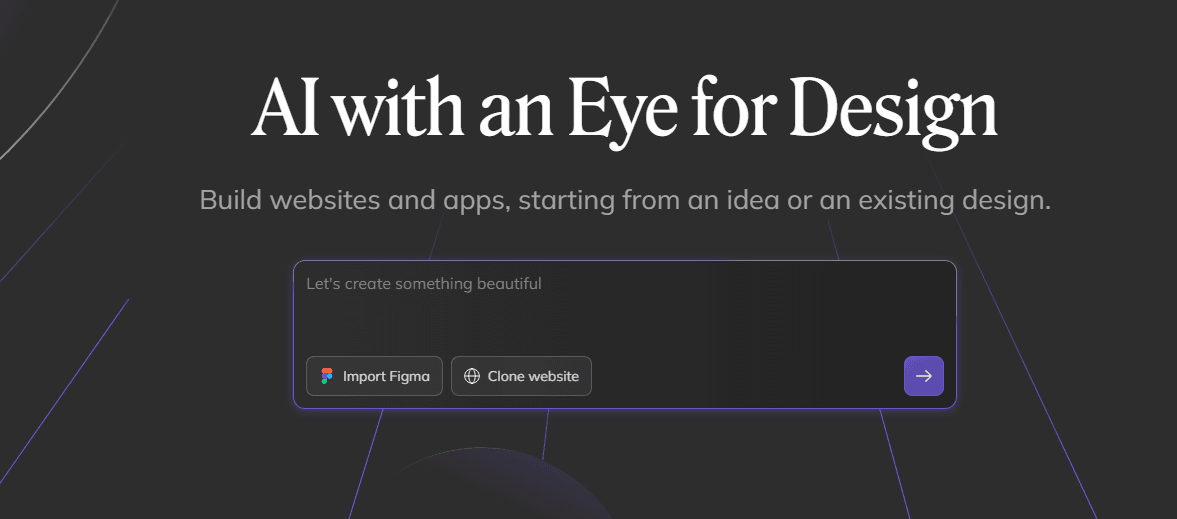
Anima skiller sig ud som en AI-drevet løsning, der bygger bro mellem design og udvikling og muliggør effektiv konvertering fra design til kode.

We review tools independently, and commissions help fund our testing. See our transparency policy, our methodology, or suggest a tool.
Anima is a product design tool that turns Figma, Sketch, and Adobe XD designs into production-ready HTML, CSS, and React code. I'd consider it when your team needs to close the gap between design and development without relying on manual handoff. Compared to Zeplin, which stops at design specs and annotations, Anima actually generates working code from your designs—making it the stronger pick when developers need something they can build on directly, not just reference.
Anima Evaluation Summary
4.2/5
- From $20/user/month (billed annually)
- Free plan available
Anima Overview
In my opinion, Anima excels as a product design tool by efficiently converting designs to code, making it ideal for tech-savvy design and development teams. Its standout features include integration with popular design platforms and support for auto layout, breakpoints, and Dev Mode, which set it apart from competitors. However, onboarding could be improved to better accommodate new users. Its pricing is competitive, with the paid plans providing good value for money. Anima is best suited for teams that prioritize speed and accuracy in design handoffs and have some technical skills.
Pros
- You can convert designs to code using templates and reusable snippets.
- It integrates with popular design platforms, including Figma designs.
- It offers intuitive design handoff that improves collaboration.
Cons
- Onboarding can be challenging for new users.
- Its customization options are limited compared to some other tools.
- Occasional bugs can disrupt your work.
Is Anima Right For Your Needs?
Who Would be a Good Fit for Anima?
Anima is a great tool for tech startups, digital agencies, and development teams that need to bridge the gap between design and code. If your work involves frequent design-to-code conversion, Anima's ability to efficiently turn mockup files into front-end code will save you time and reduce errors. It’s particularly useful for teams building landing pages and designs using breakpoints and auto layouts.
- Tech StartupsAnima improves iterative design and code, speeding up development processes with support for frameworks such as Vue and Tailwind.
- Digital AgenciesDigital agencies can deliver projects faster with Anima's flawless design-to-code conversion and reusable templates.
- Web DevelopersAnima's intuitive design handoff ensures that development teams maintain high-quality code.
- User Interface/User Experience DesignersAnima simplifies the handoff of Figma designs, increasing workflow efficiency.
- Product TeamsYour team can move swiftly from design concepts to development-ready code using Anima Playground.
- App DevelopersAnima's ability to accurately translate designs into functional code improves your app development process and supports scalable codebases.
Who Would be a Bad Fit for Anima?
Anima may not be suitable for traditional industries with a limited digital presence or small teams without technical expertise. If your team doesn’t frequently convert designs to code, Anima's features may be excessive. Teams that struggle with onboarding or need extensive customization may find Anima's setup challenging, as it requires some technical understanding.
- Small Non-Tech TeamsAnima's features could be overwhelming if your team lacks technical skills or doesn’t need design handoffs.
- Highly Customized ProjectsIf your work requires extensive customization and frequent manual tweaks, Anima’s limited options may not meet your needs.
- Basic Design TasksFor simple design tasks, Anima’s advanced features may be unnecessary and too complex.
- New UsersIf your team struggles with onboarding, Anima's setup could be challenging without prior experience.
- Non-Digital AgenciesNon-digital agencies may not find value in Anima if digital design isn’t the main focus.
How We Test & Score Tools
We’ve spent years building, refining, and improving our software testing and scoring system. The rubric is designed to capture the nuances of software selection and what makes a tool effective, focusing on critical aspects of the decision-making process.
Below, you can see exactly how our testing and scoring works across seven criteria. It allows us to provide an unbiased evaluation of the software based on core functionality, standout features, ease of use, onboarding, customer support, integrations, customer reviews, and value for money.
Core Functionality (25% of final scoring)
The starting point of our evaluation is always the core functionality of the tool. Does it have the basic features and functions that a user would expect to see? Are any of those core features locked to higher-tiered pricing plans? At its core, we expect a tool to stand up against the baseline capabilities of its competitors.
Standout Features (25% of final scoring)
Next, we evaluate uncommon standout features that go above and beyond the core functionality typically found in tools of its kind. A high score reflects specialized or unique features that make the product faster, more efficient, or offer additional value to the user.
We also evaluate how easy it is to integrate with other tools typically found in the tech stack to expand the functionality and utility of the software. Tools offering plentiful native integrations, 3rd party connections, and API access to build custom integrations score best.
Ease of Use (10% of final scoring)
We consider how quick and easy it is to execute the tasks defined in the core functionality using the tool. High scoring software is well designed, intuitive to use, offers mobile apps, provides templates, and makes relatively complex tasks seem simple.
Onboarding (10% of final scoring)
We know how important rapid team adoption is for a new platform, so we evaluate how easy it is to learn and use a tool with minimal training. We evaluate how quickly a team member can get set up and start using the tool with no experience. High scoring solutions indicate little or no support is required.
Customer Support (10% of final scoring)
We review how quick and easy it is to get unstuck and find help by phone, live chat, or knowledge base. Tools and companies that provide real-time support score best, while chatbots score worst.
Customer Reviews (10% of final scoring)
Beyond our own testing and evaluation, we consider the net promoter score from current and past customers. We review their likelihood, given the option, to choose the tool again for the core functionality. A high scoring software reflects a high net promoter score from current or past customers.
Value for Money (10% of final scoring)
Lastly, in consideration of all the other criteria, we review the average price of entry level plans against the core features and consider the value of the other evaluation criteria. Software that delivers more, for less, will score higher.
Core Features
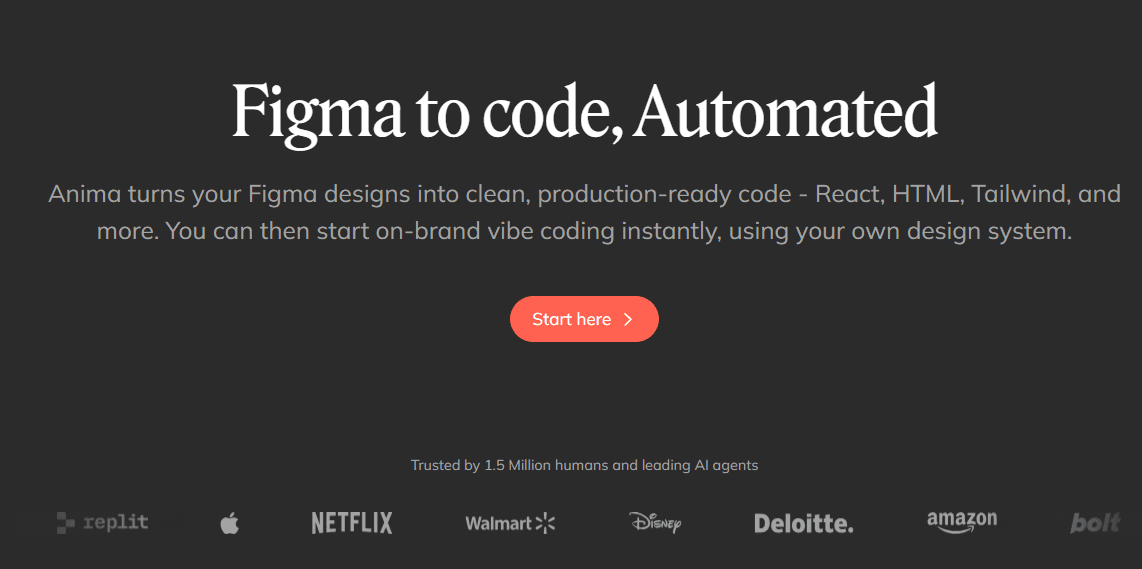
Design-to-Code Conversion: Anima converts your designs into clean, developer-friendly generated code, saving your team time and reducing errors. It supports HTML, CSS, React, and Vue, making it versatile for a wide range of projects.
Responsive Design: You can create responsive designs that adapt to different screen sizes, ensuring your work looks great on any device. This helps your team maintain a consistent user experience.
Live Prototyping: Anima lets you turn static designs into interactive prototypes with animation, which you can share with stakeholders. This helps you obtain prompt feedback to refine your design.
Design Handoff: You can hand off designs to developers with all the necessary specs, assets, and Anima code. This ensures that your team has everything they need to start coding right away.
Version Control: Anima offers version control so you can track changes, manage your codebase, and revert to previous versions if needed.
Collaboration Tools: Anima provides real-time collaboration tools that improve operational efficiency and communication, accelerating the design process.
Ease of Use
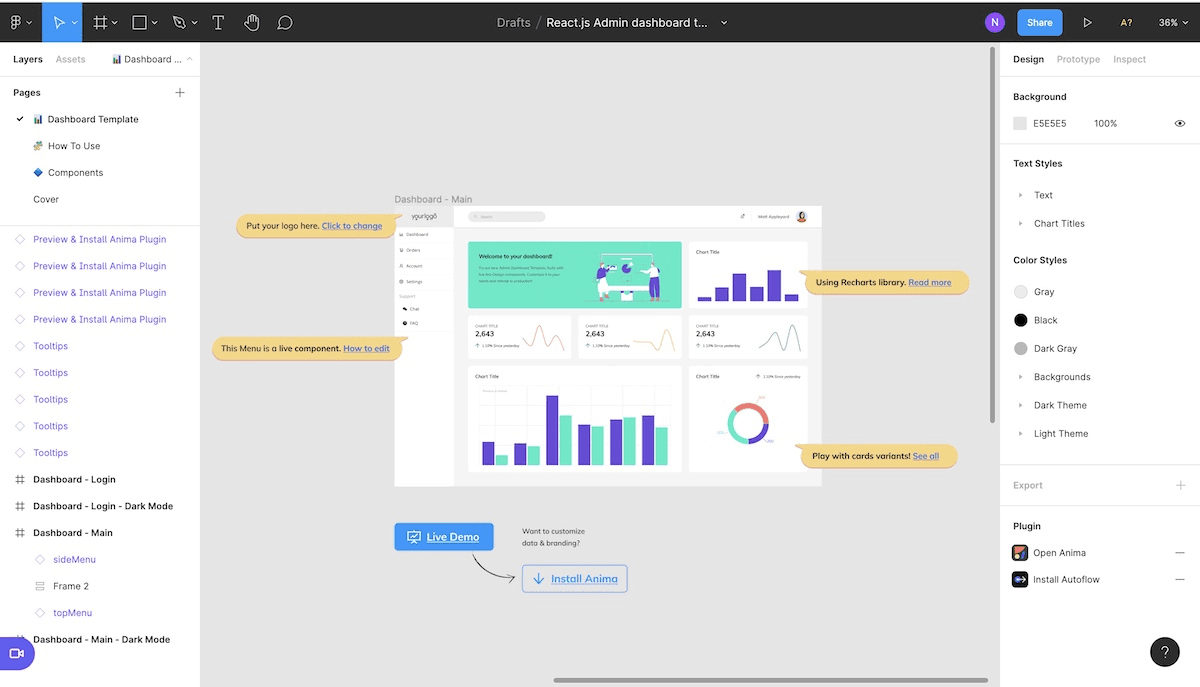
Anima is generally user-friendly, allowing your team to quickly convert designs into code. Its intuitive interface improves navigation, although new users may need some time to get familiar with its features. Although the rapid design-to-code conversion and responsive design capabilities improve usability, occasional bugs may disrupt your workflow. Overall, Anima offers powerful functionality and ease of use, making it a solid choice for teams familiar with design tools.
Integrations
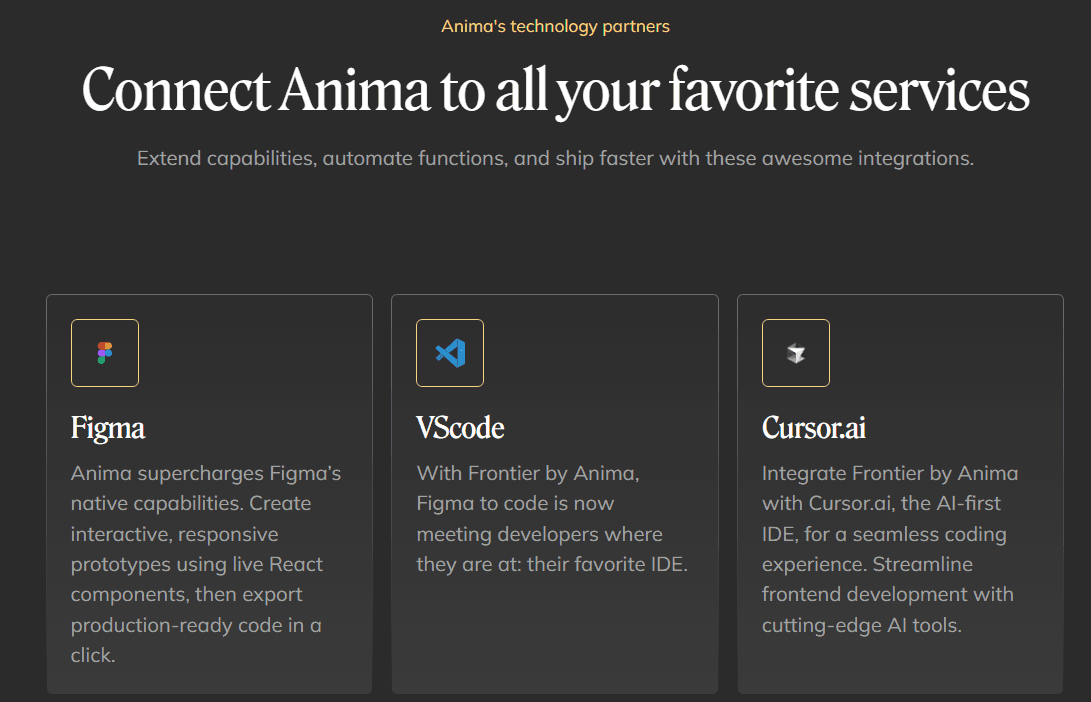
Anima integrates with Figma, VSCode, Cursor.ai, Vercel, Netlify, AWS Amplify, Firebase, Strapi, Contentful, and Material UI.
It also offers an API for custom integrations and connects with third-party tools to extend its capabilities.
Anima Specs
- API: No
- Approval Workflows: No
- Bug Tracking: No
- Collaboration Support: Yes
- Custom Reports: No
- Design Templates: Yes
- Document Management: No
- External Integrations: Yes
- History/Version Control: Yes
- Multi-Source Feedback: No
- Multi-User: Yes
- Review Monitoring: No
- Template Designer: No
- Third-Party Plugins/Add-Ons: Yes
- Workflow Management: No


